For most kitchens, buy the gyuto first. It is the all-purpose knife: vegetables, meat, fish and tip work with one blade. A nakiri is a vegetable specialist with a flat edge and no point. It earns its place as a second knife beside a gyuto, or as the main knife only when vegetables are nearly all of the cooking and something else handles the rest.
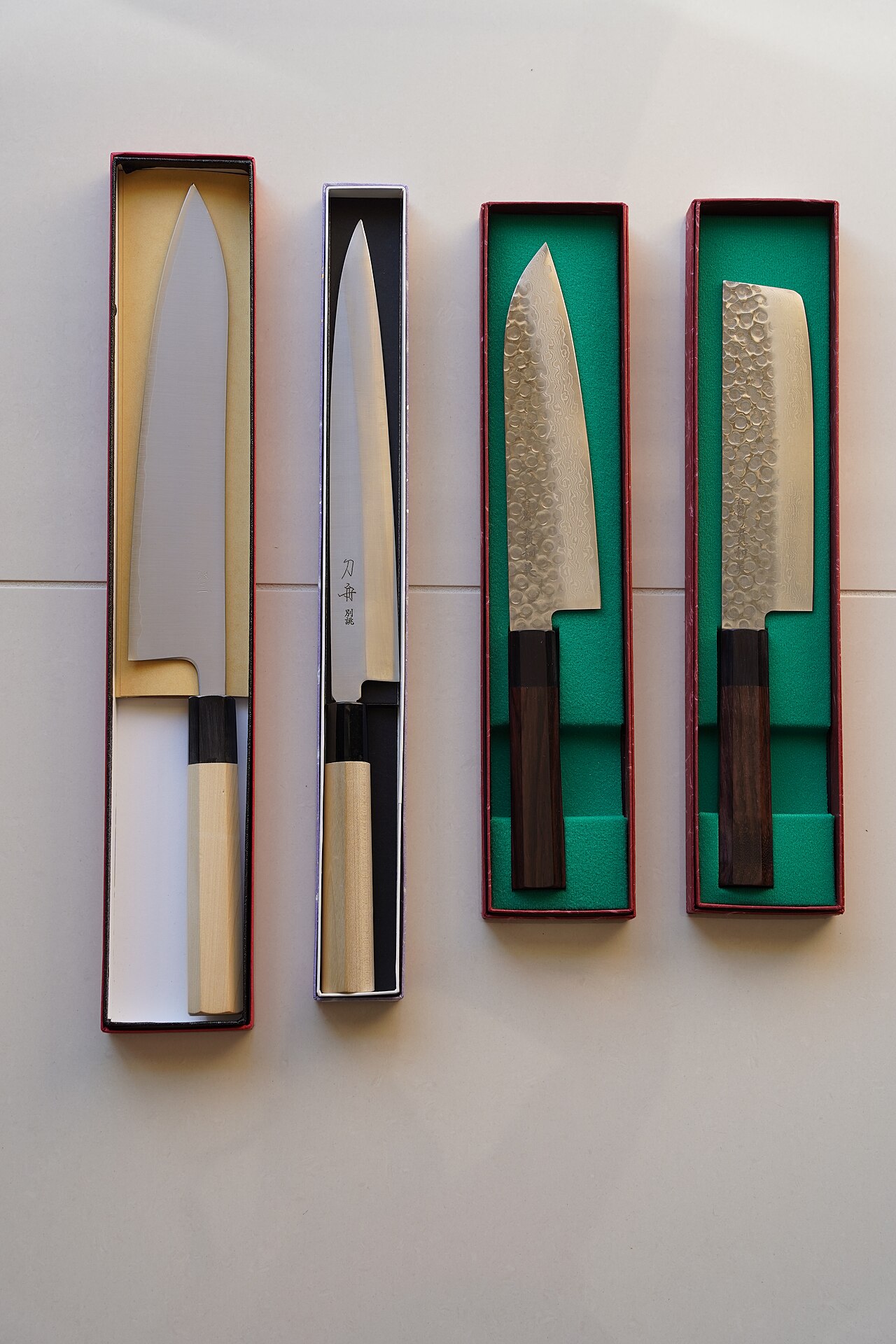
Nakiri vs gyuto at a glance
One maker’s matched pair, with the same steel, bevel and handle and every figure as Korin lists it:
| Korin Kaguya Wa-Gyuto | Korin Kaguya Wa-Nakiri | |
|---|---|---|
| Blade length | 210mm (also 240mm) | 165mm (one size) |
| Weight | 169g (210mm) | 212g |
| Blade width at its widest | 1.86 in (about 47mm) | 2.2 in (about 56mm) |
| Bevel | 50/50 | 50/50 |
| Spine at its widest | 3mm | 3mm |
| Steel | White Steel #2, HRC 64–65 | White Steel #2, HRC 64–65 |
| Handle | Magnolia wa handle, 5.35 in | Magnolia wa handle, 5.3 in |
| What it is for | Korin’s gyuto range: “The gyuto is a versatile chef’s knife.” | Korin’s nakiri range: “a vegetable chopping knife with an easy to sharpen 50:50 symmetrical blade” |
| Who it suits | One knife for mixed cooking | A second knife for vegetable-heavy prep |
Sources: Korin Kaguya Wa-Gyuto, Korin Kaguya Wa-Nakiri, Korin’s gyuto range and nakiri range. In this pair the shorter nakiri is the heavier and wider knife. That is one maker’s pair, not a rule, so check the listing of the knife you are actually considering.
Where each one wins
The nakiri. Korin says its boxy shape comes from the traditional usuba. The long, flat edge meets the board along its whole length, which suits the straight down-and-forward cuts of vegetable prep, and the tall face guides the knuckles and scoops food off the board. What it gives up is the point: trimming, scoring and small detail cuts are less handy. Our guide to how to use a nakiri covers the motion and its limits.
The gyuto. It has the length and the point. Wikipedia’s Japanese kitchen knife article describes the gyuto being used to rock-chop stiffer produce and to make fine cuts at the tip, and across many cuts of meat. A 210mm blade also passes through a cabbage or a large piece of meat in fewer strokes than a 165mm one. For a large cooked cut, see how to slice brisket.
Both are double-bevel, so neither is handed. The single-bevel vegetable knife is the usuba; see nakiri vs usuba if that is the knife you are weighing.
Which to buy first
Buy the gyuto first unless your cooking is nearly all vegetables. It covers the whole meal, and once it is in the drawer a nakiri adds something distinct instead of repeating it. If you already own a gyuto or a chef’s knife, the nakiri is the natural second knife for vegetable days. If the gyuto’s length is the problem in a small kitchen, compare a shorter all-rounder first in santoku vs nakiri and gyuto vs santoku.
Handle size for this knife
A matched pair does not take the same handle. On our wa handle size guide, a nakiri of 150–190mm takes the Mid-size · santoku, bunka, nakiri size, with a starting handle length of about 115–125mm. A gyuto from 196 to 255mm takes Chef · gyuto, kiritsuke, at about 125–135mm, while a gyuto of about 180mm rides with the Mid-size tier. On our product pages you enter the knife type and blade length and the size recommender picks the tier. To build one, open the handle configurator and choose wood, ferrule, end cap, shape and size.