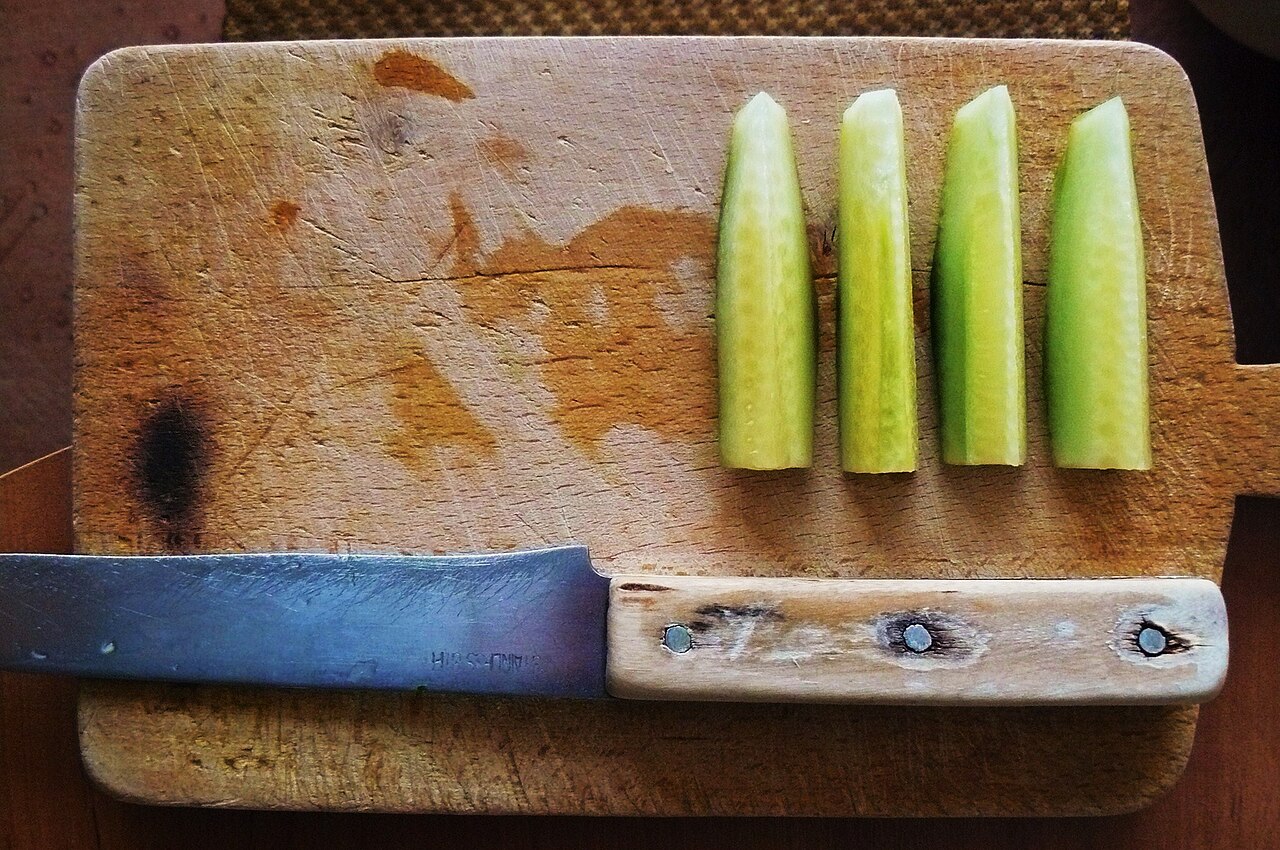
To cut a cucumber, wash it, trim both ends, and decide whether to peel and seed it. Then slice rounds straight across, halve it lengthwise for half-moons, cut seeded spears across for dice, or stack thin diagonal slices and cut them into matchsticks. For sushi rolls, cut the cucumber lengthwise into quarters to make long strips that run the length of the roll.
Purdue Extension lists several types. Garden or slicing cucumbers, the most common in North America, have smooth dark skin and large seeds and are usually sold waxed, so peeling is common and so is removing the seeds. English (hothouse) cucumbers have thin skin and soft seeds, and Armenian cucumbers need no peeling or seeding.
Wash, peel and seed
The FDA suggests scrubbing firm produce such as cucumbers with a clean vegetable brush under running water, and rinsing produce before you peel it so dirt is not carried from the knife onto the flesh. Purdue peels with a knife or vegetable peeler and seeds a cucumber by cutting it in half lengthwise and scooping the seeds out of each half with a spoon or knife; larger cucumbers can be quartered first. Purdue also notes that bitterness is stronger at the stem end and comes from compounds in and under the skin, so peeling may improve the flavor.
Step by step
- Rounds. Kikkoman’s guide cuts off both ends and slices at consistent widths from end to end; the thinner version is the same cut, closer together.
- Half-moons. Cut the cucumber in half lengthwise, set each half cut-side down and slice at consistent widths. Our nakiri guide uses exactly this as its practice exercise.
- Dice. Cut the halves lengthwise into spears, seeded or not, then line the spears up and cut across. Utah State Extension’s knife-skills handout defines a small dice as ¼-inch cubes and a medium dice as ½-inch cubes.
- Julienne (matchsticks). Kikkoman thinly slices the cucumber at an angle, slides and stacks the slices, then cuts them finely into thin sticks. Utah State defines a julienne as ⅛ by ⅛ by 2½ inches.
- Random cut (rangiri). For chunky pieces with many cut faces, Kikkoman cuts off both ends and rotates the cucumber as it chops from one end to the other.
Cucumber for sushi rolls
Kikkoman’s nori-maki method makes thin single-filling rolls (hoso-maki) from Japanese cucumbers quartered lengthwise, each about 18–20 cm (7–8 in.) long, and lays one strip of cucumber in the center of the rice on half a sheet of nori before rolling. A thin roll filled with cucumber is called kappamaki. To prepare the strips:
- Wash the cucumber and trim off both ends.
- Cut the cucumber in half lengthwise, then cut each half lengthwise again to make four long spears.
- If you prefer strips without seeds, slice the seed section away along each spear; Purdue notes that removing the seeds is common.
Our guide to using a sushi mat suggests a simple cucumber roll as a first rolling task, and hangiri vs ohitsu covers seasoning the rice. For other Japanese vegetable shapes, see Japanese vegetable cutting techniques.
Keep your fingers clear
A whole cucumber rolls. Mississippi State Extension’s knife basics recommend cutting round foods in half first, laying the flat side down, and tucking the fingertips of the guiding hand toward your palm.
Storing cucumbers
Purdue says cucumbers can be placed in a plastic bag and refrigerated for up to one week.
The knife for this job
A nakiri or santoku suits rounds, half-moons and dice, and a 196–255mm gyuto is longer than an 18–20 cm cucumber, so it can make each lengthwise cut for sushi strips in one stroke; nakiri vs gyuto compares them. Our paring vs utility knife guide notes that a utility knife gives more edge for cutting a small cucumber. In our wa handle size guide, a 150–190mm nakiri or santoku takes the Mid-size handle and a 196–255mm gyuto the Chef size.
Sources: Purdue Extension FoodLink, cucumber (types, peeling, seeding, bitterness, storage); FDA, 7 Tips for Cleaning Fruits, Vegetables (brush, rinse before peeling); Kikkoman, thin rounds, half-circle slices, matchstick juliennes and random cut; Kikkoman Food Forum, Making Nori-maki (quartered cucumbers, one strip per roll); Wikipedia, Makizushi (kappamaki); Utah State University Extension, Knife Skills handout (dice and julienne sizes); Mississippi State University Extension, Kitchen Knife Basics (flat surface, curled fingertips).