Cut Brussels sprouts to suit the recipe. Halves keep each side joined at the core; quarters make larger sprouts smaller; thin shreds work for slaw or salads. Trim only the dry stem tip, and stop before any piece becomes too small to hold securely.
Choose a cut
| Cut | Choose it when | How to start |
|---|---|---|
| Halves | The recipe calls for serving-size pieces. | Cut lengthwise through the stem and center of the core. |
| Quarters | The sprouts are large or the recipe needs smaller pieces. | Halve through the stem, set flat-side down, then cut lengthwise again. |
| Shreds | You want thin pieces for slaw or salad. | Halve, rest the flat face on the board, then slice crosswise. |
Wash and trim
- Rinse and dry. Wash the sprouts in cool water and pat them dry. Pat them dry before setting them on the board.
- Remove damaged leaves. Peel away yellowed, blemished or loose outer leaves. Keep sound leaves that come away; they can be cooked with the rest.
- Trim the stem end. Cut off only the dry or discolored tip. Leave most of the core in place so the leaves stay connected when you halve or quarter the sprout.
Set each sprout on a stable cutting board. If it rolls, cut it in half first and rest a half on its flat face. Curl the fingertips of your guiding hand inward, with your knuckles facing the blade. Move the hand back only after the blade clears the food.
Halve or quarter
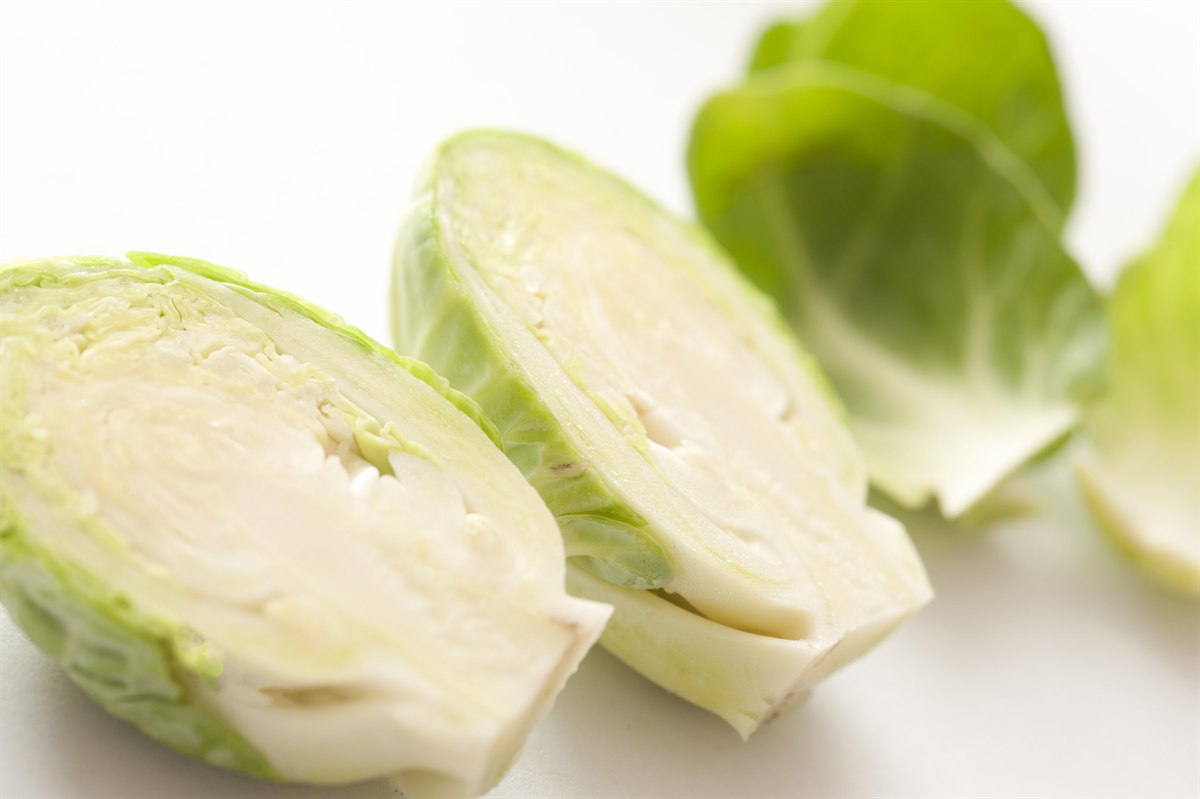
For halves, place a sprout on its side and cut lengthwise from tip to stem, through the center of the core. Each half should retain part of the core along its base. Keeping part of the core attached helps each half stay together.
Quarter a large sprout when the recipe calls for smaller pieces. First halve it through the stem, set each half cut-side down, then cut lengthwise through the core again. A small sprout usually needs only one lengthwise cut. Use similarly sized pieces for more even cooking.
Make thin shreds
Halve the sprout lengthwise, then place each half flat-side down. Slice crosswise into thin ribbons. Work with one half at a time and keep its flat face on the board. Stop when the remaining piece is too small to guide safely; set it aside rather than holding it in your palm or chasing tiny scraps.
Thin ribbons suit recipes that call for shredded Brussels sprouts, slaw or salad. Leaves that separate naturally can be used whole or set aside with other sound leaves. Remove blemished leaves, but do not strip away every outer layer just to make the cut look tidy.
For another stem-first leafy vegetable cut, see our guide to cabbage shreds, slices and wedges. Our broccoli guide shows how to separate florets and prepare the tender stem.
Sources: Iowa State University Spend Smart, Brussels sprouts; Colorado State University Extension, Crispy Brussels Sprouts with Balsamic and Honey (cutting notes only); University of Minnesota Extension, Brussels sprouts; Virginia Cooperative Extension, The Basics of Knife Skills (claw grip).