A Chinese cleaver and a meat cleaver share a rectangular outline, but they are built for opposite jobs. Many Chinese cleavers are thin, sharp all-purpose knives for vegetables, fish and boneless meat; used on bone, the edge can chip or bend. A meat cleaver has a thick, heavy blade with a tougher, blunter edge, made to chop through thin bones; the thickest ones tend to wedge in dense vegetables. Between the two sit Chinese “choppers” that take small bones, so check what each model is made for before it meets a bone.
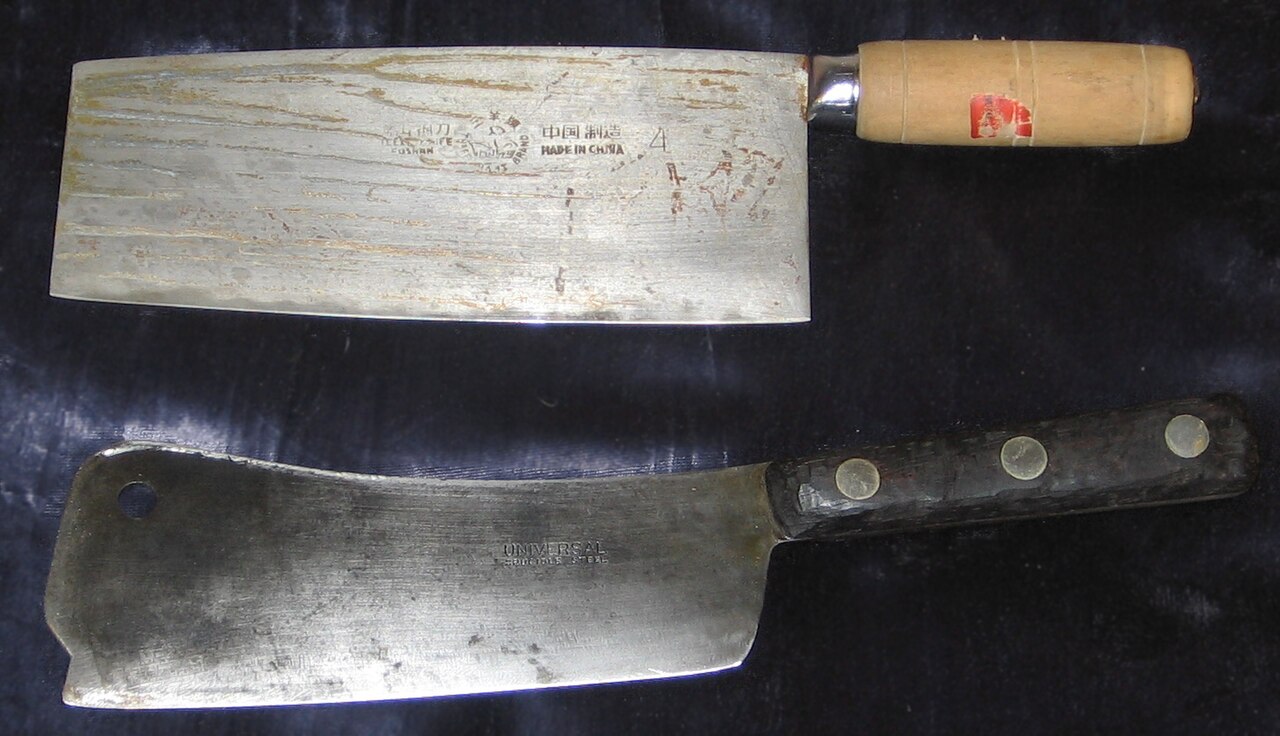
Side by side
| Chinese cleaver (slicer) | Meat cleaver | |
|---|---|---|
| Blade | Thin in cross-section | Thick; most spines 3–6mm at their thickest (America’s Test Kitchen) |
| Edge | Fine, chef’s-knife bevel | Tough; Western cleavers have historically used edge angles of 20° or more (ATK) |
| Works by | Sharpness, slicing and chopping | Weight and momentum |
| Made for | Vegetables, herbs, fish, boneless meat; flattening garlic and ginger | Chicken pieces, ribs, thin or soft bones |
| Not for | Any bone | Thick, hard bones, which need a bone saw |
Each row is sourced in the list at the end of this page.
“Chinese cleaver” covers a range
Chinese kitchen knives are sold in three broad classes, Wikipedia’s caidao article explains: slicers, the thinnest and sharpest, unsuitable for any bone; choppers, thicker, able to go through thin soft bones such as fish and poultry; and true cleavers, or bone choppers, with thick, heavy blades. The word “cleaver” on an English listing does not tell you which class you are buying.
Knifewear’s comparison guide shows the same range inside one maker’s line, Chan Chi Kee of Hong Kong: a small slicer listed for no bones, a stainless chopper that can take fish or chicken bones near the heel, a kitchen chopper for bigger poultry bones such as turkey and goose, and a heavy Kau Kong chopper for pork ribs at the heel. Knifewear sums up the trade-off: the thick ones chop through bones with ease but wedge in dense vegetables, while the thin ones slice well and are not for bones.
Japanese-made versions, sold as chuka bocho, use harder steel that holds an edge longer but is more brittle; Knifewear says those rated for small bones are made from slightly softer steel or ground thicker, sometimes both. Our guide to what a chuka bocho is covers the Japanese knife itself.
What a meat cleaver is built to do
A meat cleaver is designed to take repeated blows into meat, cartilage, bone and the board beneath. Wikipedia’s cleaver article describes how: a softer, tougher steel and a thicker blade, because a harder steel or thinner blade might fracture or buckle, and a much blunter grind than other kitchen knives. It is used on thin or soft bones, such as chopping a chicken through its bones or separating ribs, and not on solid, thick bones; that is bone-saw work.
America’s Test Kitchen’s cleaver review adds a useful caution: the very thickest, axe-like blades wedged into chickens and cracked squash instead of cutting it neatly, and its reviewers favored a moderately thick spine of about 2.5 to 3.3mm and a weight of 14 to 15 ounces.
Shun states the boundary from the other side. It calls its Classic Vegetable Cleaver the Chinese answer to a chef’s knife, and says plainly that it “isn’t for use on joints or bones; a Meat Cleaver is made for that.”
How to tell which one you have
- Look at the spine. A slicer’s spine is thin and the blade tapers gently. A bone cleaver’s spine is visibly thick, and the edge is ground at a wider angle.
- Feel the weight. A bone cleaver is noticeably heavier than a slicer of similar size.
- Read the maker’s description. It is the only reliable test. If a listing does not say the knife is for bones, treat it as a slicer.
Which one a home cook needs
If you mostly cut vegetables, herbs and boneless meat, a thin Chinese cleaver can be your main knife. The broad blade also carries cut food to the pan. Chuka bocho vs nakiri compares one with a smaller vegetable knife, using listed dimensions and weights.
For whole chickens, most of the work is separating joints, which a boning knife or a honesuki does by going around bone rather than through it; see what a honesuki is. Keep a meat cleaver for cuts that must pass through bone, such as chopping bone-in pieces for stock or separating ribs. Never use a thin, hard Japanese edge for that job; why Japanese knives chip explains what bone does to it.
A chuka bocho that needs a new wa handle is fitted individually after checkout; see the wa handle size guide.
Sources: Wikipedia, Caidao (Chinese chef’s knife) (thin blade, uses, slicer/chopper/cleaver classes); Wikipedia, Cleaver (tough steel and thick blade, blunter grind, weight and swing, thin or soft bones, bone saw for thick bones); America’s Test Kitchen, The Best Cleavers (spine 3–6mm, preferred 2.5–3.3mm and 14–15 oz, edge angles, thick blades wedging); Knifewear, Chinese Cleaver and Chuka Bocho Comparison Guide (CCK range, wedging, chuka bocho steel); Shun, Classic 7” Vegetable Cleaver (not for joints or bones). Knifewear and Shun sell the knives they describe.