To cut a papaya, rinse it, trim both ends, halve it lengthwise and scoop out the black seeds with a spoon. From there you can eat each half straight from the skin with a spoon, or peel the halves and cut the flesh into slices or cubes. A ripe papaya is soft and slippery, so do every cut with the fruit lying flat on the board.
Check that it is ripe
A papaya has a green to yellow outer skin and orange to pink flesh, as University of Illinois Extension describes it, and UF/IFAS Extension notes that the skin is yellow when the fruit is ripe. Illinois Extension advises keeping papayas at room temperature until they ripen, then refrigerating them for up to three days.
Wash before the knife goes in
The FDA’s advice is to rinse produce before you peel it, so the knife does not carry dirt and bacteria from the skin onto the flesh. Rub the papaya gently under plain running water, with no soap or produce wash, and dry it with a clean cloth or paper towel. UF/IFAS Extension adds the obvious but easily skipped step: use a clean knife and a clean cutting board.
Halve and seed
- Trim the ends. Lay the papaya on its side and cut a thin slice off the stem end and the blossom end.
- Halve it lengthwise. Keep it on its side and cut from end to end through the middle. Illinois Extension uses a large knife for this, and a long blade makes it one smooth stroke instead of several.
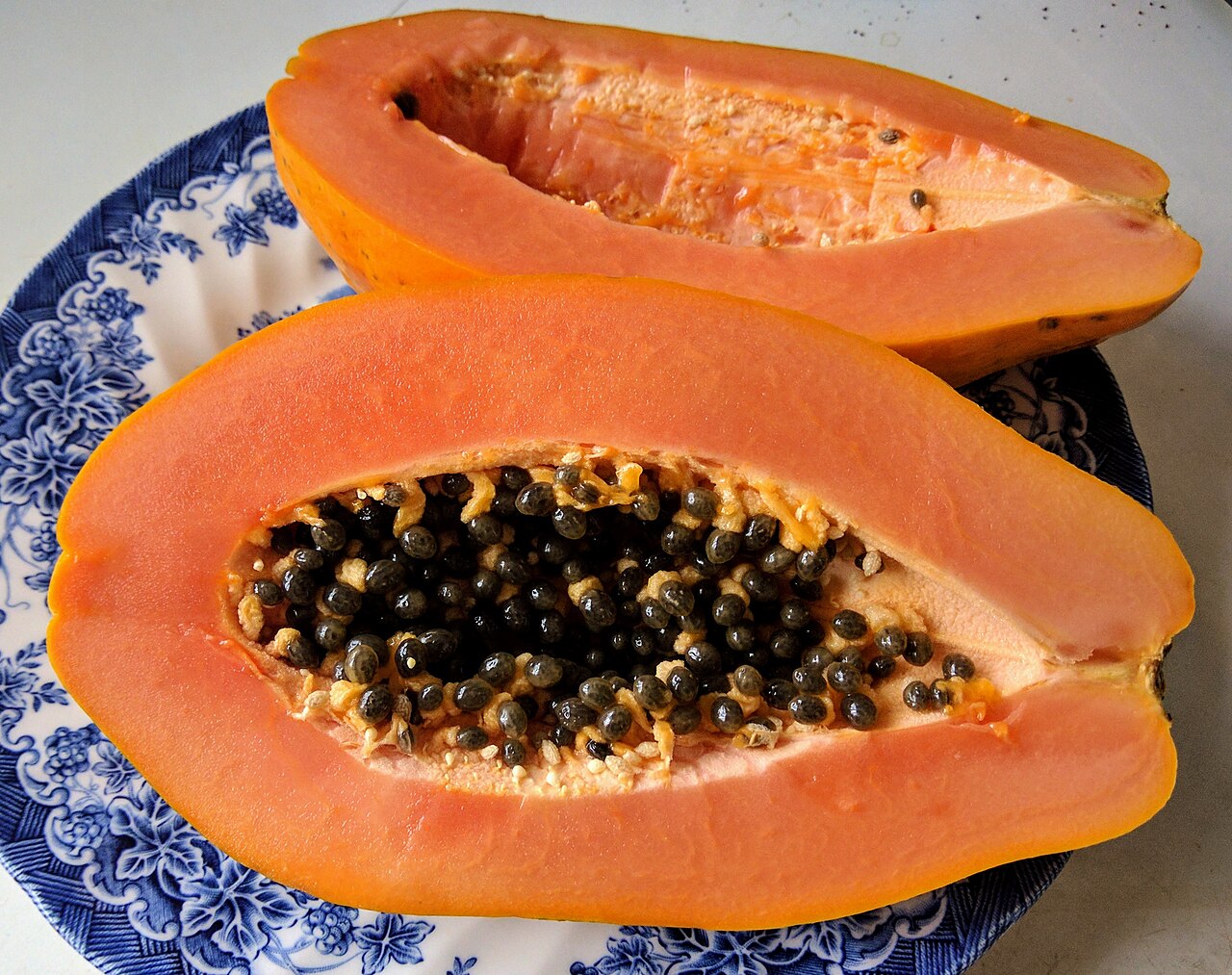
- Scoop out the seeds. Illinois Extension scoops them out with a spoon. Run the spoon under the seed mass, then scrape lightly along the hollow to lift any loose fibers left behind.
The photo above shows both stages: one half still full of seeds, the other scooped clean.
Eat it from the skin
The quick way to serve it is a seeded half and a spoon. Illinois Extension suggests a squeeze of lime juice over papaya. If the halves rock on the plate, cut a thin slice off the rounded skin side so each one sits flat.
Peel, then cut slices or cubes
There are two ways to take the skin off. Illinois Extension peels the whole fruit with a vegetable peeler first, then halves and seeds it. If your papaya is very ripe and slippery once peeled, peel after halving instead: lay each seeded half cut side down and cut the skin away in strips with a knife, following the curve from end to end, as in our guide to cutting a cantaloupe.
- Long slices. Keep a peeled half cut side down and slice it lengthwise into strips.
- Half-moons. Slice the same half crosswise instead.
- Cubes. Cut long strips, turn the board, then cut across the strips. Illinois Extension notes the cubed flesh can be eaten as is or used in a dish.
- Rings. For papaya “boats”, UF/IFAS Extension peels the fruit and cuts it crosswise into 2-inch-wide slices, removing the seeds so each slice has an opening in the middle.
Move the cut pieces with the flat of the knife or a spatula rather than picking them up one by one; ripe flesh bruises and slides.
What about the seeds?
Illinois Extension describes the seeds as edible, with a peppery taste, and suggests using them over salads in place of black peppercorns. UF/IFAS Extension garnishes one of its papaya recipes with a few seeds. If you do not want them, scoop them straight into the compost.
One kitchen warning: gelatin
Fresh papaya contains an enzyme called papain, which breaks down protein. Illinois Extension warns that this means fresh papaya should never go into a gelatin dish, because it will not set. Heat destroys the enzyme, so canned or cooked papaya works with gelatin.
Which knife and board
A papaya is long, so a full-size knife suits the halving cut. A santoku or a gyuto has the length for it; see our guide to the santoku. For peeling a firm papaya whole, see our vegetable peeler guide. Choose a board long enough for the whole fruit on its side, with room to set the halves down. For another soft tropical fruit with a different center, see how to cut a mango, and for the rest, browse all our how-to-cut guides.
Sources: University of Illinois Extension, Step into the Tropics with a Papaya (skin and flesh color, storage, peel with a peeler, halve with a large knife, scoop seeds with a spoon, cubes, lime juice, edible peppery seeds, papain and gelatin); UF/IFAS Extension Broward County, Papaya: A Tropical Nutrition Powerhouse (yellow skin when ripe, clean knife and board, 2-inch slices with the seeds removed, seed garnish); FDA, 7 Tips for Cleaning Fruits, Vegetables (rinse before peeling, no soap, dry).