To cut boneless chicken thighs, trim off the loose fat and any hard bits of cartilage, then cut the meat into strips or cubes of a similar size. To bone a bone-in thigh, lay it skin side down, cut along the length of the thigh bone, scrape the meat away from it, then free each end at the joint with the tip of the knife. Near bone, use a honesuki or a boning knife, keep the tip tracing the bone, and never twist or pry with the edge. Cook the chicken to 165°F.
Before you start
Take the thighs from the pack to the board without rinsing them: a University of Maine Cooperative Extension bulletin warns that washing raw chicken can spread bacteria in your kitchen. Its routine starts with hands washed in hot, soapy water for 20 seconds, rinsed and dried on a clean towel, and a clean damp towel or paper towel laid under the board.
Use the board you keep for raw meat, poultry and seafood, with another for produce and bread, as USDA’s Food Safety and Inspection Service suggests; see our cutting board for raw meat guide.
Boneless thighs: trim, then cut
- Open it out. Lay the thigh flat, smooth side down, so you can see the inside.
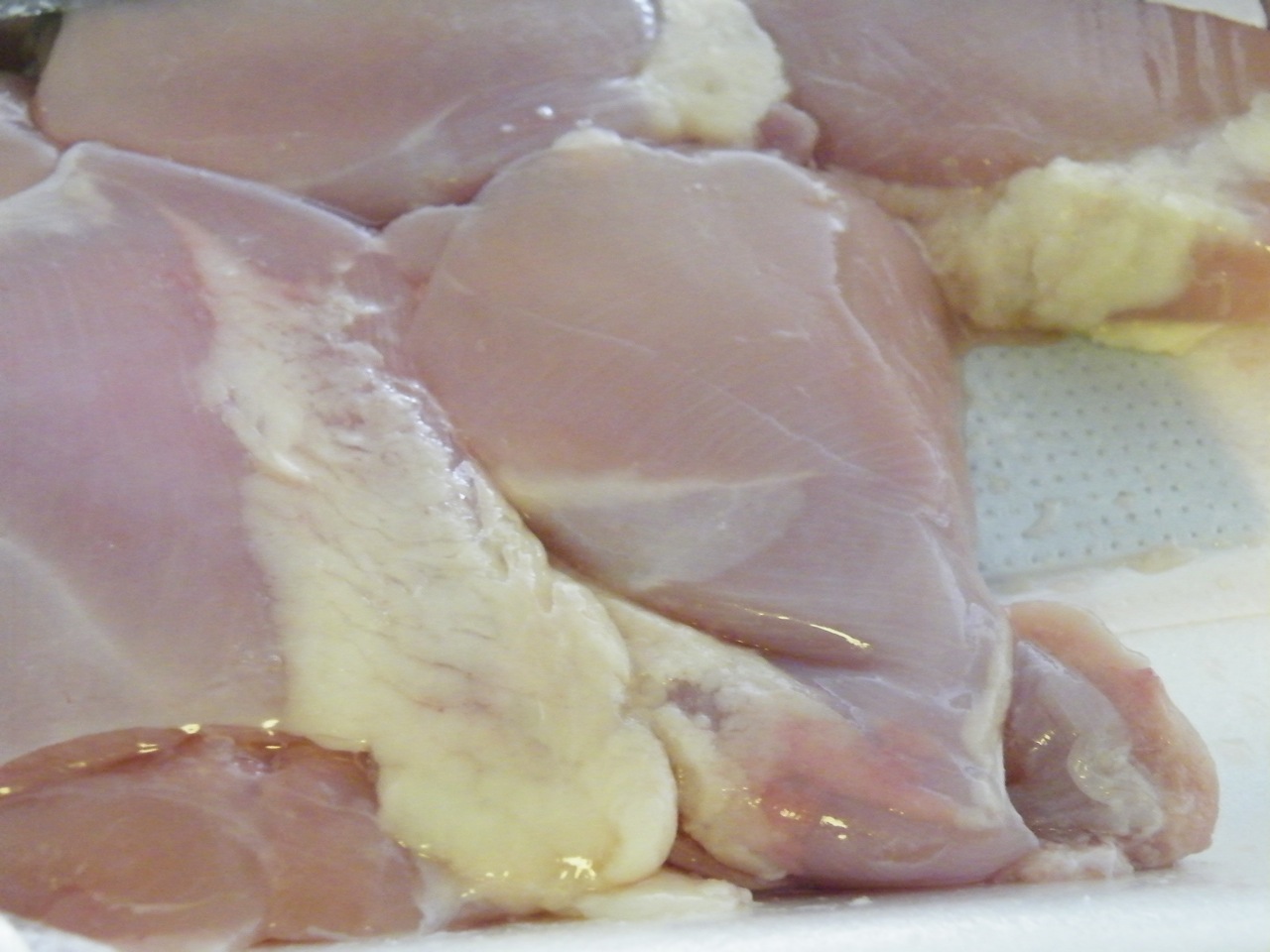
- Trim the fat. Thighs carry soft pads of yellow-white fat along the edges, as in the photo above. Cut off as much as you want with the tip of the knife; how much to leave is a matter of taste.
- Feel for hard bits. Fred Decker of Tasting Table notes that a deboned thigh often keeps one or two small pieces of cartilage or gristle, and checks it with his fingertips. Cut out anything hard.
- Cut strips. Thigh meat is uneven in thickness. Cut it into strips of a similar width, slicing through any thick lobes so the pieces match.
- Cut cubes. Line up the strips and cut across them. Pieces of a similar size cook at a similar rate.
Bone-in thighs: cut along the bone
This is the job a short, stiff blade is for. Decker suggests a boning knife, though a sharp paring knife also works.
- Skin side down. Decker and The Woks of Life both start with the thigh skin side down, which shows you the lines of the muscles and where the bone lies.
- Find the bone. One bone runs along the length of the thigh. Decker points to a visible seam in the muscles near one side of it; follow that seam with the knife tip, feeling for the bone.
- Cut down both sides. The Woks of Life runs the knife along the length of the bone to reveal it, then slices down both sides of it to expose it further.
- Keep the edge on the bone. Decker angles the knife toward the bone as he goes and slides the tip along the top of it, scraping the surface.
- Free the joints. The bone has a joint at each end, the larger hip joint and the smaller knee joint. Lift one end, cut around and underneath the joint with the tip, then cut under the bone to separate it from the meat below.
- Check and tidy. Feel for cartilage again, then cut the boneless thigh as above or cook it whole.
Do not twist the blade or use it as a lever against bone. Let the tip trace the bone and the joints, and cut through cartilage, not bone. Our honesuki guide puts it plainly: the knife goes around bone, not through it. Keep a thin Japanese edge, such as a gyuto, away from bone altogether.
Cook and clean up
Bone-in or boneless, cook thighs to 165°F, the USDA figure for all poultry as listed by South Dakota State University Extension; UMaine Extension also says at least 165°F. SDSU says to keep the thermometer away from bone or fat, so on a bone-in thigh push it into the thickest part of the meat, clear of the bone.
FSIS advises hot, soapy water for the board after every use, a rinse with clear water, then air drying or a pat with clean paper towels. To sanitize wood or plastic, it gives 1 tablespoon of unscented liquid chlorine bleach to a gallon of water, left on the surface for several minutes and then rinsed off. Wash the knife and your hands too.
Which knife
For boneless thighs, any sharp knife you are comfortable with will do. For bone-in thighs, a honesuki or a Western boning knife is the right shape: a pointed tip for joints and a blade that can take contact with bone. Our honesuki vs boning knife comparison helps you choose. Breaking a whole bird into thighs first is joint work, covered in how to cut up a whole chicken. For other cuts and produce, browse all our how-to-cut guides.
Sources: University of Maine Cooperative Extension, Bulletin #4068 (do not wash raw chicken, 20-second handwash, damp towel under the board, 165°F); USDA FSIS, Cutting Boards and Food Safety (separate boards, washing, bleach solution); SDSU Extension, Is It Done Yet? (all poultry 165°F, per USDA FSIS; thermometer away from bone or fat); Fred Decker, Tasting Table (knife, skin side down, seam, angling toward the bone, joints, cartilage check); The Woks of Life, How to Debone Chicken Thighs (cutting along and down both sides of the bone, scraping, the cut underneath).