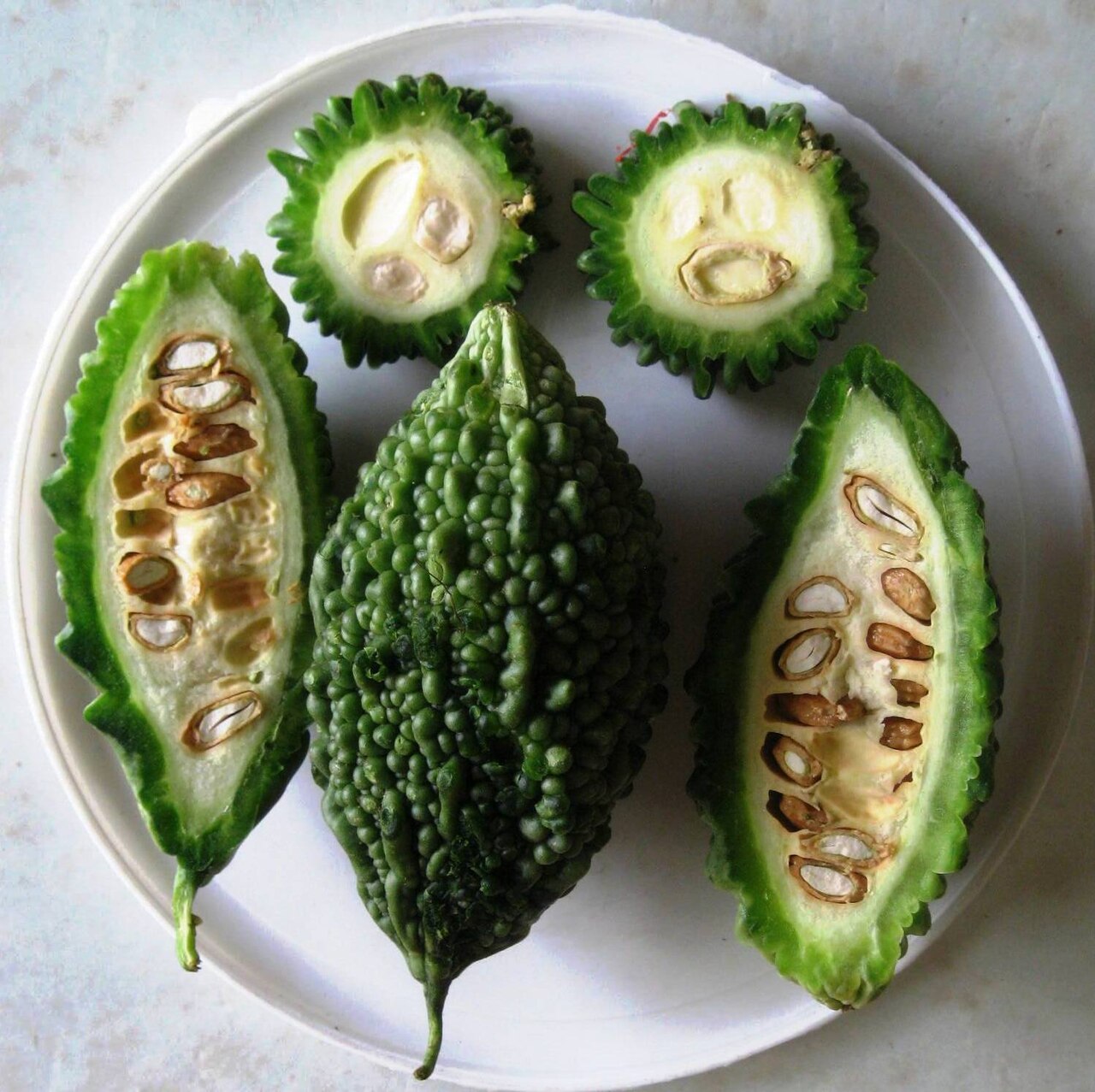
To cut bitter melon, trim off both ends, halve it lengthwise and scrape out the seeds and the white pith with a spoon. Then lay each half cut side down and slice it: thin crescents for stir-fries such as goya champuru, angled slices for black bean or beef stir-fries, or chunks for stews like pinakbet. For stuffed bitter melon, cut it crosswise into thick rings and hollow out each ring instead. The skin stays on.
Choose and wash it
Bitter melon is also called bitter gourd, and in Japan goya. The Woks of Life notes that the varieties in Indian groceries look spikier, while Chinese bitter melon is lighter green and smoother; it has a firm, crunchy texture. Just One Cookbook suggests choosing a relatively small one with lots of bumps, a fresh, shiny green surface, and a firm feel. Every variety is cut the same way.
Rinse it before you cut it. The FDA advises gently rubbing produce while holding it under plain running water, with no need for soap or a produce wash, then drying it with a clean cloth or paper towel. The bumps hold dirt, so rub between them as you rinse.
Halve it and scrape out the pith
- Trim the ends. Cut a thin slice off the stem end and the blossom end.
- Halve it lengthwise. Lay the melon on the board, curl the fingertips of your guiding hand, and cut from end to end. Inside are the seeds and a white, spongy pith.
- Scrape it clean. Run a spoon down each half to lift out the seeds and as much of the pith as you can. The Woks of Life explains that the pith is more bitter than the fruit itself, and Just One Cookbook says it is where the bitterness concentrates, so scrape down to the firm green flesh. Kikkoman does the same with a spoon. Foodwise notes that mature melons can be cooked unpeeled, but their seeds and pith should be removed.
Each half now rests on its flat, cut face, so it cannot roll while you slice.
Cut for the dish
- Thin crescents. Slice each half straight across into thin half-moons. For goya champuru, Just One Cookbook slices crosswise about 1/8 inch (3 to 4 mm) thick, and uses the same 1/8-inch (3 mm) slices for its bitter melon salad.
- Angled slices. For a Chinese-style stir-fry, angle the knife and slice the halves on the diagonal. The Woks of Life slices its bitter melon on a 45-degree angle into thin slices for a black bean sauce stir-fry. Angled slices are longer and show more of the green edge.
- Chunks. For stews, soups, curries and pinakbet, cut each half lengthwise into strips, then across into bite-size pieces, at the size your recipe gives.
- Rings for stuffing. Skip the halving. For stuffed bitter melon, The Woks of Life slices the whole melon crosswise into rings about 3/4 inch thick, then scoops out the centers with a small spoon or paring knife: it cuts the middle out with the paring knife and scrapes away the remaining pith with a spoon. Turn the ring as you cut, with the knife tip pointing into the center and your fingers on the outside.
Taking the edge off the bitterness
Foodwise notes that soaking, blanching or salting reduces the melon’s bitterness. Cooks disagree on which works best; Just One Cookbook says everyone seems to suggest something different and you need to try the method that works for you. Three common ones, all done after slicing:
- Salt. Just One Cookbook tosses the slices with salt and lets them stand for 10 minutes for goya champuru, because salt draws out moisture with some of the bitter flavor.
- Salt water. Kikkoman soaks thin slices in about a 5% salt and water solution for about 10 minutes, stirring gently, then pats them dry. It prefers this to rubbing salt into the slices because it keeps the crunch.
- Blanching. The Woks of Life notes that blanching the slices in boiling water with salt and baking soda can reduce the bitterness slightly, and calls the step optional.
None of these removes the bitterness completely. The Woks of Life puts it plainly: cooking with bitter melon is less about hiding the bitter flavor than about balancing it.
Storing cut bitter melon
Just One Cookbook removes the seeds and pith before storing bitter melon, because they go bad quickly, and keeps the sliced melon in an airtight container in the refrigerator for later use.
Which knife
A santoku, a nakiri or a small gyuto handles the halving and slicing; bitter melon is crisp but not hard, so let the edge slice rather than pressing down. A petty knife suits the rings, where you cut around inside a small circle; see what a petty knife is for. For another long vegetable that is halved, seeded and sliced, see how to cut a cucumber. For other vegetables, browse all our how-to-cut guides.
Sources: The Woks of Life, Bitter Melon Stir-fry with Black Bean Sauce (varieties, firm crunchy texture, trim, halve, scrape the seeds and pith with a spoon, the pith is more bitter, 45-degree thin slices, optional blanching with salt and baking soda, balancing the bitterness); The Woks of Life, Stuffed Bitter Melon (rings about 3/4 inch thick, centers cut out with a paring knife and scraped with a spoon); Just One Cookbook, Goya Champuru (choosing, the pith concentrates the bitterness, storing without seeds and pith, 1/8-inch slices, salting for 10 minutes, try the method that works for you); Just One Cookbook, Bitter Melon and Tofu Salad (1/8-inch slices); Kikkoman, How to prepare bitter melon / goya (scraping seeds and cotton with a spoon, 5% salt water soak for about 10 minutes); Foodwise, Bitter melon (soaking, blanching or salting reduces bitterness; cook mature melons unpeeled with seeds and pith removed); FDA, 7 Tips for Cleaning Fruits, Vegetables (rub under plain running water, no soap, dry with a clean cloth).