To slice sashimi, start with fish the seller sells for eating raw, cut into a skinned, boneless block. Lay the block on a cold, clean board, set the heel of a long, sharp knife on the fish, and draw the whole edge toward you in one pull, cutting across the grain. Each slice of the standard cut, hira-zukuri, is a thick rectangle, about 7 to 10 mm (¼ to ⅜ inch). Never saw back and forth.
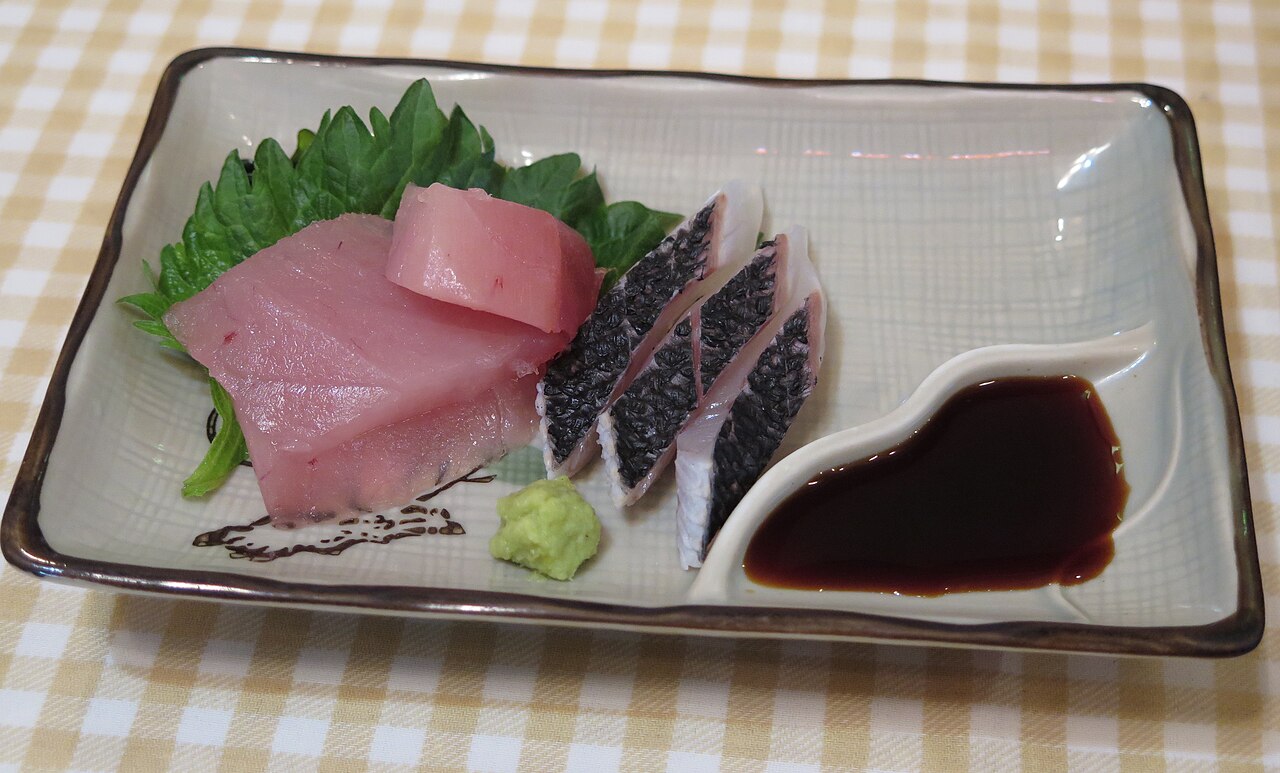
Start with fish sold for raw use
The FDA’s position is that it is always best to cook seafood thoroughly. If you choose to eat raw fish anyway, its rule of thumb is to eat fish that has been previously frozen: some species can carry parasites, and freezing kills any that are present, though it does not kill all harmful germs. The FDA lists raw or undercooked fish, such as sashimi, among the foods that pregnant women, children, older adults and people with weakened immune systems should avoid.
For seafood processors, the FDA’s parasite guidance names three freezing treatments as sufficient to kill parasites: freezing and storing at -4°F (-20°C) or below for 7 days in total; freezing at -31°F (-35°C) or below until solid and storing at -31°F or below for 15 hours; or freezing at -31°F or below until solid and storing at -4°F or below for 24 hours. It adds that these conditions may not suit particularly large fish, such as fish thicker than 6 inches. Those are processing conditions, so the practical step at home is to buy fish sold for raw eating and, as RecipeTin Japan suggests, ask the shop whether it is OK to eat raw; ask too whether it was previously frozen. If you cannot confirm it, cook the fish instead.
Keep it in the refrigerator until you slice it, and keep cold seafood refrigerated until it is served. The FDA says to serve cold seafood on ice if it will stay out longer than 2 hours.
Prepare the block
Sashimi is cut from a trimmed block, called a saku: skinned, boned and squared off. If you start from a fillet, take out the pin bones and the skin first; our guide to cutting a salmon fillet covers that. SBS’s guide, quoting fishmonger Narito Ishii, says to wipe away excess moisture from fish that has been defrosted; a paper towel does it.
Find the grain: the lines that run through the flesh. SBS says to always cut sashimi against the grain for more tender slices, and RecipeTin Japan’s Yumiko cuts perpendicular to the direction the spine ran.
Slice hira-zukuri
- Position. If you are right-handed, start at the right end of the block and work left, as SBS describes. Reverse it if you are left-handed.
- Place the heel. Set the edge near the heel, the part closest to the handle, on the top of the block at your chosen thickness.
- One pull. Draw the knife toward you through the fish, letting it descend as it travels, so the cut finishes near the tip. SBS is firm that you should never push and pull. Draw rather than press; the length of the edge does the cutting.
- Thickness. RecipeTin Japan puts a slice of sashimi at about 7 to 10 mm, or ¼ to ⅜ inch, thick. Keep every slice the same.
- Move the slice. Yumiko tilts the knife slightly to the right to carry the slice off the block. Lay the slices in a row as you go.
- Wipe the blade. Counter cooks wipe the blade between cuts so it slides cleanly through the next one. Do the same.
If your knife is too short to finish in one stroke, use the fewest calm pulls you can rather than quick sawing. Our piece on the yanagiba at the sushi counter explains why the single stroke matters for the cut face.
Thinner slices: sogi-zukuri
An angled cut gives a thinner slice with a broader face. SBS describes it simply: cutting at an angle makes the sashimi thinner with a broader cross-section. SBS starts sogi-zukuri from the left end of the block with the knife angled to the right, so the blade enters at a slant; then make the same single pull. Its fishmonger recommends it for white fish with firmer flesh, such as snapper.
Which knife
The traditional tool is the yanagiba, a long, narrow, single-bevel slicer made for exactly this pull. It is for boneless fish only: it should never touch bone, which is one reason the fish reaches it as a trimmed block. A double-bevel sujihiki also works well, and SBS notes that a fillet knife or any sharp knife with a thin, long blade should do the job at home. What matters most is a sharp edge and enough length to finish the slice.
Clean up
Wash your hands for at least 20 seconds with soap and warm water after handling raw fish, and wash the board, knife and counter with soap and hot water before preparing other ready-to-eat food, as the FDA advises. For other cuts, browse all our how-to-cut guides.
Sources: FDA, Selecting and Serving Fresh and Frozen Seafood Safely (cooking the safest route, previously frozen fish for raw eating, freezing and parasites, higher-risk groups and sashimi, keeping cold seafood cold, handwashing, washing boards); FDA, Fish and Fishery Products Hazards and Controls Guidance, Chapter 5: Parasites (freezing conditions and the large-fish caveat); Yumi Oba, SBS Food, How to Cut Sashimi at Home (sashimi grade, wiping defrosted fish, against the grain, right to left, one pulling motion, sogi-zukuri, knife choice); Yumiko, RecipeTin Japan, Sashimi (perpendicular to the spine, 7 to 10 mm, base to tip in one go, tilting the knife).