To cut napa cabbage, remove the outer leaves, rinse and dry the head, then halve it lengthwise through the base. Cut the core out of each half with a V-shaped cut, lay the half flat and slice across it: thin for slaw, wider for soups and stir-fries. For stir-fries, keep the thick white ribs and the leafy tops in separate piles so the ribs can go into the pan first. For braised wedges, leave the core in so the leaves stay together, the same rule our round-cabbage guide uses.
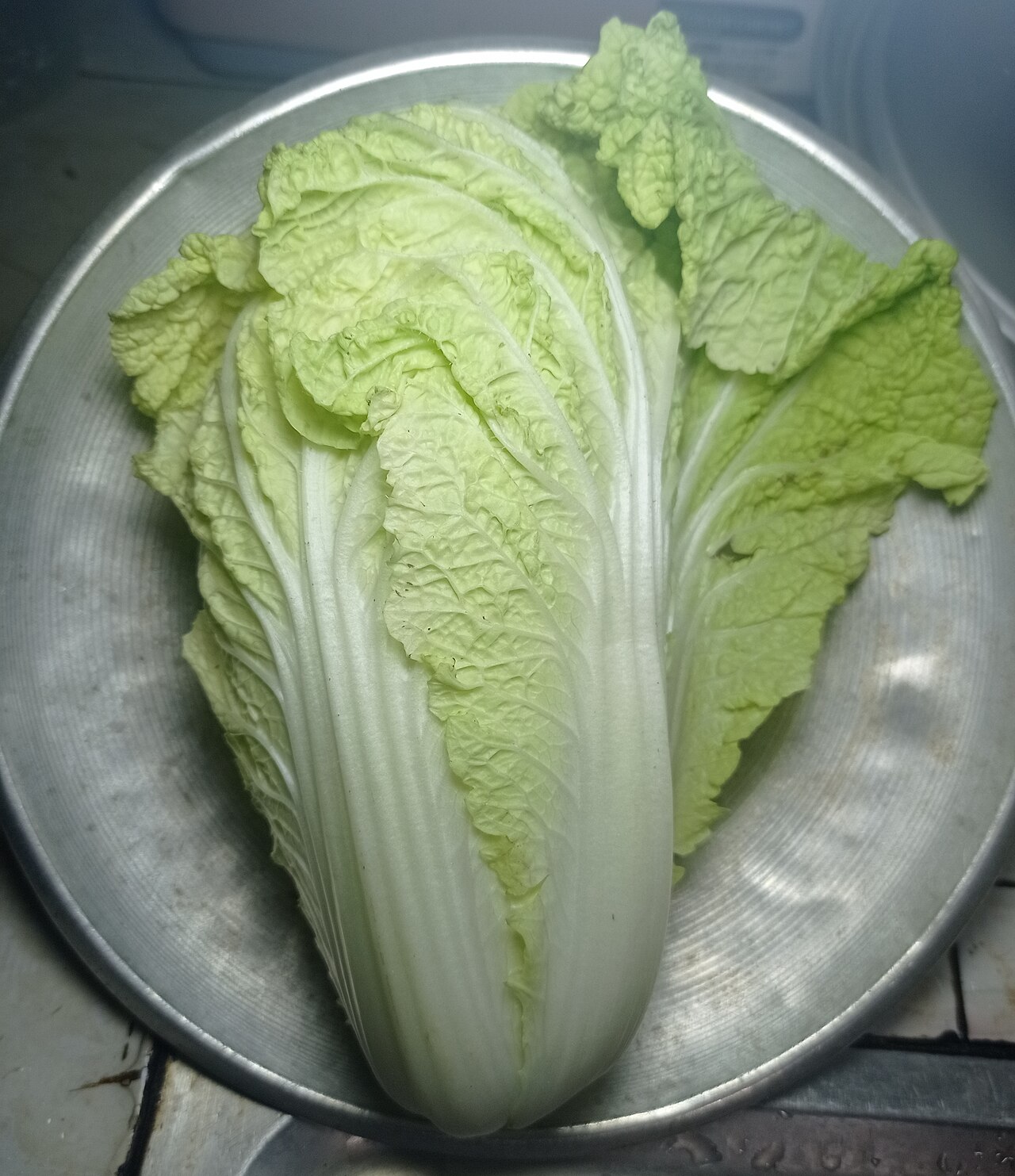
Napa cabbage is a type of Chinese cabbage (Brassica rapa subsp. pekinensis), called hakusai in Japan. Its long, layered head of crinkled leaves on broad white ribs cuts differently from a round green cabbage, which is covered in our cabbage guide.
Prepare the head
The FDA’s produce advice is to remove the outermost leaves of a head of cabbage, rub the produce under plain running water without soap or produce wash, and dry it with a clean cloth or paper towel. Trim a thin slice off the base. If you see soil between the leaves once the head is cut, rinse the pieces in a colander and drain them well before they go into a hot pan.
Step by step
- Halve it. Lay the head on its side on a long board and cut it in half lengthwise, from the base through the tips of the leaves. A long blade can make this in one stroke; with a shorter knife, cut from the base end first and finish from the tip end.
- Remove the core. Set a half cut-side down, or cut-side up if that is steadier, and make two angled cuts either side of the solid core at the base to lift it out as a V-shaped wedge.
- Slice across. Lay the half flat-side down and slice across from the leafy end toward the base. Utah State Extension’s knife-skills handout defines shredding as cutting into thin strips with a chef’s knife, with shredded cabbage for coleslaw as its example. Go as thin as the recipe needs.
- Separate ribs and leaves for cooking. For stir-fries or soups, cut the half into strips, then sort the white rib pieces from the green leaf pieces. Kikkoman’s napa cabbage mapo, for example, cuts the hakusai into strips about 6 cm long and 2 cm wide and adds the stalks to the pan before the leaves.
Cuts by dish
| Dish | Cut | Core |
|---|---|---|
| Slaw and salads | Thin crosswise shreds | Removed |
| Stir-fries | Strips, ribs kept apart from leaves | Removed |
| Soups and hot pots | Wider strips or bite-size pieces | Removed |
| Braising or grilling | Lengthwise wedges | Kept, to hold the leaves together |
Keep your fingers clear
Mississippi State Extension’s knife basics ask you to tuck the fingertips of the guiding hand toward your palm and to give round food a flat surface before cutting. A halved napa lies flat on its cut face, so start from that position and move the guiding hand back only after each cut. Stop before the last piece gets too small to hold; chop it separately or save it for soup.
The knife for this job
Napa cabbage is a job of many straight board cuts, which suits a nakiri’s broad, flat edge; our guide on how to use a nakiri shows the down-and-forward stroke. A santoku or gyuto works just as well, and a longer gyuto makes the first lengthwise cut of a big head easier; nakiri vs gyuto compares the two, and what a santoku is covers the compact all-rounder. In our wa handle size guide, a 150–190mm nakiri or santoku takes the Mid-size handle and a 196–255mm gyuto the Chef size. A long head also needs a long board; see the cutting board size guide.
Sources: FDA, 7 Tips for Cleaning Fruits, Vegetables (outer leaves, plain running water, drying); Utah State University Extension, Knife Skills handout (shred definition); Kikkoman, Napa Cabbage Mapo (6 × 2 cm strips, stalks before leaves); Mississippi State University Extension, Kitchen Knife Basics (curled fingertips, flat surface); Wikipedia, Napa cabbage (term).