A cherry wood cutting board suits a cook who wants a wooden board that yields under the knife and slowly deepens to a reddish brown. American black cherry is a little softer than black walnut and well below hard maple on the Janka hardness scale, so it shows knife marks sooner than maple does. It is a fine, even-textured wood, sold as both edge-grain boards and end-grain blocks, and it takes the same care as any wooden board: wash it by hand, dry it standing up and oil it when it looks dry.
What cherry wood is
In North American boards, “cherry” usually means black cherry (Prunus serotina), also sold as American cherry. The USDA Forest Products Laboratory’s Wood Handbook calls it the only native Prunus species that produces commercial lumber, with heartwood from light to dark reddish brown, a fairly uniform texture and very good machining properties. It describes the wood as moderately heavy and moderately hard, and very dimensionally stable once dried. The Wood Database notes that black cherry is not the same tree as sweet cherry (Prunus avium), the European and Asian species grown for fruit, which is far less used for lumber. If a listing says only “cherry,” check which species the maker means.
How hard is cherry compared with maple and walnut?
The Janka test measures the force needed to press a steel ball 0.444 inch (11.28 mm) across halfway into the side grain of the wood. A lower figure means the surface dents more easily. These are the Wood Handbook’s side-hardness values for each species at 12% moisture content:
| Wood | Side hardness (Janka) | Where it sits |
|---|---|---|
| Sugar (hard) maple | 1,450 lbf (6,400 N) | Hardest of these four |
| Black walnut | 1,010 lbf (4,500 N) | Slightly harder than cherry |
| Teak | 1,000 lbf (4,400 N) | Close to walnut and cherry |
| Black cherry | 950 lbf (4,200 N) | Softest of these four |
The Wood Database gives the same 950 lbf (4,230 N) for black cherry and an average dried weight of 35 pounds per cubic foot (560 kg/m³). Any one board can differ from these averages, and an end-grain board presents the ends of the fibres rather than the side grain that the test measures.
What cherry means for your knife
A wooden board protects an edge by giving way a little as the blade reaches it. Cherry’s lower hardness puts it toward the forgiving end of common board woods, and the cost of that is a face that marks and needs sanding sooner than a maple board. In our guide to cutting boards for Japanese knives, the bigger difference is between wood or rubber and hard surfaces such as glass, stone or marble; between suitable woods, the gap is much smaller. We found no published test that compares how fast a kitchen knife dulls on cherry, maple or walnut, so treat any claim that one of them keeps knives sharper as unproven. What protects a thin Japanese edge most on any board is technique: do not twist the knife while the edge is in the board, and scrape food with the spine rather than the edge.
End grain or edge grain?
Cherry is made both ways. John Boos’s cherry range, for example, lists end-grain chopping blocks from 1¾ to 4 inches thick alongside thinner boards, including a square edge-grain board. On an end-grain board the knife meets the ends of the fibres; on an edge-grain board it meets their sides. End-grain boards are usually thicker, heavier and more expensive, and John Boos says its end-grain construction may need more oiling. Our end-grain versus edge-grain guide sets out the tradeoffs. Cherry is also often combined with maple or walnut in striped boards; the table above shows that the woods in such a board are not equally hard.
Expect the color to change
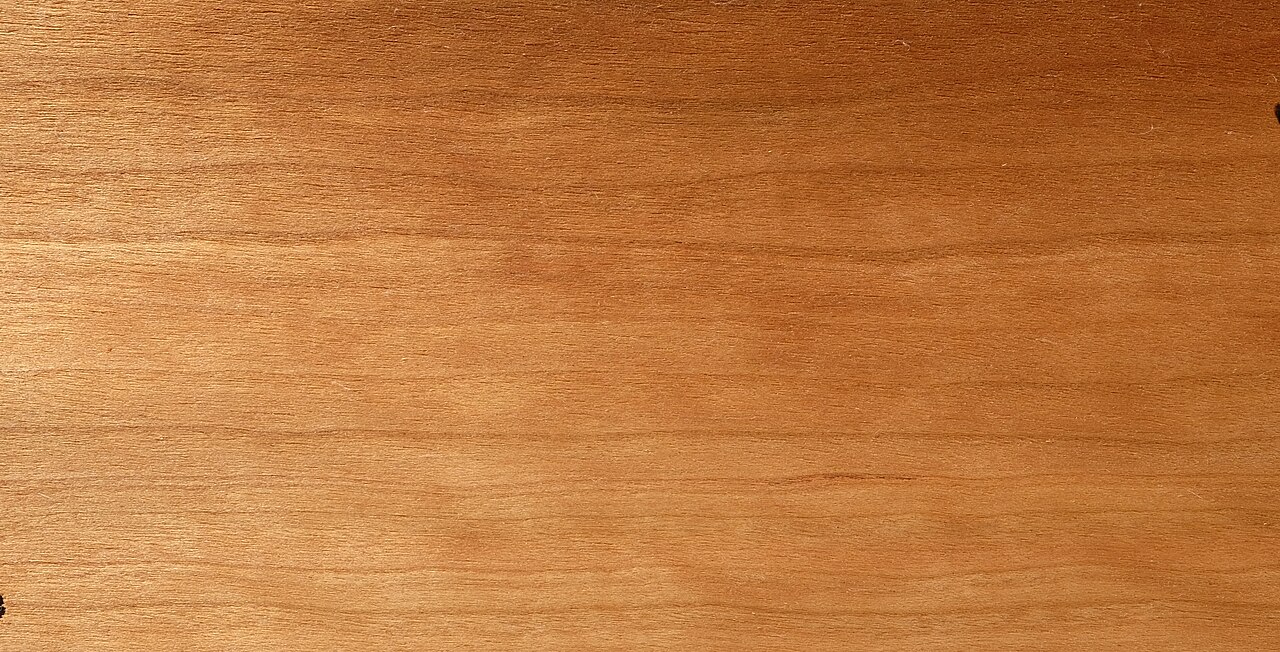
The Wood Database says black cherry heartwood is a light pinkish brown when freshly cut and darkens to a medium reddish brown with time and exposure to light, and that its pale yellowish sapwood often shows along the edges of boards. A new cherry board will therefore not stay the shade it arrives in, and pale streaks of sapwood are part of the wood, not a defect in the finish.
Caring for a cherry board
Cherry needs no special routine. Wash it by hand with warm, soapy water, never soak it or put it in the dishwasher, and stand it on edge to dry. Oil it with food-grade mineral oil when the surface looks dry and pale, and follow your board maker’s instructions where they differ. Our guides cover how to clean a wooden cutting board, how to oil it and which food-safe finishes board makers specify. When knife marks start to trap food, sanding restores the face.
How to choose a cherry cutting board
- Species: look for black cherry or American cherry (Prunus serotina) in the listing if you want the wood described here.
- Construction: decide between end grain and edge grain, and check whether the board is solid cherry or a mix of woods.
- Size and weight: check the listed thickness and weight against your sink and storage; our cutting board size guide explains how to measure.
- Care: read the maker’s washing and oiling instructions before you buy, and choose a routine you will keep.
To compare other board woods, see maple versus walnut cutting boards and our teak cutting board guide, or browse the kitchen tools guide. Our guide to the best wood for cutting boards compares a dozen board woods side by side.
Sources: USDA Forest Products Laboratory, Wood Handbook (FPL-GTR-190, 2010), chapter 2 (black cherry) and Tables 5–3b and 5–5b (side hardness at 12% moisture content); The Wood Database, Black Cherry (Janka test method, hardness, weight, color change, sapwood, sweet cherry) and Teak; John Boos, cherry cutting boards (constructions and thicknesses listed) and FAQ (mineral oil, no soaking or dishwasher).