Cut carrots by how you will cook them. Thin coins and bias slices suit steaming, sautéing and stir-fries; roll-cut chunks suit stews and simmered dishes; lengthwise halves, quarters and wedges suit roasting; sticks suit snacking; small dice suit soups and sauces. Most shapes start the same way: scrub, peel if you like, trim, and cut short lengths that are easier to hold steady. For fine matchsticks, see our separate guide to julienne carrots.
Before the first cut
Illinois Extension’s carrot advice is to scrub off every speck of soil with a vegetable brush and to peel if you want to. The FDA advises rinsing produce before you peel it and scrubbing firm produce with a clean brush. Cut off the stem end and the thin tail.
A whole carrot is long and rolls easily; short lengths are easier to steady. On a thick length, take a thin slice off one side, or halve it lengthwise, and put the flat face down before you shape it. Mississippi State Extension’s knife basics give round foods that flat surface and ask you to tuck the fingers of the holding hand toward your palm.
Pick the shape for the dish
| Shape | How it is cut | Typical use |
|---|---|---|
| Coins | Straight across the carrot | Steaming, boiling, soups |
| Bias slices | Across at a slant, for long oval slices | Stir-fries, sautés |
| Roll cut (rangiri) | Angled cuts with a turn between each | Stews, curries, simmered dishes |
| Wedges | Short lengths split lengthwise into halves or quarters | Roasting |
| Sticks and dice | Slabs, then sticks, then across for dice | Snacks and dips; soups and sauces |
Coins, bias slices and half-moons
For coins, lay a trimmed length on its side and cut straight across at the thickness the recipe asks for. Keep that thickness the same from the fat end to the thin end, so every piece cooks in the same time.
For bias slices, angle the blade across the carrot instead of square to it; the more you angle the blade, the longer each oval. On a carrot that is thick at the top, halve that section lengthwise and slice the halves flat-side down, so its half-moons match the coins from the tail.
Roll cut for stews and simmered dishes
- Prepare the carrot. Peel it. If it is thick, Kikkoman’s method halves it lengthwise first.
- Make the first angled cut. Cut across the end at a slant.
- Turn, then cut. Lift the blade clear, roll the carrot about a quarter turn, and cut at the same slant. Kikkoman places the knife near the centre of the face left by the previous cut, which keeps the pieces similar.
- Adjust toward the tail. Space the cuts a little farther apart as the carrot narrows, so the last chunks are not much smaller than the first.
Our Japanese vegetable cutting guide places rangiri alongside the other named Japanese shapes.
Carrot wedges for roasting
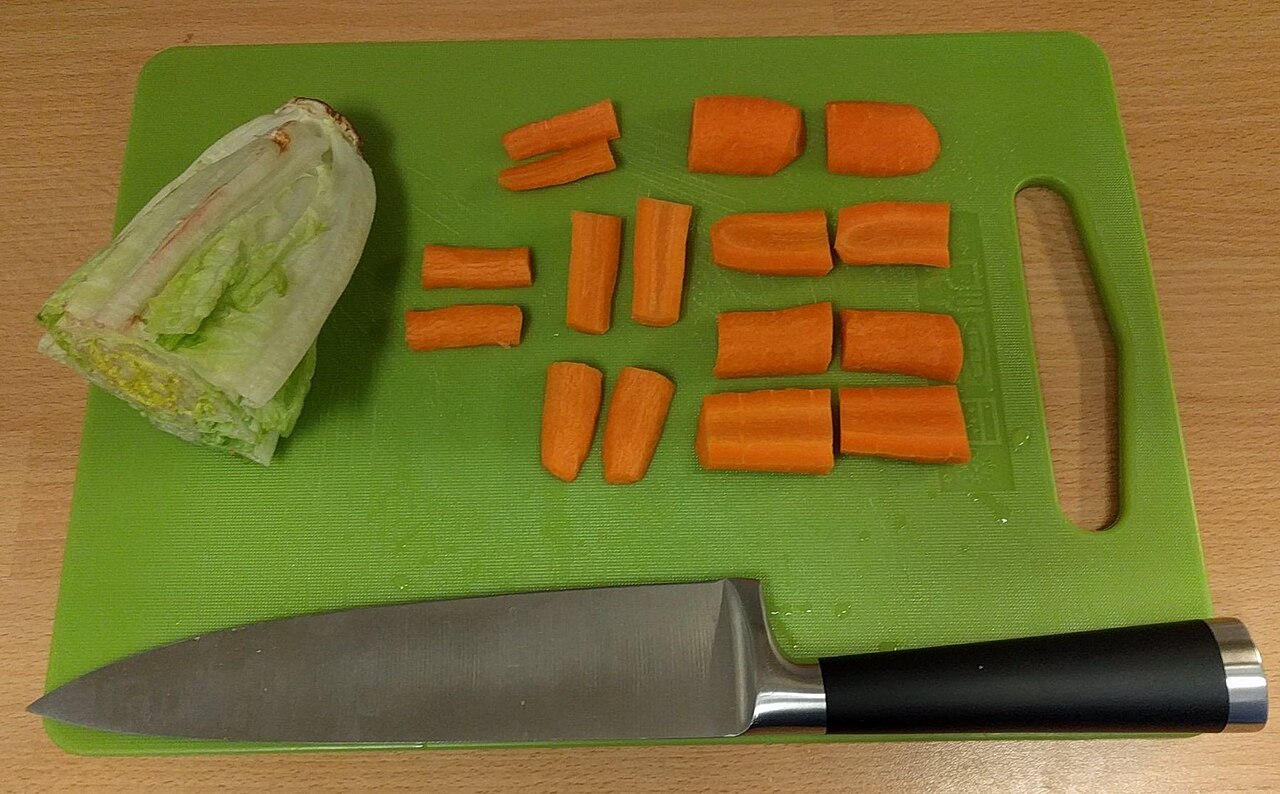
A carrot wedge is a short length split lengthwise, so it has a long flat face to lie on the tray. Utah State Extension’s roasting handout cuts carrots crosswise into 1-inch lengths and splits some lengths into halves or quarters, as in the photo above.
- Cut the carrot crosswise into short lengths; the Utah State handout uses 1 inch.
- Lay each length flat and halve it lengthwise through the centre.
- Turn each thick half cut-side down and halve it again; leave the narrow tail pieces as halves, so every wedge ends up about as thick as the next.
Match thickness more than length: a thick piece and a thin one will not finish together.
Sticks and dice
For carrot sticks, cut a length about 3 inches long, slice a sliver off one side so it sits flat, and cut it into slabs as thick as you want the sticks to be wide. Lay each slab down and cut it lengthwise into sticks. For dice, line the sticks up and cut across them at the same spacing; Utah State Extension’s knife-skills handout gives a small dice as 1/4-inch cubes.
A big carrot with a tough centre
Large carrots can be fibrous; Illinois Extension recommends small carrots for canning for that reason. If the middle of a thick carrot looks pale and woody, halve it lengthwise and cut the core out in a narrow strip before you shape the rest.
The knife for carrots
Carrots are dense, so a thin blade does most of the work. A nakiri’s straight edge suits rows of coins and bias slices; a santoku does the same and adds a point for trimming. Santoku vs nakiri compares the two. Use a push or draw slice rather than pressing straight down.
If the knife enters a carrot cleanly and then binds as more of the blade goes in, that is wedging, not a dull edge. Slide the blade back out rather than twisting it; why a sharp knife wedges in carrots and potatoes explains what to check next. Other vegetables, fruit and roasts are in all our cutting guides.
Sources: University of Illinois Extension, Preparing Carrots (scrub, peel if desired, large carrots fibrous); FDA, 7 Tips for Cleaning Fruits, Vegetables (rinse before peeling, brush firm produce); Mississippi State University Extension, Kitchen Knife Basics (flat surface, tucked fingers); Kikkoman, Random cut (roll cut, halving thick carrots, knife near the centre of the last cut); Utah State University Extension, Roasting Vegetables handout (1-inch lengths, halves or quarters); Utah State University Extension, Knife Skills handout (small dice).