To cut daikon, wash it, cut it into sections you can control, and peel each section thickly enough to remove the fibrous layer under the skin. Then cut for the dish: thick rounds with softened edges for simmering, half-moons or quarter-rounds for soups and stir-fries, or thin matchsticks for salads. For grated daikon, use a grater rather than a knife.
A whole daikon is long, heavy and dense, and much of its trouble at the board comes from trying to cut it in one piece. This guide follows one root from the whole vegetable to the finished pieces. The Japanese names for the shapes, and how each is made, are in our Japanese vegetable-cutting reference.
Start with sections, not the whole root
- Wash it. Scrub the skin with a clean vegetable brush under plain running water before you peel, as the FDA advises for firm produce; otherwise the peeler drags soil from the skin across the white flesh.
- Cut off the leaf end and the tip. Trim just enough at each end to remove the leaf base and the thin, root-like tail.
- Cut sections. Cut across the root into lengths for the dish you are making, rather than slicing the whole daikon at once. Cut only as much as you need and keep the rest whole.
- Give it a flat face when needed. A section stands steady on its cut end. When a piece has to lie on its side, shave a thin strip off one side first and rest it on that cut face; Mississippi State Extension’s knife basics give the same advice for any round food.
Peel thickly
Kikkoman’s cooking notes say to peel daikon thickly, about 3 to 4 mm, to remove the fibrous part that runs lengthwise just under the skin. On a short section, stand it on end and cut the skin away in strips from top to bottom, following the curve. A vegetable peeler takes off a thinner layer, so it takes more than one pass to reach the thicker peel Kikkoman describes. The continuous thin sheet called katsuramuki is a separate skill; see what an usuba is.
Thick rounds for simmering
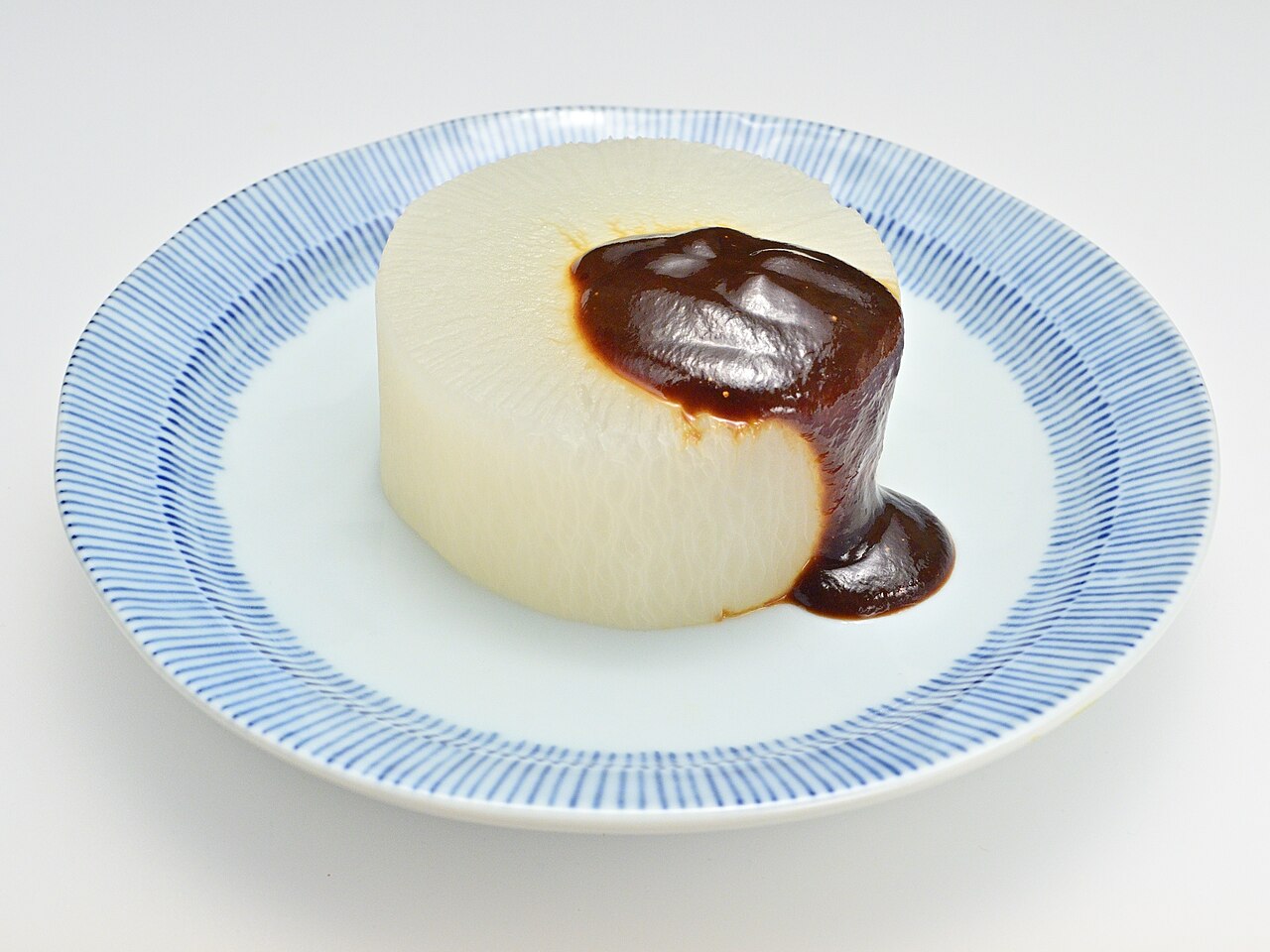
Daikon for simmering is cut thick. Kikkoman’s simmered daikon with sweet miso cuts rounds 4 to 5 cm (1½ to 2 in.) thick; its simmered daikon with tsukune uses rounds 3.5 cm thick.
- Cut the rounds. Cut the peeled section straight across at the thickness the recipe gives, keeping the knife upright so each round is even.
- Soften the edges. Kikkoman notes that for simmered dishes the corners should be chamfered to prevent them from splitting: shave the sharp edge off both faces of each round with a short stroke of the knife.
- Score the back. Kikkoman cuts a cross into one face of each round, about a third to a half of the way through; the tsukune recipe scores about a quarter of the depth. Lay the round scored-side down in the pot.
Half-moons and quarter-rounds
A wide daikon makes rounds too large for a spoon. For soups, stews and stir-fries, halve a peeled section lengthwise and slice across it for half-moons, or quarter it lengthwise first for quarter-rounds. Put the flat face down before slicing. How thick to slice is the recipe’s call.
Matchsticks for salads
Kikkoman’s julienne method peels the daikon and cuts it into 4 to 5 cm (1½ to 2 in.) pieces, slices them into planks 1 to 2 mm thick, stacks the planks by sliding them over one another, and then slices them into thin sticks from end to end. Even planks give even sticks, so take the most care on the first set of cuts. Stack only a few planks at a time so the pile does not slide.
When the blade sticks
Daikon is dense and wet, and a long section can grip the blade partway through a cut. If that happens, stop and draw the knife back out the way it went in. Do not twist or lever it; that sideways load is how thin edges chip. Then cut a shorter section, or halve the piece lengthwise, so the next cut is shorter or shallower.
Which knife
Long, straight cuts through a dense root are the home ground of a straight-edged vegetable knife. A nakiri has the flat edge for full board contact; the single-bevel usuba goes further into peeling and fine vegetable work. A gyuto or santoku handles the same cuts, and the extra length of a gyuto helps with wide sections. For grated daikon, see Japanese graters by ingredient, and for every other ingredient, our how-to-cut guides.
Sources: Kikkoman, Simmered Daikon with Sweet Miso Sauce (4–5 cm rounds, thick peel of 3–4 mm, chamfered corners to prevent splitting, cross-cut on the back); Kikkoman Food Forum, Simmered Daikon and Tsukune Meatballs (3.5 cm rounds, edges rounded, cross-scoring a quarter deep); Kikkoman, Julienned (4–5 cm pieces, 1–2 mm planks, thin sticks); Mississippi State University Extension, Kitchen Knife Basics (flat surface for round food); FDA, 7 Tips for Cleaning Fruits, Vegetables (vegetable brush for firm produce, rinse before peeling).