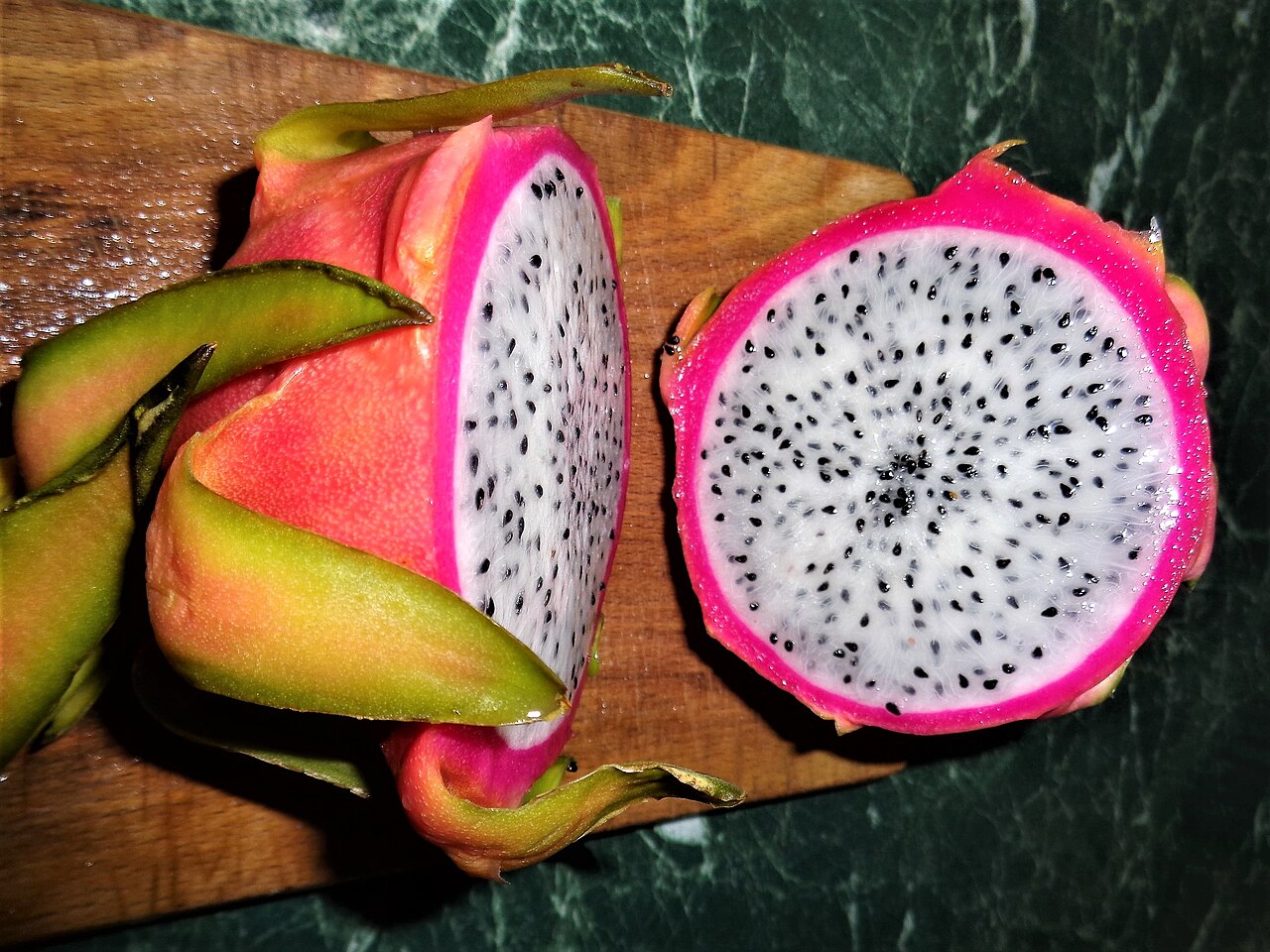
To cut a dragon fruit, rinse and dry it, trim the ends, then halve it lengthwise. Scoop the flesh out with a spoon, or peel the skin back with your thumb and cut the flesh into cubes or half-moon slices. The skin is thick but soft, so a small knife is enough; there is no pit or core to work around, and the tiny black seeds are eaten with the flesh.
Pick a ripe one
Harvard Health suggests a fruit that feels heavy for its size, with no shriveling or bruising. Ripe fruit, it says, will feel firm but slightly soft to the touch, and a firmer one can finish ripening on the counter. Food Network adds that the riper the fruit, the sweeter the flesh, and that an unripe dragon fruit has no flavor at all. University of Florida Extension’s guide for home growers advises picking only well-colored, mature fruit.
Colors vary by type. The most common dragon fruit, Food Network notes, has bright red skin, green scales and white flesh with small black seeds. Others have yellow skin, and UF lists flesh that may be white, red or magenta depending on the species. All are cut the same way.
Wash and trim
Food Network runs the fruit under cold water, then pats it completely dry in a clean kitchen towel. The FDA’s general advice for produce fits: wash your hands, rub the fruit under plain running water without soap or produce wash, and rinse it before you peel it, so dirt and bacteria are not carried from the knife onto the flesh. Then set it on the board and trim off both ends, scales and all.
Halve and scoop
- Halve it lengthwise. Lay the fruit on its side, curl the fingertips of your guiding hand, and cut from end to end through the middle. Each half now has a flat face to rest on.
- Scoop. Harvard Health calls this the easiest way in: cut the fruit in half, then scoop out the flesh with a spoon and eat it as is or cut it into cubes. Run the spoon close to the skin and the flesh comes out in one piece.
- Or cube it in the skin. Score the flesh of each half into a grid, cutting down to the skin but not through it, then scoop the cubes into a bowl.
Peel, then cut
For neater pieces, peel the halves. Food Network’s method is to use your thumb to separate the skin from the flesh and pull the skin away; it is thick but pliable and peels easily. A spoon helps where it sticks, the way you would loosen an avocado. Harvard Health gives a third route for a whole fruit: trim the thick rind off all around with a paring knife, then slice the flesh into rounds.
- Cubes. Lay a peeled half flat side down and slice it into planks, then stack the planks, cut them into thin, even strips, and turn the strips to cut them into small, even squares, as Food Network does. Cubes suit fruit salads, yogurt and smoothie bowls.
- Half-moons. Slice a peeled half crosswise into thin slices; Food Network calls these perfect for salads and fruit platters.
- Rounds. Lay a whole peeled fruit on its side and slice across it.
The flesh is soft and wet. Use a light slicing stroke rather than pressing straight down, which squashes it, and wipe the board between batches so the pieces do not slide around.
Store it
UF Extension says whole fruit keeps 4 to 5 days at room temperature or several weeks in plastic bags in the refrigerator. Once peeled, Food Network refrigerates dragon fruit in an airtight container for up to 4 days, and says cut dragon fruit can be frozen in an airtight container for up to 3 months.
Which knife and board
A paring knife or a petty knife is all a dragon fruit needs; our guides to paring vs utility knives and the petty knife explain where each fits. A small board is enough for one or two fruits; see the cutting board size guide. A kiwi can be halved and scooped the same way; how to cut a kiwi covers its other cuts. For other fruit and vegetables, browse all our how-to-cut guides.
Sources: Harvard Health Publishing, Dragon fruit: How to enjoy this antioxidant-rich fruit (choosing, ripeness, ripening on the counter, halve and scoop, trimming the rind, edible seeds); Food Network, How to Peel Dragon Fruit (common type, ripeness and flavor, washing, trimming, halving, peeling with the thumb or a spoon, cubes, half-moons, storage); University of Florida IFAS Extension, Pitaya Growing in the Florida Home Landscape (peel and pulp colors, well-colored mature fruit, keeping whole fruit); FDA, 7 Tips for Cleaning Fruits, Vegetables (hands, plain running water, no soap, rinse before peeling).