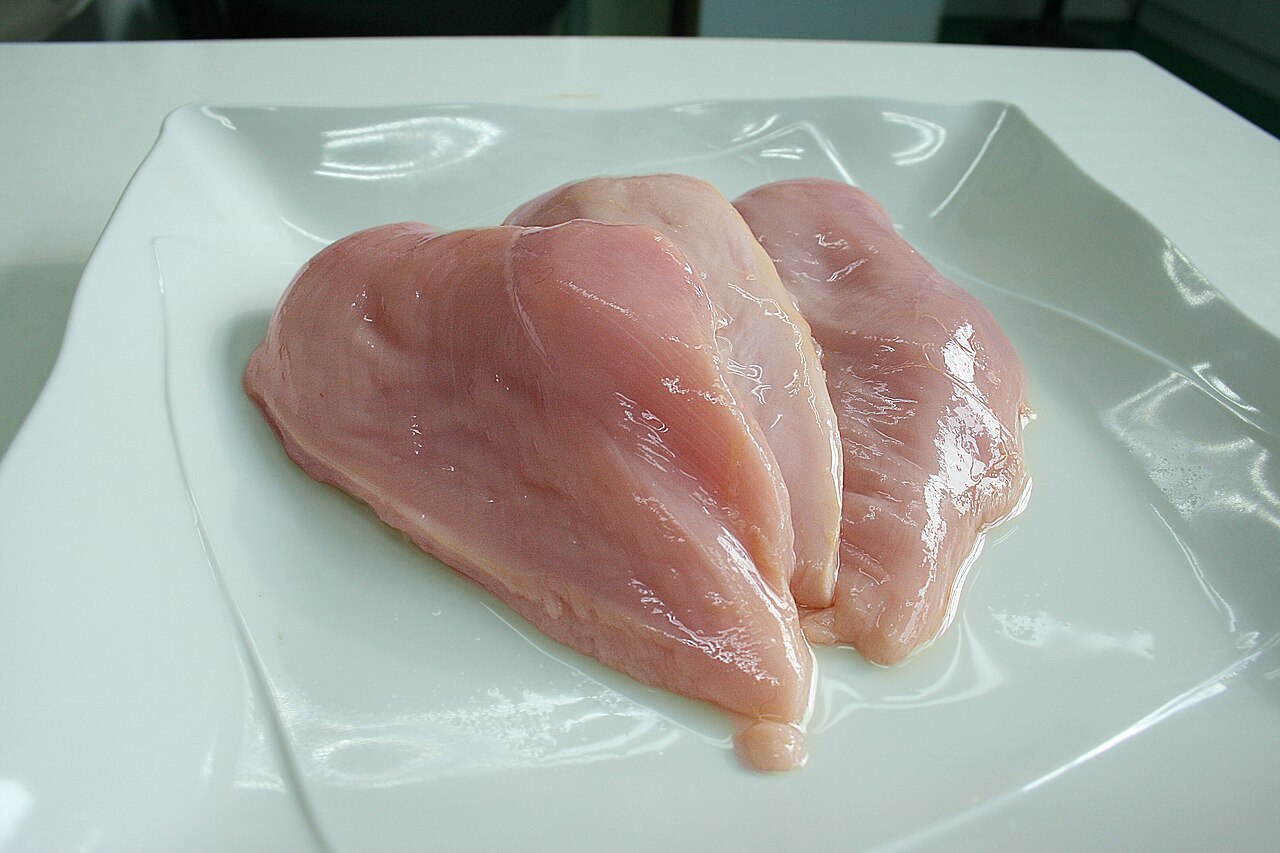
To cut a boneless chicken breast, lay it flat on a board you keep for raw meat, take off the loose tenderloin from the underside, then cut what the recipe needs: thin slices against the grain for a stir-fry, two thin cutlets, or a butterflied breast opened like a book. A short spell in the freezer firms the meat so the slices stay even. Wash your hands, board and knife when you finish, and cook the chicken to 165°F.
Set up before you unwrap it
Do not rinse the breast. University of Maine Cooperative Extension says washing raw chicken can spread bacteria in your kitchen. Wash your hands with hot, soapy water for 20 seconds first, and put a clean damp towel or paper towel under the board so it cannot slide, as the same UMaine bulletin does.
USDA’s Food Safety and Inspection Service suggests one cutting board for fresh produce and bread and a separate one for raw meat, poultry and seafood. Our guide to the cutting board for raw meat sets out that two-board routine. Keep the chicken in the coldest, lowest part of the refrigerator until you are ready to cut it.
Take off the tenderloin
Turn the breast over. The tenderloin is the narrow strip lying underneath; Martha Stewart’s guide describes it as attached to the breast by a thin white tendon. Peel it away with your fingers and free it with the tip of the knife where it holds. The same guide advises removing the white tendon before cooking; trim it out with the tip of the knife.
That strip is a ready-made chicken tender. The Martha Stewart guide says tenderloins are extremely quick cooking and best suited to breading and frying, baking, searing or grilling. For more pieces of the same shape, cut the rest of the breast lengthwise into strips of a similar width.
Thin slices and strips for a stir-fry
- Firm it. In his Serious Eats method, J. Kenji López-Alt puts the breast in the freezer for about 15 minutes to firm it up. Keep it wrapped or on a covered plate so raw juices cannot drip onto other food. A firm breast is easier to slice evenly than a soft one.
- Read the grain. Look for the lines of the muscle fibers on the surface of the breast.
- Cut on a bias against the grain. López-Alt slices not quite 100 percent against the grain, because chicken can end up almost too tender, but still at a sharp bias against it.
- Use long, even strokes. He cuts slices about ¼ inch thick. Draw the knife through each slice rather than pressing down.
- Cut strips or cubes. Stack a few slices and cut them into strips, or cut across the strips for cubes.
Cutlets and butterflying
Tasting Table defines butterflying as splitting the breast in half horizontally, like a hamburger bun, leaving one edge intact. The point is a uniform thickness that cooks more evenly and quickly.
- Lay it flat. Put the breast on the board with the thick, rounded long side facing your knife hand.
- Keep your hand flat on top. Press lightly with your palm and keep your fingers flat and above the line of the blade.
- Cut parallel to the board. Start at the thick side and draw the knife through the middle of the breast in long strokes.
- Stop or go through. For a butterflied breast, stop short of the far edge and open the two halves like a book. For two thin cutlets, keep cutting until the halves separate.
Clean up, then cook
FSIS recommends washing boards with hot, soapy water after each use, then rinsing with clear water and air drying or patting dry with clean paper towels. Wooden and plastic boards can both be sanitized with 1 tablespoon of unscented liquid chlorine bleach per gallon of water: flood the surface, let it stand several minutes, then rinse. Wash the knife and your hands before you touch anything else.
UMaine Extension says poultry should be cooked to an internal temperature of at least 165°F, the USDA figure South Dakota State University Extension lists for all poultry. Thin cutlets and strips reach it quickly, so check with a thermometer rather than by time.
Which knife
A boneless breast has no joints, so it needs a sharp edge more than a special shape. Tasting Table suggests a sharp boning knife or a chef’s knife; a petty knife also handles the tenderloin and tendon. If you are taking the breasts off a whole bird, that is joint work: see how to cut up a whole chicken and the honesuki, which works around bone rather than through it. Keep a thin Japanese edge away from bone. For produce and other cuts, browse all our how-to-cut guides.
Sources: University of Maine Cooperative Extension, Bulletin #4068 (do not wash raw chicken, 20-second handwash, damp towel under the board, coldest and lowest part of the refrigerator so raw juices cannot drip onto other foods, 165°F); USDA FSIS, Cutting Boards and Food Safety (separate boards, washing, bleach solution); SDSU Extension, Is It Done Yet? (all poultry 165°F, per USDA FSIS); J. Kenji López-Alt, How to Slice Chicken Breast for Stir-Fries (Serious Eats) (15 minutes in the freezer, sharp bias against the grain, ¼-inch slices, long strokes); Martha Stewart, Chicken Tenderloin vs Chicken Breast (tenderloin and tendon, uses); Tasting Table, butterflying a chicken breast (definition, even cooking, knife choice).