A teak cutting board is durable and copes well with moisture, and its Janka hardness of about 1,000 lbf puts it close to walnut and cherry and well below hard maple. The open question for a Japanese knife is silica. The USDA Wood Handbook says the silica in teak often dulls tools, and the Wood Database puts teak’s silica content as high as 1.4%. Those statements are about woodworking tools machining the wood. We found no published test of how kitchen knives fare on teak boards, so neither “knife-friendly” nor “dulls your knives” is established for kitchen use.
What teak is
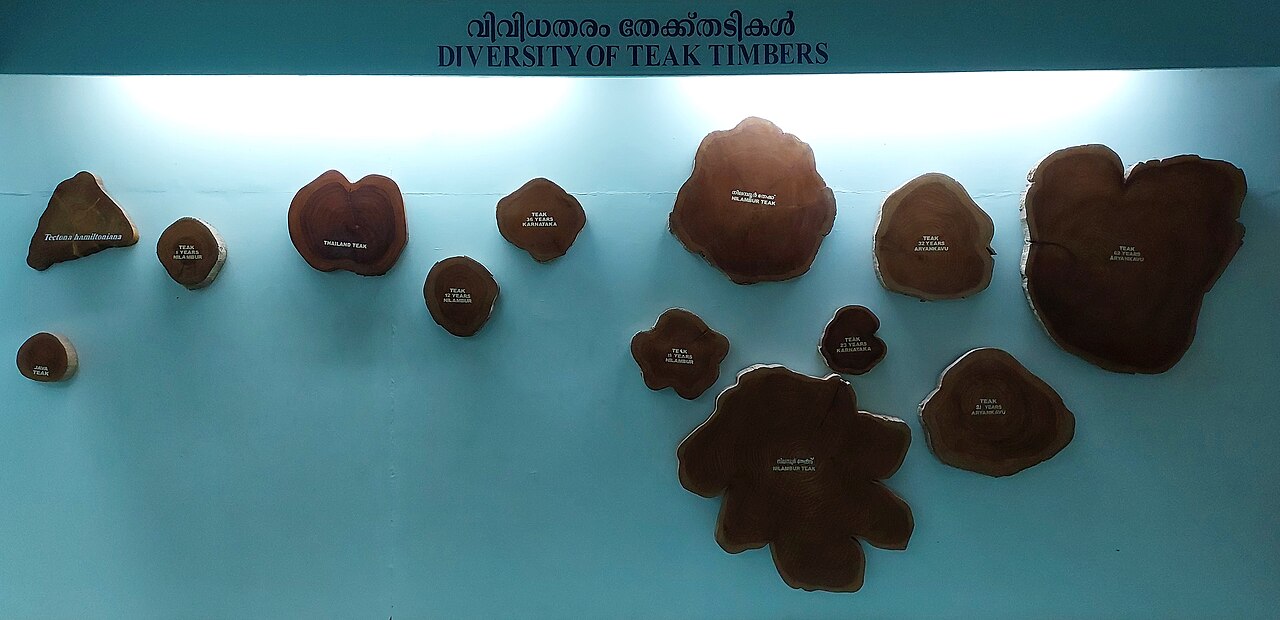
Teak (Tectona grandis) is a tropical hardwood native to southern Asia, now also grown on plantations in tropical Africa, Asia and Latin America. The Wood Handbook describes heartwood from yellow-brown to dark golden brown that turns a rich brown in air, a coarse, uneven texture, usually straight grain and a distinctly oily feel. It credits teak with excellent dimensional stability and a very high degree of natural durability, and lists boats, furniture and flooring among its uses. The name is also borrowed: the Wood Database notes that other woods are sold under labels such as “Brazilian teak” (cumaru) or “Rhodesian teak,” which are not Tectona grandis.
How hard is teak?
The Wood Handbook gives teak a side hardness of 1,000 lbf (4,400 N) at 12% moisture content. The Wood Database lists 1,070 lbf (4,740 N) and an average dried weight of 40.9 pounds per cubic foot (655 kg/m³); the two references measured different samples, and any one board can vary. For comparison, the Wood Handbook gives sugar (hard) maple 1,450 lbf, black walnut 1,010 lbf and black cherry 950 lbf. On hardness alone, then, teak sits with walnut and cherry, not with maple.
Does teak dull Japanese knives?
Hardness is only half of the question for teak. The other half is the silica deposited in the wood:
- The Wood Handbook: teak is generally worked with moderate ease, “however, the presence of silica often dulls tools.”
- The Wood Database: teak contains a high level of silica, up to 1.4%, “which has a pronounced blunting effect on cutting edges.” Its anatomy notes list whitish silica deposits in the vessels as common.
- TeakHaus, a teak board maker, says in its FAQ that teak boards “are known to be knife-friendly” and calls teak a medium hardwood, “not too hard to keep your knives sharp.”
These do not contradict each other as directly as they seem. The reference books describe woodworking tools cutting through the wood again and again, while a kitchen knife meets the board only at the end of each cut. Neither the references nor the maker give a measurement for kitchen knives, and we found none elsewhere. If you use a thin, hard Japanese edge, the practical answer is to watch how your edge holds up on the board you have, and to keep the habits that matter on any board: no twisting with the edge in the wood, no scraping with the edge. Our guide to cutting boards for Japanese knives explains why wood and rubber are forgiving surfaces and glass, stone and marble are not.
End grain or edge grain?
Teak boards come in both. TeakHaus sells end-grain and edge-grain teak boards and describes end grain as small pieces glued so the fibres face the knife. On an edge-grain board the knife meets the sides of the fibres instead. End-grain boards are generally thicker, heavier and more expensive; our end-grain versus edge-grain guide compares the two. Edge grain does not settle the silica question either way.
How to clean and oil a teak cutting board
TeakHaus’s care guide for its teak boards gives a routine that matches the general advice for wooden boards:
- After each use: scrape off food, wash with warm water and a mild dish soap, rinse, and dry the board straight away with a towel.
- Never put it in the dishwasher or leave it soaking, and do not use bleach or harsh chemical cleaners.
- Oil it with food-grade mineral oil or a board oil on every surface, leave it 4–6 hours or overnight, then wipe off the excess. TeakHaus suggests this two to three times a month for a board in daily use and monthly for occasional use.
- Do not use cooking oils such as olive or canola oil, which the maker warns can turn rancid.
- For stains or smells, it suggests a lemon and salt or baking-soda paste, then washing and drying the board.
Teak’s natural oil does not replace that routine. For the full methods, see how to clean a wooden cutting board, how to oil a wooden cutting board and our guide to food-safe cutting board finishes.
How to choose a teak cutting board
- Species: look for Tectona grandis in the listing. “Teak” with a place name in front of it may be a different wood.
- Source: teak now comes from plantations as well as natural forests. The Wood Database notes that sanctions were placed on teak imported from Myanmar after the 2021 military takeover; a listing that names the source or a certification such as FSC tells you more.
- Construction and size: choose end grain or edge grain, then check thickness, weight and footprint against your sink and storage with the cutting board size guide.
- Teak or bamboo: bamboo boards are built from joined pieces, and our bamboo versus wood comparison explains why a hard, scratch-resistant surface is not the same thing as one that is kind to an edge.
To compare other board woods, see our cherry wood cutting board guide and maple versus walnut cutting boards, or browse the kitchen tools guide. Our guide to the best wood for cutting boards puts teak alongside maple, walnut, beech and harder woods such as purpleheart.
Sources: USDA Forest Products Laboratory, Wood Handbook (FPL-GTR-190, 2010), chapter 2 (teak: color, texture, stability, durability, silica) and Tables 5–3b and 5–5b (side hardness at 12% moisture content); The Wood Database, Teak (hardness, weight, silica up to 1.4%, look-alike names, Myanmar sanctions); TeakHaus, FAQ (knife-friendly claim, end and edge grain, mineral oil and beeswax, cooking oils) and care guide (washing, oiling, lemon and salt).