To cut an eggplant, wash it, cut off the green cap, and pick the shape before you start: rounds for eggplant parmesan or frying, lengthwise planks for grilling, cubes for roasting, curries and sautés, or roll-cut chunks for simmered dishes. Cut it shortly before you cook it, because the pale flesh starts to brown once it meets the air. Peeling and salting are both optional; the recipe decides.
Three decisions to make first
Peel or leave the skin on. Penn State Extension notes that the skin is edible but may be too chewy, and Illinois Extension says some recipes keep the skin and some peel it. Purdue Extension’s grilling method peels the eggplant first, while its roasting and baking directions do not call for peeling. A sharp vegetable peeler takes the skin off a firm eggplant in long strips.
Salt or not. Purdue Extension describes salting as the traditional way to remove bitterness and some water: salt the slices, set them aside for 45 minutes, then rinse, squeeze gently and dry them. It adds that fresh Asian and Italian eggplants from farmers markets tend to be less bitter and do not need it. Illinois Extension notes that salted eggplant is firmer, which suits grilling and baking.
When to cut. Nebraska Extension advises cutting an eggplant right before you use it, because the white flesh can turn brown quickly. Illinois Extension explains that this is the effect of oxygen, as with a cut apple, and that browned eggplant is safe to eat; trim the brown areas if they bother you.
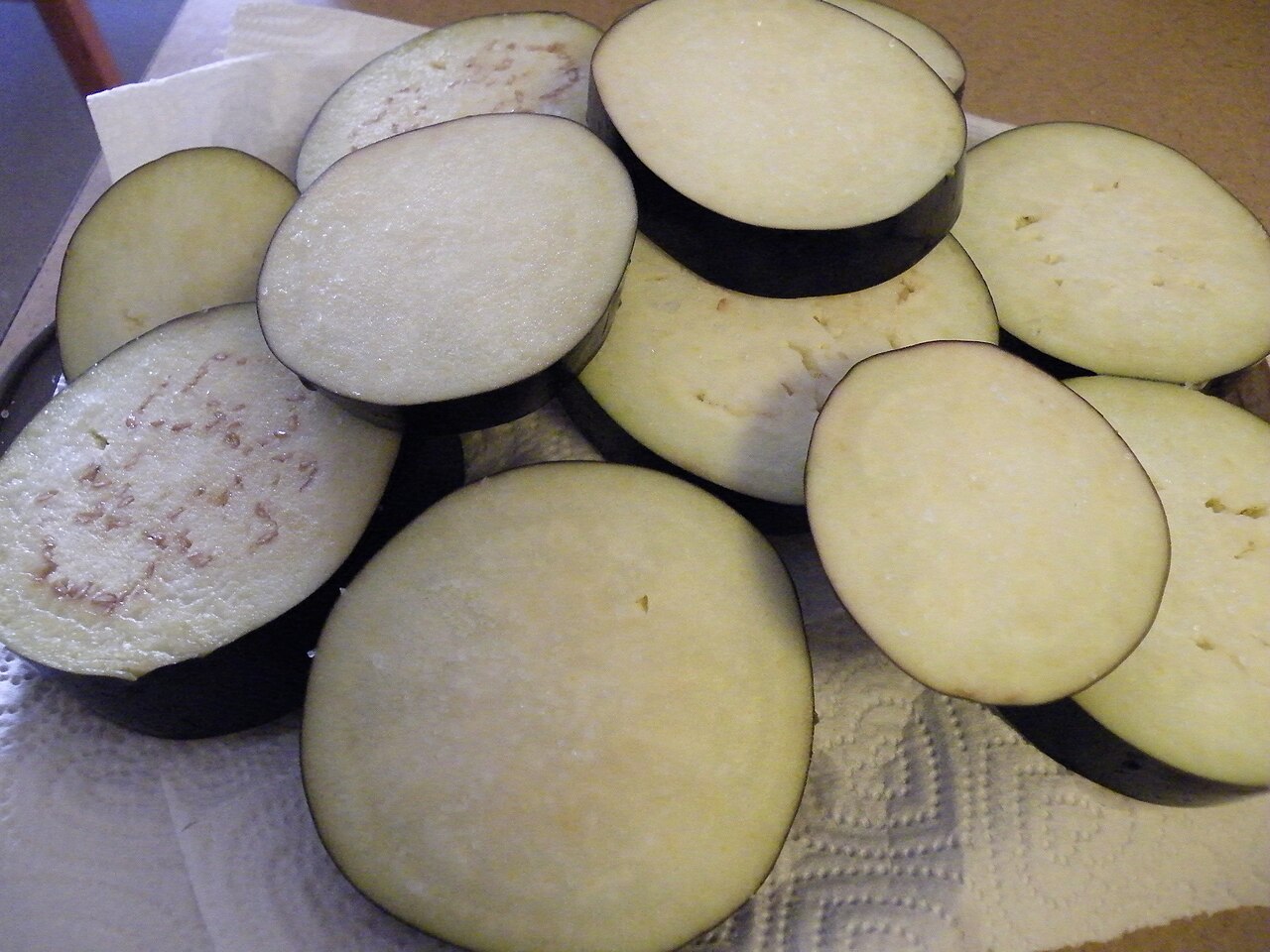
Rounds for eggplant parmesan and frying
- Lay the eggplant on its side and cut off the cap end.
- Cut straight across at an even thickness. A Penn State Extension eggplant recipe uses peeled 1/2-inch rounds.
- The neck is narrower than the bulb, so the rounds change in diameter along the eggplant. Keep their thickness the same anyway, so the batch cooks evenly.
- Lay the rounds out in one layer as you go, on a tray or on paper towels, ready for salting, breading or the pan.
Planks for grilling
Purdue Extension’s grilling method peels the eggplant and cuts it lengthwise into slices 1/2 to 1 inch thick. To get even planks:
- Cut off the cap. Take a thin slice off one long side and lay the eggplant on that flat face so it cannot roll.
- Cut down through the full length at even spacing, keeping the blade upright so each plank is the same thickness at both ends.
- When the remaining piece is too narrow to stand steady, turn it onto a cut face and slice the rest from there.
A long eggplant needs a blade that covers its length; with a shorter knife, start the cut at the cap end and finish it from the other end.
Cubes for roasting, curry and sautés
Purdue Extension roasts eggplant in 1-inch cubes, spread out in a single layer. To cube it, cut 1-inch rounds, lay each one flat, cut it into 1-inch strips, then cut across the strips. Rest each piece on a cut face rather than on its curved skin, so it does not rock under the knife. Purdue also warns that eggplant soaks up oil in the pan, so go easy with the oil when you sauté the cubes.
Roll cut for simmered dishes
Kikkoman’s random-cut method for eggplant is to cut off the stem and rotate the eggplant as you cut from one end. Make an angled cut, lift the knife clear, turn the eggplant about a quarter turn, and cut again at the same slant. Aim for pieces of a similar bite size, not a uniform shape. Our Japanese vegetable cutting guide describes this cut, rangiri, with the other named Japanese shapes.
When slices stick to the blade
Eggplant flesh is moist and spongy, so thin rounds often cling to the side of the knife. That is a food-release problem, not a sign of a dull edge. A gentle draw-slice instead of a straight push, fewer slices before you clear the board, and a bench scraper for the pile all help; why food sticks to a kitchen knife covers the rest. To free a stuck slice, push it off toward the spine with a utensil, never along the edge with your fingers.
Choosing the knife
An eggplant is soft inside but has a slick, tight skin, so a sharp edge matters more than weight. A nakiri’s long, straight edge meets the board along its whole length, which suits rounds and planks; see how to use a nakiri for its down-and-slightly-forward stroke. A santoku or gyuto works as well, and a gyuto’s extra length helps with lengthwise planks on a big eggplant. Our wa handle size guide fits a 150–190mm nakiri or santoku with the Mid-size handle and a 196–255mm gyuto with the Chef size. Every other vegetable, fruit and roast we cover is in the full list of cutting guides.
Sources: Penn State Extension, Eggplant in the Garden and the Kitchen (edible but chewy skin; 1/2-inch rounds); University of Illinois Extension, Eggplant is a recipe centerpiece and a team player (peeling by recipe, browning from oxygen, safe to eat, salting for firmness); Purdue Extension FoodLink, Eggplant (salting method and when it is unnecessary, grilling planks, 1-inch roasting cubes, oil absorption); Nebraska Extension, Eggplant (cut right before use); Kikkoman, Random cut (rotating random cut for eggplant).