To cut fresh ginger, peel off the thin skin with a spoon or vegetable peeler, then slice the root thinly from end to end. For matchsticks, stack a few slices and cut them into thin strips; for minced ginger, gather the strips and cut across them at right angles. Peel and cut only as much as the recipe needs, and keep the rest unpeeled in the refrigerator.
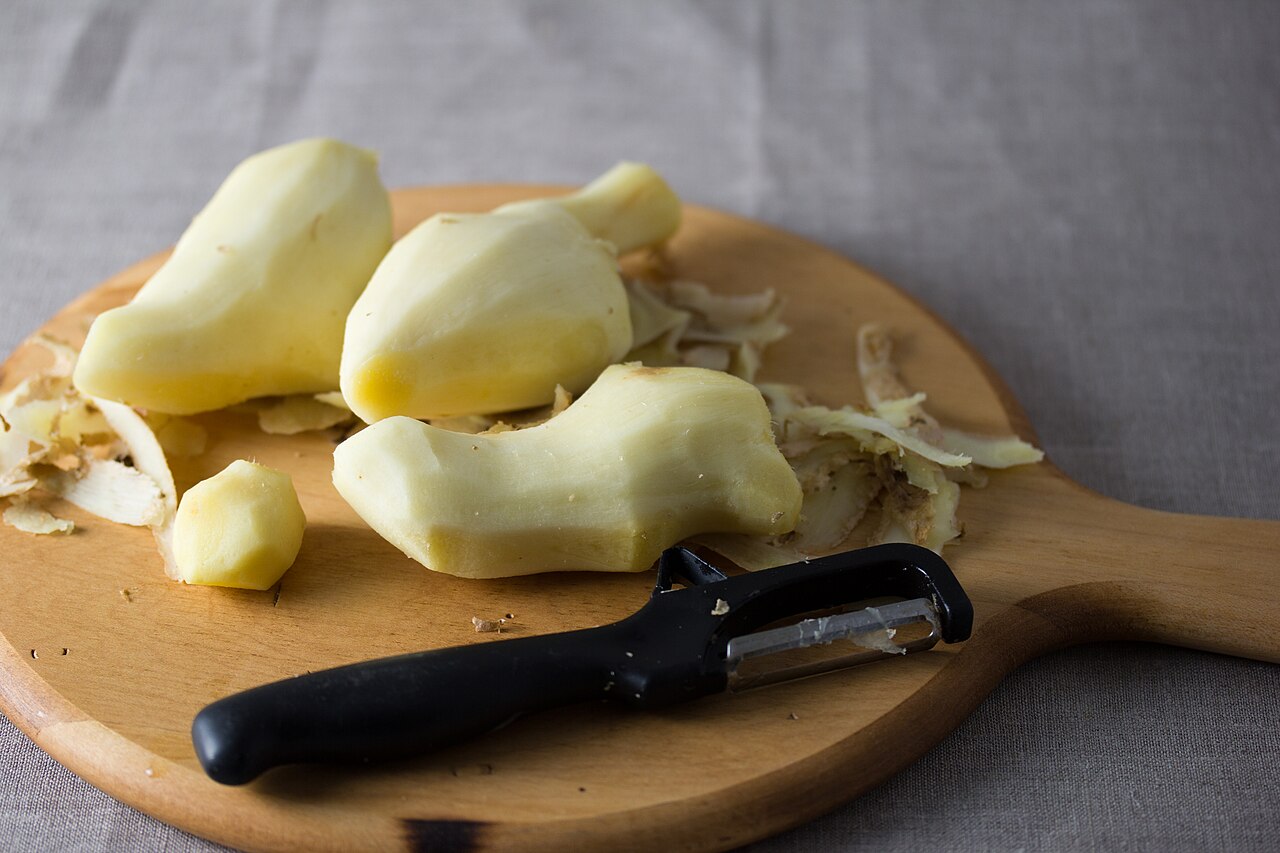
The part of ginger we cook with is the rhizome of the Zingiber officinale plant, sold as ginger root. Illinois Extension suggests avoiding ginger that is dry, shriveled or soft. Its knobby shape is the main difficulty at the board, so the method below starts by making it stable.
Peel it
Illinois Extension describes peeling the tough skin with a vegetable peeler or even a spoon, then slicing or mincing with a knife. Break off a knob the size you need first, so the rest of the root stays unpeeled. If the root was dirty, rinse it under running water before peeling, as the FDA advises for produce in general, so dirt is not carried from the knife onto the cut surface.
Step by step
- Make a flat side. Mississippi State Extension’s knife basics recommend giving round food a flat surface before cutting. Trim a thin slice off one side of the peeled knob and set it on that face.
- Slice thin coins or planks. Kikkoman’s guide peels the ginger and then slices it thinly from end to end. Keep the slices as even as you can; every later cut depends on them.
- Cut matchsticks (julienne). Kikkoman’s julienned ginger slides the thin slices into a stack and slices them thinly again from end to end. In Utah State Extension’s knife-skills handout, a julienne is a strip ⅛ inch by ⅛ inch by 2½ inches. Kikkoman’s ginger strips are simply as long as the slices they come from.
- Mince. For minced ginger, Kikkoman gathers the thin strips and cuts across them finely at right angles. Utah State defines mince as chopping into very fine pieces. Run the knife through the pile again if some pieces are still large.
The cuts at a glance
| Cut | How | Size |
|---|---|---|
| Thin slices | Across the peeled knob, end to end | As thin as you can keep even |
| Matchsticks (julienne) | Stack slices, cut thin strips | About ⅛ inch square in section |
| Minced | Gather strips, cut across | Very fine pieces |
| Grated | Fine grater, not a knife | Fine pulp and juice |
Illinois Extension lists salad dressings, stir-fries, marinades, smoothies and applesauce among the dishes that take fresh minced ginger. When a recipe calls for grated ginger, a small condiment grater does the job better than a knife; see our guide to Japanese graters for ginger, daikon and wasabi.
Keep your fingers clear
Ginger pieces get small quickly. Tuck the fingertips of your guiding hand toward your palm, as Mississippi State Extension advises, and stop slicing when the last piece is too small to hold; save it for a dish where a rough chop is fine. The same thin-slices, strips, then crosswise cuts sequence is used for garlic in our guide to mincing garlic.
Storing ginger
Illinois Extension says unpeeled ginger keeps in the refrigerator for up to three weeks.
The knife for this job
A knob of ginger is a small job, which suits a petty knife: our petty guide describes it as the knife for slicing a few small ingredients and for peeling or shaping in the hand. For a large batch of matchsticks, a santoku or nakiri gives more edge on the board. In our wa handle size guide, a 105–155mm petty takes the Compact handle and a 150–190mm santoku or nakiri the Mid-size.
Sources: Illinois Extension, The many benefits of ginger (selection, peeler or spoon, uses, storage); Wikipedia, Ginger (rhizome); Kikkoman, thinly sliced, julienned and mincing (ginger cuts); Utah State University Extension, Knife Skills handout (julienne and mince definitions); Mississippi State University Extension, Kitchen Knife Basics (flat surface, curled fingertips); FDA, 7 Tips for Cleaning Fruits, Vegetables (rinse before peeling).