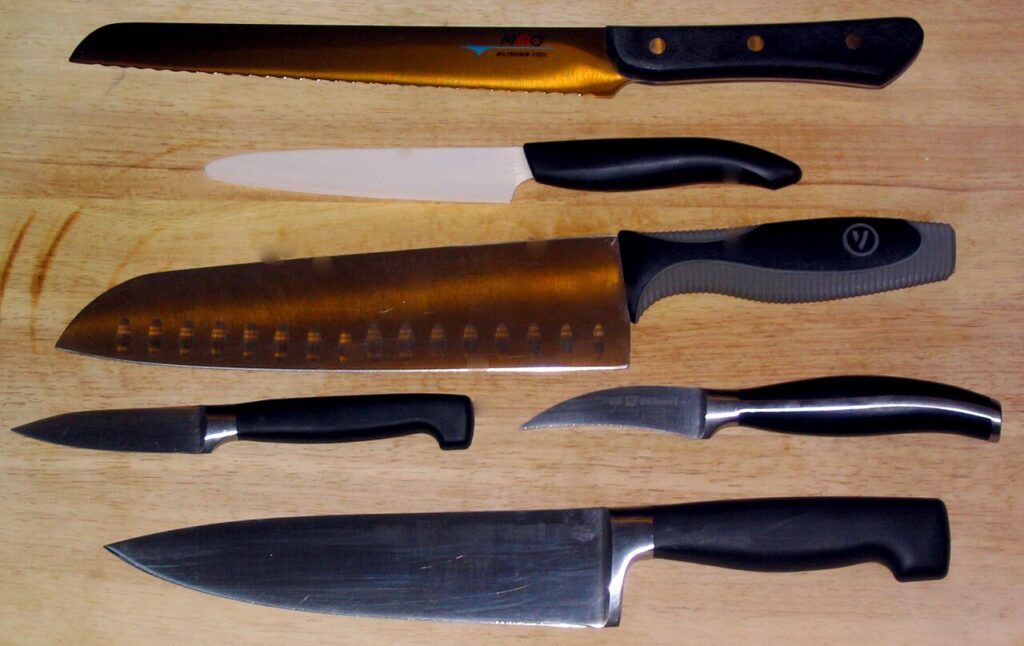
Choose a Japanese knife by the job you repeat, not by the longest list of names. A gyuto or santoku covers mixed everyday prep. A nakiri suits repeated vegetable work; a yanagiba or sujihiki suits particular slicing jobs; a deba, honesuki, or petty answers narrower tasks. Most kitchens need one comfortable generalist before any specialist.
Start with your everyday board knife
If you want one knife for a mixed dinner—vegetables, fruit, herbs, and boneless meat or fish—start by comparing a gyuto and a santoku. Both are intended as all-purpose kitchen knives. A gyuto has a longer chef-knife profile; a santoku is commonly shorter and taller. The right choice depends on board room, cutting style, and the length that feels controlled in your kitchen. Use the detailed gyuto vs santoku comparison rather than treating either name as a quality ranking.
For a first Japanese knife, size, care, and the work already done by other knives matter alongside type. The first-knife guide works through those decisions. This page is a route for when a task or unfamiliar knife name is the question.
Match a specialist to a repeated task
| Work you do | Knife to consider | Why it fits; what to check |
|---|---|---|
| Vegetables most days | Nakiri | A broad, straight profile suits repeated vegetable cuts. Korin lists one nakiri model with a 50:50 bevel; check the exact knife. A nakiri-use guide shows its board motion. The single-bevel usuba is a more specialist practice, not an automatic upgrade. |
| Long slices of boneless fish or meat | Sujihiki or yanagiba | A sujihiki is a long, narrow slicer for boneless portions. A yanagiba is traditionally associated with drawing sashimi slices from boneless fish, as Korin’s style guide describes. Choose for the food and technique, not just the appearance. |
| Preparing whole fish | Deba | A deba is a substantial fish-preparation knife. It is not a general-purpose vegetable cleaver; learn the specific model’s intended use and edge before working near bones. |
| Separating poultry meat from bone | Honesuki | This pointed, stiff poultry knife is for controlled boning work. Do not assume that a boning profile is meant to cut through bones. |
| Small fruit, herbs, or close detail | Petty | A small utility knife is easier to place for detail work than a long board knife. Check whether you prefer to work on the board or hold the food. For a separate Western-style small-knife comparison, see paring vs utility knives. |
These are starting points, not a required collection. If the task is occasional, the knife already in your hand may be enough. Add a specialist when the same job keeps exposing a limitation or when learning its technique is part of what you want to do.
Read the edge and the model, not only the name
Knife-type names describe a family, while the maker’s specifications describe the individual knife. Tojiro’s category list, for example, groups products by types such as gyuto, santoku, nakiri, deba, yanagi, and usuba. Korin’s guide likewise distinguishes general-purpose styles from specialist fish and vegetable knives. A label such as “Japanese knife” alone does not tell you the edge, handedness, weight, or maintenance the particular model requires.
Pay close attention to single-bevel versus double-bevel construction. Bevel is model-specific: Korin lists one nakiri at 50:50. Traditional usuba, yanagiba, and deba patterns often use single-bevel geometry with task-specific sharpening and handedness; Korin’s FAQ describes these patterns and handed versions. Confirm the exact model. The nakiri and usuba comparison shows why two similar outlines can behave differently.
Blade length, height, thickness, grind, handle, and balance also change how a knife feels. The Japanese knife anatomy guide explains those parts. For choosing a size that fits the board and counter, use the gyuto size guide as a concrete example.
A simple shortlist
- Mixed meals, one main knife: compare a gyuto and santoku.
- Vegetable-heavy prep with another knife for tip work: compare a nakiri and santoku.
- One repeated specialist job: choose the relevant fish, poultry, slicing, or detail knife and learn its limits.
- Not sure yet: use a comfortable generalist for a while. Your actual board, meals, and habits will tell you whether a second profile would help.
Japanese knife types are a practical vocabulary, not a ladder to climb. Start with the work, verify the exact knife, and let experience—not the size of a collection—decide what belongs in your kitchen.