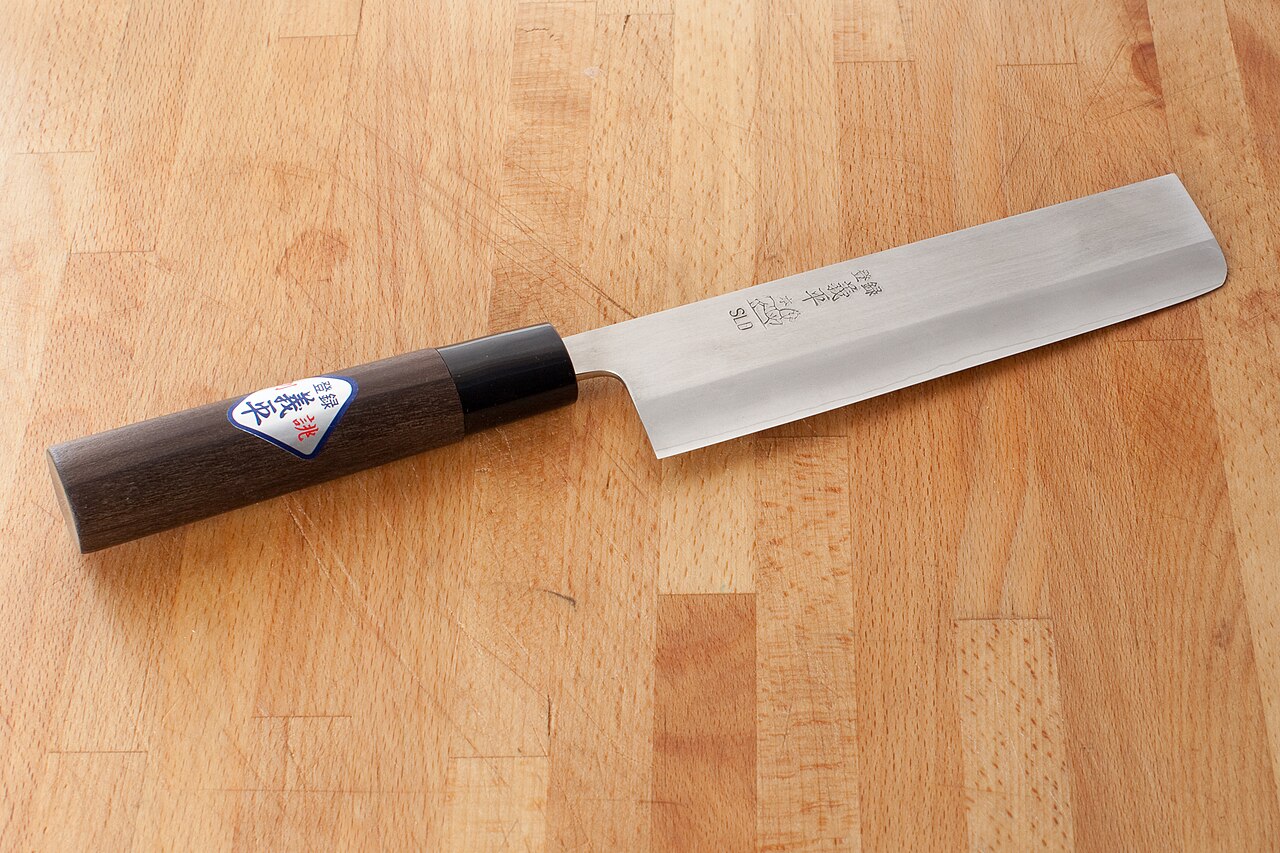
An usuba is a traditional Japanese vegetable knife with a thin, rectangular, single-bevel blade and a straight edge. Its name means “thin blade”. It is made for precise vegetable work, such as katsuramuki, the thin rotary peel of a daikon, and fine strips. There are two main shapes: the square-ended Kanto usuba and the pointed kamagata usuba from Kansai.
Usuba at a glance
Every figure below is as the maker or seller lists it:
| Spec | What the sources list |
|---|---|
| Name | “Thin blade” (Korin) |
| Bevel | Single bevel: “Although it resembles the Nakiri, the Usuba is single bevel” (TOJIRO) |
| Blade length | 150–180mm for home use and 150–210mm for professionals (TOJIRO); 180–210mm at Korin; 150–270mm across Masamoto’s lines |
| Profile | A rectangular blade with a flat cutting edge (Masamoto); a square end on the Kanto usuba, a curved, pointed tip on the kamagata (Korin, Masamoto) |
| Typical use | Peeling vegetables, especially daikon (TOJIRO); thin “katsuramuki” sheets and “sengiri” strips (Masamoto) |
| Region | Kanto (Tokyo) for the square usuba; Kansai (Osaka) for the kamagata (Korin, Masamoto) |
Sources: Korin’s usuba style page; TOJIRO’s knife guide (archived copy); the Masamoto Sohonten catalogue. Lengths vary by maker and line.
Kanto usuba and kamagata usuba
Both shapes do the same core work. The Kanto usuba, which Korin and Masamoto both trace to Tokyo, ends in a square front, so the whole blade is a rectangle. The kamagata usuba, from Osaka, keeps the thin blade but curves down to a point at the front. Korin says that point allows more delicate work and decorative carving, and Masamoto describes it the same way.
Why the single bevel matters
An usuba is ground on one face. Korin explains the thin, very sharp blade as the point of the knife: without it, the edge would break down the cell walls of vegetables, causing ingredients to discolour and lose flavour.
A single bevel also makes the knife handed: a right-handed usuba is made for the right hand, and left-handed versions are made in smaller numbers. Our guide to left-handed Japanese knives explains what to check. Sharpening one face and the back is a different routine from a double-bevel knife; single bevel vs double bevel sets out what changes.
Usuba vs nakiri
A nakiri has a similar rectangular outline but is double bevel, so it works in either hand and suits everyday vegetable chopping. The usuba rewards practised technique in Japanese vegetable cuts. If you are choosing between them, nakiri vs usuba compares bevel, weight and the jobs each suits.
Who it suits
An usuba suits a cook who wants to learn katsuramuki and fine Japanese vegetable cuts, and who will sharpen a single-bevel edge. For general vegetable chopping, a nakiri or santoku covers more of the work. Our guide to Japanese vegetable cutting techniques shows the cuts an usuba is built for.
Handle size for this knife
Our wa handle size guide does not auto-size an usuba. A deba, honesuki, usuba or single-bevel kiritsuke, at any length, is fitted individually by hand by the owner after checkout. You can still order the handle: measurements and photos are optional before buying, and the owner’s individual fitting replaces the automatic size recommendation. The size guide also notes that a D-shape handle gives directional control for single-bevel knives, and that handedness should be checked before sizing. Start in the handle configurator.