Honing maintains an edge you already have; sharpening makes a new one. Shun puts it this way: honing realigns an edge that has begun to roll, while sharpening restores sharpness by removing a small amount of metal. Hone between sharpenings with a honing steel, and sharpen on a stone, plate or abrasive rod when honing no longer brings the edge back.
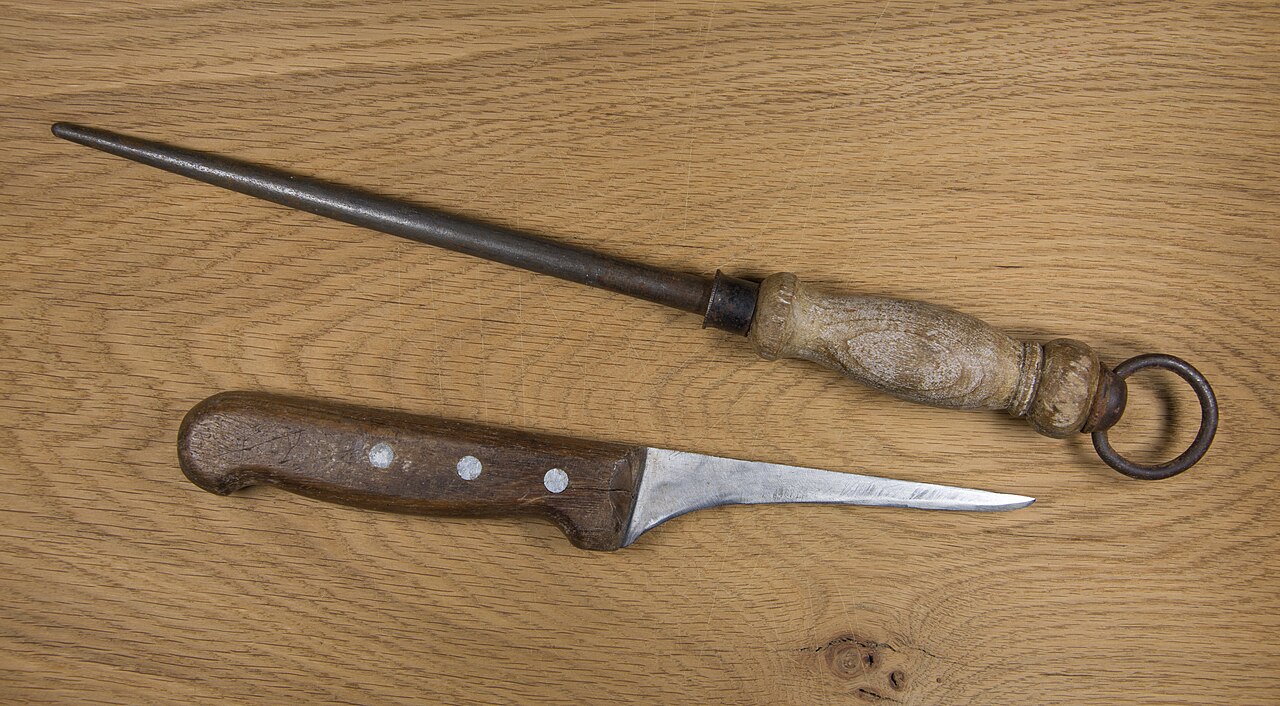
Honing, sharpening and stropping compared
| Job | Usual tool | Removes metal? | When |
|---|---|---|---|
| Honing | Steel honing rod (smooth or ridged) | Makers say no; microscopy suggests a little (see below) | Between sharpenings, when a still-sound edge feels less precise |
| Sharpening with a rod | Ceramic or diamond rod | Yes | Light sharpening, used more sparingly than a steel |
| Sharpening | Whetstone or diamond plate | Yes | When honing no longer restores the edge |
| Stropping | Leather or other strop | Depends on the strop and compound | Finishing after sharpening; see our stropping guide |
What honing does
In use, the very fine edge of a knife can begin to roll slightly out of alignment, so the knife feels less precise even though the edge is still there. Shun says a honing steel straightens that rolled edge, does not create a new edge and does not remove metal. WÜSTHOF describes honing the same way, as realigning the microscopic teeth of the blade, and says a honing steel should be used regularly.
Not everyone agrees on the mechanism. Science of Sharp, which examines edges at microscopic scale, reported that in its tests a ribbed steel did not realign a rolled edge but produced a small micro-bevel by removing metal. Its blades were utility blades dulled on purpose, so it is one tested setup, not a verdict on every steel and knife. The practical advice is the same either way: a steel is maintenance for an edge that is still sound, used with light pressure.
What sharpening does
Sharpening grinds the bevel to form a fresh edge. Shun says to sharpen once honing no longer improves the knife’s performance. A ceramic or diamond rod is a sharpening tool, not a honing steel: WÜSTHOF says diamond and ceramic steels grind material away to reset the edge, and Shun says its ceramic rod takes material off the blade and should be used more sparingly than its honing steel. For a full sharpening, a whetstone gives you the most control; our whetstone guide walks through it, and the sharpening angle guide explains how to hold the bevel.
How to tell which one your knife needs
Start with a simple check from our guide to checking whether a kitchen knife is sharp. If the knife was cutting well recently and has just lost a little bite, honing is the light first step. If it skates on food skins, or honing makes no difference, sharpen. If you can see chips or a broken tip, neither rod is the fix; read how to fix a broken tip or a deep chip.
Japanese knives and honing rods
Hard, thin Japanese edges need more care with a rod. Use one only if your knife maker approves that tool and method; our page on using a honing rod on a Japanese knife covers what Shun and other makers say. Another route is to skip the rod and keep the edge up with a stone and, if you like, a strop, as described in stropping Japanese knives.
What this means for your handle
Honing and sharpening both depend on a steady grip at a constant angle, and a loose or cracked handle makes that harder. If the handle moves on the tang, read loose tang: refit or repair?; if the blade is worth keeping but the handle is not, compare the options in our re-handling cost guide.
Sources: Shun, “Sharpening vs. Honing” (definitions; when to sharpen); Shun FAQ (honing steel versus ceramic rod); WÜSTHOF, Using a Steel (honing realigns; diamond and ceramic steels grind material away); Science of Sharp, “What Does Steeling Do? Part 1” (micro-bevel and metal removal in one tested setup).