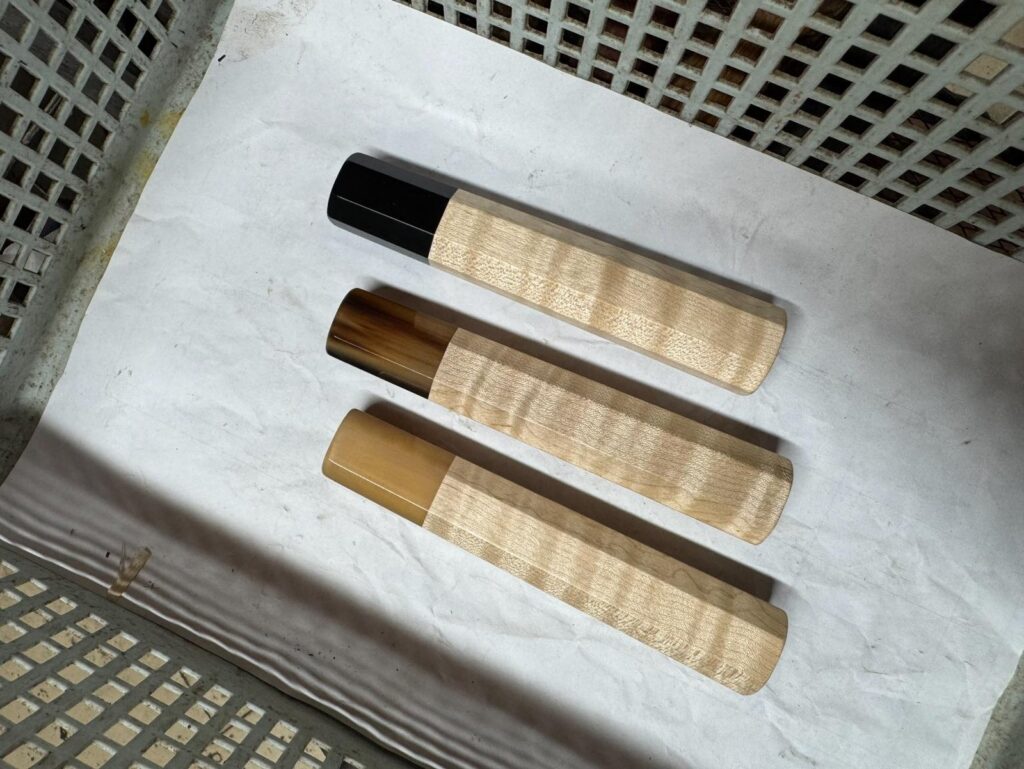
Replacing a Japanese knife handle has three routes: compatible routine care for a structurally sound handle, a stock replacement whose price varies by seller, or a made-to-order re-handle. A made-to-order hardwood handle from our catalogue costs $55–$177. DIY fitting may be reasonable when the attachment, fit, condition, tools and required skill are understood; otherwise, knife shops and sharpening services commonly charge $25–$75 for specialist installation. Assessment of the handle, junction and fit decides which route is appropriate.
What are the symptoms actually telling you?
A tired-looking handle is not necessarily a dead handle. Before buying anything, separate a care problem from a structural problem.
Loose requires assessment when the handle moves against the blade or the gap at the junction changes. A dry-looking finish is a different issue and does not explain movement. Set the knife aside, keep it dry and guarded, and let the assessment determine whether the assembly needs no structural work, a controlled repair or re-handling.
Cracked cannot be given a safe verdict from its apparent size or location. A surface or finish line must be distinguished from an opening, split ferrule or changed blade-to-handle fit; a photograph cannot show the full depth. Keep the knife out of use until that assessment determines the appropriate response.
Smelly is not an automatic replacement verdict. A persistent sour odour takes the handle out of routine finish-maintenance territory. Keep it dry and have the handle and fit assessed before adding oil, glue or another finish; the outcome determines whether care, repair or re-handling is appropriate.
Just ugly is also a real symptom—though not a failure. A sound stock handle may simply feel visually wrong for a blade you value. “Fine, but wrong for this knife” is a legitimate reason to consider re-handling, not vanity and not an emergency.
Once the structural question has been resolved, use the wa handle care guide for routine cleaning, drying and finish maintenance. Oil only a clean, dry, stable handle whose known finish is meant to receive it, following the maker’s guidance. It cannot secure a loose tang, close a crack or remedy a wet joint.
What do the three paths honestly cost?
The first path is routine care. When assessment finds a structurally stable handle and a known finish, routine cleaning, drying and compatible finish maintenance may avoid buying a replacement handle. If the maker says that finish does not need oil, leave it alone; oil is not a structural remedy or a treatment for persistent odour.
The second path is like-for-like stock replacement. It can suit a straightforward replacement when assessment supports retiring the current handle. Prices vary by seller, material and construction, so this article does not assign stock handles a single market number. A stock handle is made before your particular knife is known, and final fitting is still likely to be required.
The third path is a made-to-order re-handle. Our catalogue hardwood handles cost $55–$177. Fitting is separate: DIY may be reasonable when the attachment, fit, tang and handle condition, suitable tools and required skill are understood; otherwise, budget for professional installation. Specialist knife shops and sharpening services commonly charge $25–$75 for that work; this is a general market range, not a Horn & Grain installation price.
We sell the handle and do not offer installation. Whether re-handling makes economic sense depends on the full cost of the handle and fitting, the knife’s condition, and what the owner values about keeping it. It is not automatic: a stable handle may need only compatible care, while a stock replacement may meet the need.
What does fitting a Japanese knife handle actually involve?
The most important fact is also the one that removes much of the mystery: wa handles are not standardised. There is no universal tang size that lets every handle slide perfectly onto every knife.
For that reason, a handle socket commonly arrives cut slightly small. Enlarging the socket and filing it to fit the particular tang is the normal fitting path, not evidence of a faulty handle. The relevant reference point is the machi, the notch where the blade stops and the tang begins.
At Horn & Grain, every knife is reviewed before work starts. Measurements and photos are optional before buying and can be added or corrected on the order page until bench work starts. That evidence provides a starting point, but it does not eliminate careful final fitting to the actual tang.
Burn-in fitting also exists and can be appropriate for some knives and installations. It should not be understood as simply heating the tang and forcing it home. Heat, socket preparation and controlled fitting have to work together; heat-only fitting is not the whole method.
Should you fit it yourself or use a professional?
DIY fitting may be reasonable only when the knife, tang and handle condition, attachment method and proposed fit are understood, and the fitter has suitable tools and skill. If the attachment, compatibility or geometry is uncertain, use a skilled installer. The complete sequence belongs in our guide to how to reshaft a knife, so we will not compress it into a risky miniature tutorial here.
Professional fitting is equally sensible. Specialist knife shops and sharpening services commonly charge $25–$75 for installation. A valuable blade, a lack of suitable tools, or simply no appetite for the job all make paying a professional the right call. Choosing professional fitting is not admitting defeat; it is choosing where you want the responsibility to sit.
If the installation is the only part making you hesitate, include that cost honestly when comparing the paths. A handle that looks affordable but leaves you anxious about fitting is not yet the full decision.
If fit is part of the decision, compare the wa-handle size guide by knife type and blade length. The tang measurement guide covers the three primary fit measurements in millimetres when the tang is already exposed; you can leave a secure handle installed.
What changes when you go made-to-order?
A stock replacement begins with an existing handle and asks the knife to meet it. A made-to-order handle adds choices without making measurements or photos before purchase a condition. For an eligible knife type, a deliberately small starter socket is also available and is filed to fit the actual tang. Because no universal wa tang standard exists, careful final fitting is still required.
Made-to-order also turns wood, shape and size into choices rather than accidents of whatever replacement happens to be available. Those choices may support the look or handling direction you hope for, but no new handle can promise a particular balance, feel or performance outcome before it is fitted to the real knife.
This is where a knife you already like can become more distinctly yours—without pretending that every damaged handle needs an upgrade. Maintain a structurally sound handle according to the guidance for its known finish. Choose stock when assessment supports a straightforward replacement. When re-handling is appropriate and you want to choose what comes next, begin with the configurator.