Choose by length and tip. A bunka is a compact all-rounder with an angled K-tip; a gyuto is the longer chef’s knife with a conventional point. In one maker’s line sold by Knifewear, the 170mm bunka and the 210mm gyuto share the same height, thickness, steel, bevel and handle, so the real differences are 40mm of edge and the shape of the front. Pick the gyuto if your board has room and you often slice large produce or meat; pick the bunka if you want a shorter knife with a fine point for close work.
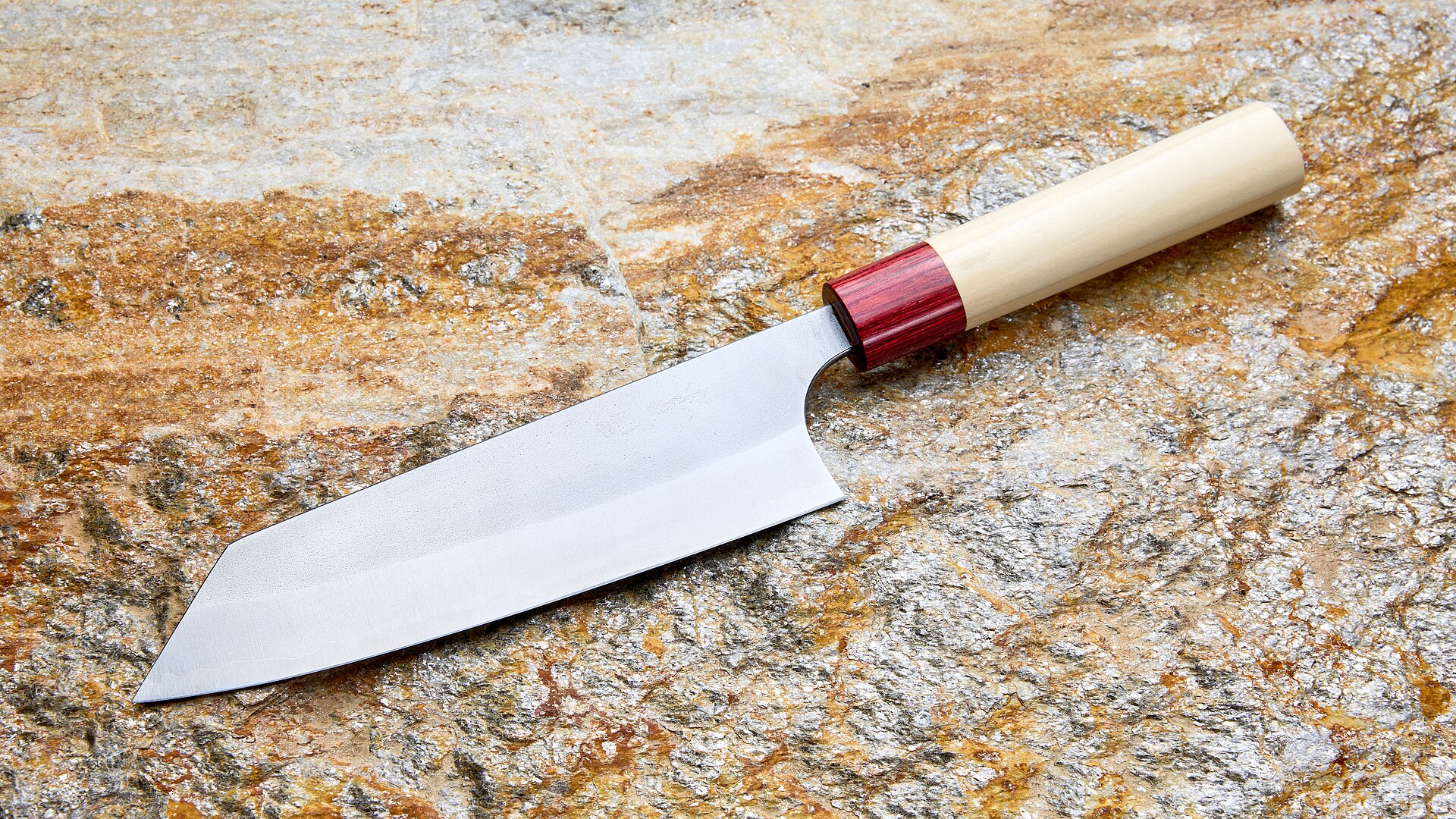
Bunka vs gyuto at a glance
The same blacksmith’s line in both shapes, with every figure as Knifewear lists it:
| Masakage Yuki Bunka | Masakage Yuki Gyuto | |
|---|---|---|
| Blade length | 170mm | 210mm (also 240mm) |
| Blade height | 47.5mm | 47mm |
| Thickness | 2.7mm | 2.7mm |
| Weight | 131g | 145g |
| Edge | Double (50/50) | Double (50/50) |
| Steel | Shirogami #2 with stainless cladding, HRC 62–63 | Shirogami #2 with stainless cladding, HRC 62–63 |
| Handle | Oval magnolia wa handle, red pakkawood collar | Oval magnolia wa handle, red pakkawood collar |
| Tip | Angled K-tip | Conventional chef’s-knife point |
| How Knifewear describes it | “A cross between the Nakiri and Gyuto”, a multi-purpose knife “akin to the Santoku” | “Inspired by the profile of a traditional European chef knife”, with “a slight meat cutting bias” |
| Who it suits | A small board, compact prep and point work | One knife for mixed cooking with room to slice |
Sources: Knifewear, Masakage Yuki Bunka 170mm and Masakage Yuki Gyuto 210mm. Knifewear notes that handmade Japanese knives vary in their dimensions and that its measurements are only an example.
What 40mm and a K-tip change
Length. Knifewear says gyuto start at 180mm and can reach 370mm, and it recommends 210–270mm for home or professional cooks. The extra edge lets a gyuto pass through a cabbage, a squash or a roast in fewer strokes. The cost is board space: a longer knife needs room in front of the food. If you are deciding between 210 and 240, see what size gyuto. For a roast whose grain changes direction partway through, see how to slice tri-tip.
Tip. Wikipedia’s Japanese kitchen knife article describes the bunka as a variant of the santoku with a more angular, straight tip instead of a curved sheep’s-foot tip. That fine, low point helps with scoring, trimming and starting a precise cut, but it needs protecting from tip-first drops and prying. Our bunka vs santoku guide covers that trade in detail.
Weight. In this pair the gyuto is only 14g heavier. Length, not mass, is what you will notice first.
If you like the angled tip but want gyuto length, there is a third option: a K-tip gyuto, a double-bevel gyuto with the same angular front. Kiritsuke, explained separates it from the traditional single-bevel kiritsuke.
Which to buy first
For one knife to cover everything, start with a 210mm gyuto if your board and counter have room for it. Start with a bunka if your board is small, most of your prep is compact vegetables and boneless protein, and you will use the point. If you already own a gyuto, a bunka is a useful shorter second knife. If you already own a santoku, a bunka mostly changes the tip, not the job.
Handle size for this knife
On our wa handle size guide, a bunka of 150–200mm takes the Mid-size · santoku, bunka, nakiri size, with a starting handle length of about 115–125mm. A gyuto from 196 to 255mm takes Chef · gyuto, kiritsuke, at about 125–135mm; a gyuto of about 180mm rides with the Mid-size tier, and a double-bevel kiritsuke uses the same bands as a gyuto. On our product pages you enter the knife type and blade length and the size recommender picks the tier. Then build it in the handle configurator, choosing wood, ferrule, end cap, shape and size.