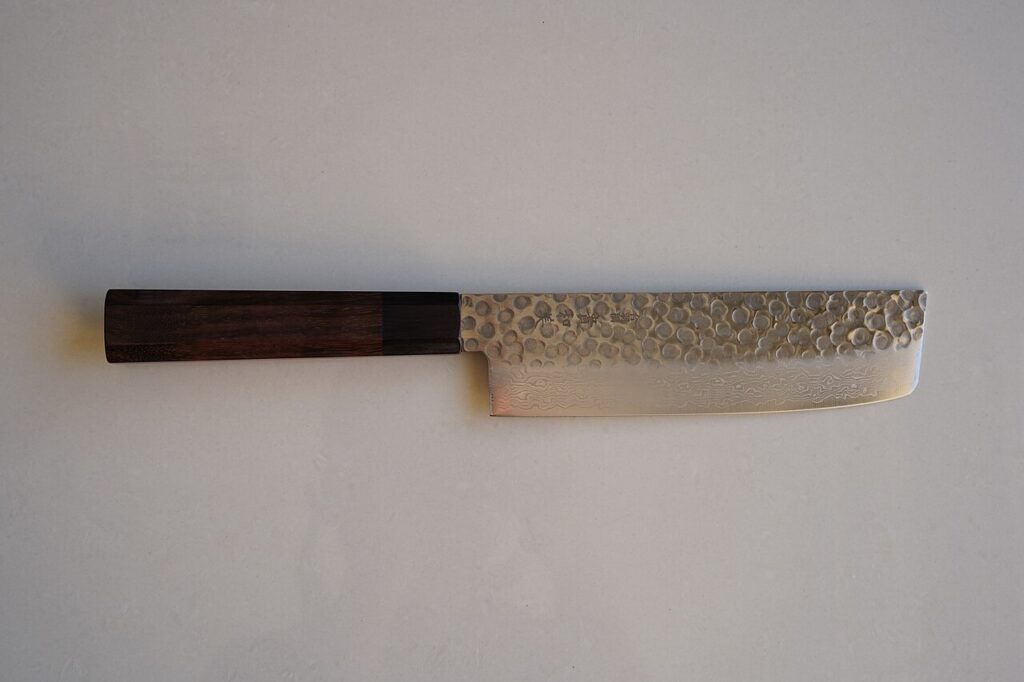
A nakiri is a Japanese vegetable knife with a broad, straight edge. Use it for repeated, controlled board cuts: set the food on a stable board, guide it with curled fingertips, move the blade down and slightly forward as needed, then lift before resetting. Its straight edge rewards complete contact with the board; it is not a cleaver and is not meant for bones or prying. For cabbage-specific setup and shred, slice or wedge cuts, see our cabbage cutting guide.
What a nakiri is built to do
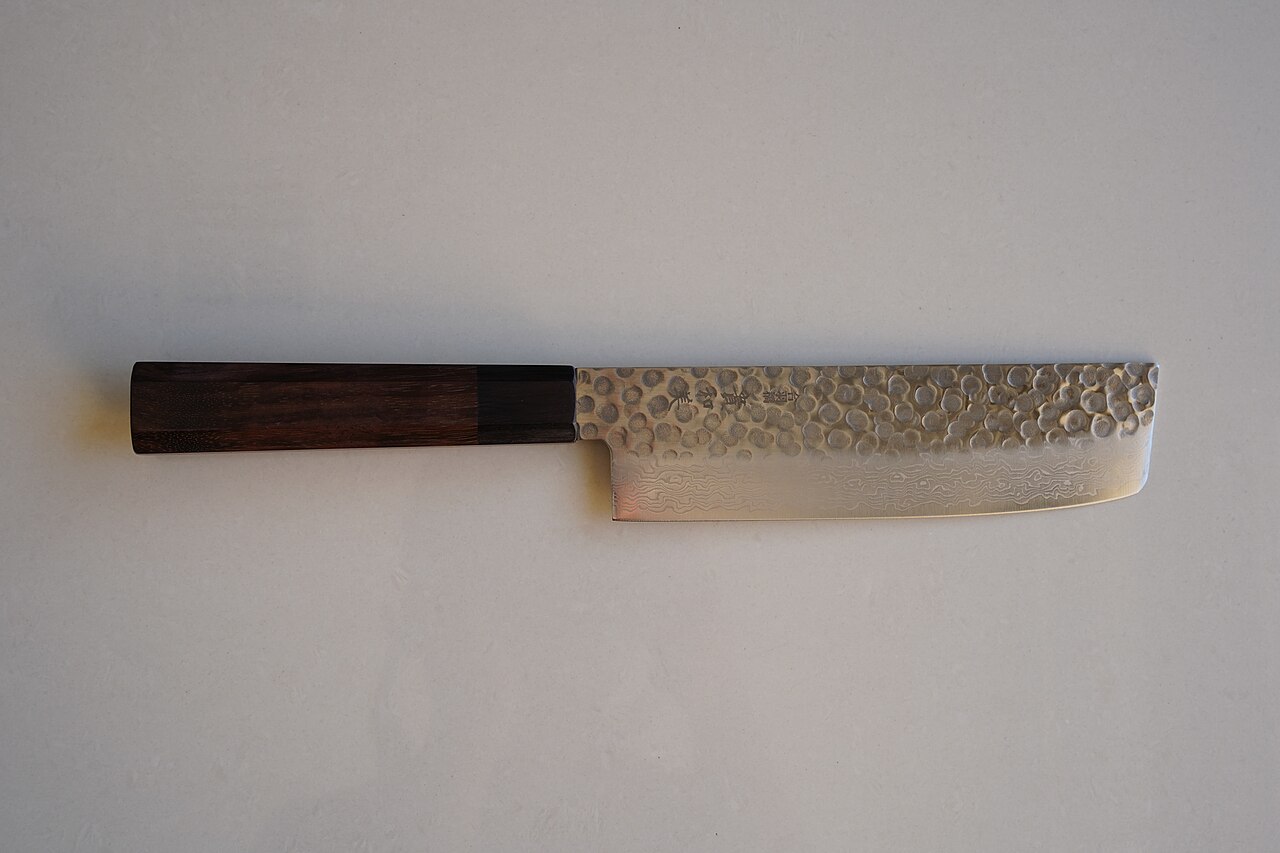
The nakiri’s squared outline and long, relatively flat edge suit vegetable preparation. Korin describes the nakiri as a vegetable chopper with a straight profile that makes broad contact with the board; Korin lists one VG10 Damascus nakiri with a 50:50 bevel. Check the exact knife you own, because edge geometry varies by model. This ordinary nakiri is different from the single-bevel usuba, even though the shapes look related. The nakiri vs usuba guide explains that choice.
The broad, flat side of the blade can serve as a visual reference beside the curled knuckles of your guiding hand. Keep fingertips curled back and the thumb tucked behind them; the blade should pass beside the knuckles, never across fingertips. The missing point is a real limit: a nakiri is less handy than a gyuto, santoku, or petty for trimming around small objects, peeling in the hand, or other precise tip work. For choosing between a vegetable specialist and an all-purpose blade, see santoku vs nakiri.
Set up before you cut
- Stabilize the board. Put it on a dry, level counter. If it slides, secure it before bringing the knife to the food.
- Make a steady base. Trim or split a round ingredient as needed so it cannot roll. Keep the piece a comfortable size; you do not need to force a whole large vegetable under the blade.
- Guide with curled fingertips. Rest the guiding hand’s fingertips against the food with the tips tucked back. Keep the blade beside the knuckles, and move the hand back only after the knife has cleared the cut.
Use light, deliberate pressure. If the food or board shifts, pause and reset it. A sharp knife should do the work; pushing harder is not a substitute for stable contact.
Make the cut, then reset
Place the section of edge over the food, lower it through the ingredient, and let the straight edge finish at the board. A small forward travel can help the edge move through a firm vegetable. Then lift the knife clear, move it to the next position, and repeat. The key is a controlled, repeatable path rather than a large swing. Leeks need a separate grit-removal step before cooking; see our guide to cleaning and cutting leeks.
A short practice with cucumber and carrot
Halve a cucumber lengthwise and place one half cut-side down so it cannot roll. With the guiding fingertips curled and thumb tucked behind them, make four or five even slices using the same small down-and-slightly-forward stroke. Let the blade reach the board, lift it clear, then move the guiding hand back before the next cut. Pause and compare the slices; aim for a steady path, not speed. Next, place a short carrot section on a freshly cut flat face and repeat the controlled stroke. If the blade binds, stop and reset the food; do not push harder or twist the knife.
A nakiri’s flat profile is a poor match for continuous rocking: much of the edge is straight, so rocking can leave part of the cut unfinished or make the blade feel awkward. Keep the blade path simple and use the whole edge where the food allows. For named Japanese vegetable shapes—rounds, strips, wedges, and angled chunks—the separate Japanese vegetable-cutting guide explains the preparation sequences. The knife guide here is about the blade’s movement and limits.
Where the nakiri fits—and where it does not
| Task | How to use the knife | When another knife fits better |
|---|---|---|
| Repeated vegetable prep | Use straight, controlled cuts and let the edge meet the board. | A nakiri is a good fit when vegetables are a frequent, distinct job. |
| Mixed meal prep with trimming | A nakiri can prepare vegetables, but it has no pointed tip. | A gyuto or santoku may be the more useful one-knife choice. |
| Peeling or small hand-held detail work | Keep the nakiri on the board rather than using it like a paring knife. | A small petty knife is easier to control for this work. |
| Bones, frozen food, or prying | Do not twist, lever, or strike hard material with the edge. | Choose a tool designed for the task; a nakiri is a vegetable knife, not a cleaver. |
Read the result before adding force
If a slice remains attached at one end, pause and check whether the edge completed its travel to the board. If a dense vegetable wedges, do not twist the blade. Stop the cutting motion, keep your fingers clear, and do not twist or lever the wedged blade. Follow the separate vegetable-wedging troubleshooting guide before continuing. The crooked-cuts guide covers the other common result.
After prep, wash and dry the knife promptly, then store it so the edge cannot knock against other tools. A nakiri is useful because it makes a recurring job feel straightforward; it does not need a special ritual beyond sound knife care.