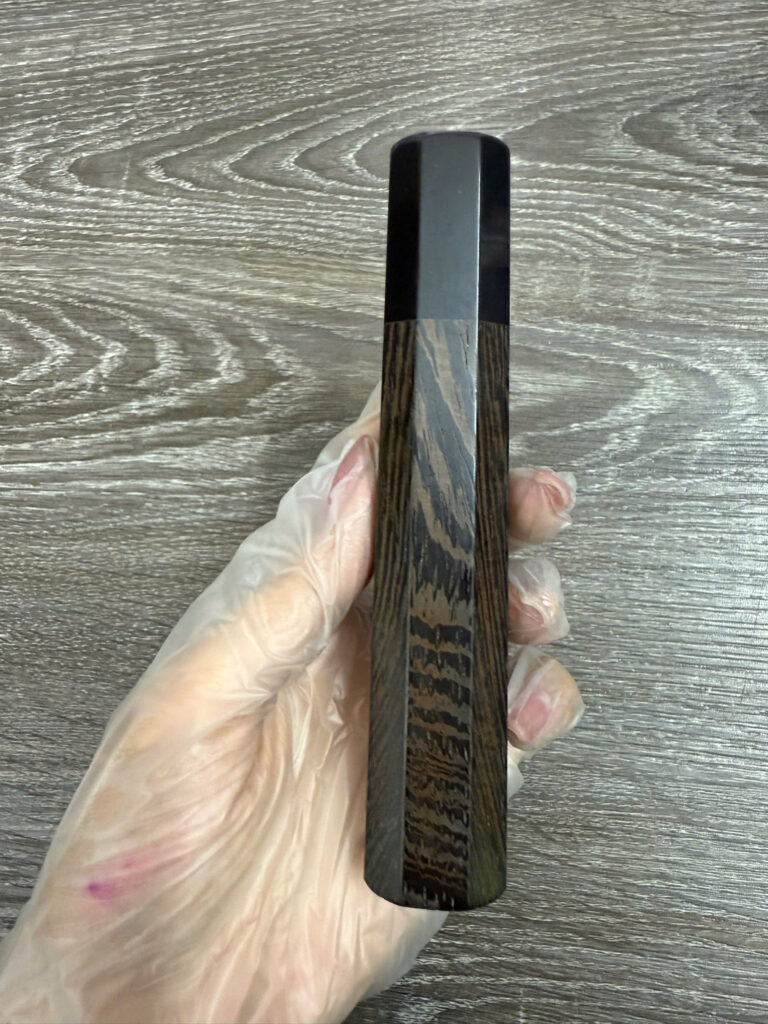
For a gyuto (Japanese chef’s knife), santoku (general-purpose knife) or bunka (angular-tipped multipurpose knife), pinch the blade between your thumb and index finger just ahead of the ferrule, then let the other fingers wrap the handle loosely. A yanagiba (long single-bevel fish slicer) uses the index finger along the spine; a deba (substantial single-bevel fish butchery knife) takes a fuller handle grip. A wa handle changes where the pinch lands and how its facets sit under your fingers, not the basic grip. Grips vary by knife and by training; there is no single correct Japanese grip. For a clear onion dicing sequence with the root held until the final cuts, see our onion dicing guide.
Where the ferrule sits under your fingers
Pick up the knife by its handle with the edge facing down. Slide your hand forward until your thumb and index finger can meet the sides of the blade. Their pads should sit on the blade just ahead of the handle, while your middle finger curls around the handle and meets the ferrule.
This is the main landmark on a wa-handled knife. There is no bolster filling the space between blade and handle, so the pinch does not land on a thick metal junction. It lands on the blade immediately in front of the ferrule.
The anatomy of a Japanese knife identifies the ferrule as the front section of the handle and the machi as the blade-to-tang transition beneath it. In the grip, the ferrule gives your middle finger a finished surface at that transition. A well-finished ferrule lets the blade, ferrule and handle meet without that junction feeling abrupt under the hand.
Keep the roles of the fingers distinct. The thumb and index finger control the blade. The middle finger meets the ferrule, while the ring and little fingers curl around the handle. They should hold the knife securely without turning the whole hand into a tight fist.
Pinch grip or handle grip?
The pinch grip suits double-bevel all-rounders such as the gyuto, santoku and bunka because it places two fingers directly on the blade. That direct contact makes it easier to guide the knife during ordinary chopping, slicing and fine preparation.
Let the remaining fingers settle around the handle naturally. The pinch is an opposing contact between thumb and finger, not a command to squeeze as hard as possible.
A handle grip keeps the fingers behind the ferrule and places more of the handle inside the hand. It can be the better choice when the task calls for more weight or reach rather than fine control near the blade.
Neither grip is automatically right or wrong. A cook may change grips when changing knives, ingredients or cutting motions. Grips vary by knife and training, so the useful question is not whether one grip is universally correct, but whether your hand position suits the knife and the cut in front of you.
How a yanagiba and a deba are held
The familiar pinch grip is not the default for every Japanese knife. The opening chapter on posture and grip in the Japanese Culinary Academy’s Mukoita I, Cutting Techniques: Fish describes distinct grips for fish preparation.
For a yanagiba, the index finger can lie along the spine instead of pinching the side of the blade. This is often called the point grip. The finger points in the same direction as the knife during the yanagiba’s long pulling cut, while the other fingers remain around the handle.
A deba uses a fuller grip around the handle. Its fish-butchery work calls for the knife’s weight to be managed through the whole hand, so the index finger stays with the other fingers rather than extending along the spine.
These grip differences belong to the knives and their tasks. The blade construction behind them is covered separately in single bevel vs double bevel. For holding purposes, remember the practical distinction: pinch a double-bevel all-rounder, point the index finger along a yanagiba, and take a fuller handle grip on a deba.
Does an octagonal, oval or D-shaped handle change the grip?
Handle shape changes what the wrapped fingers feel, but it does not replace the grip chosen for the knife. In a pinch grip, the thumb and index finger still contact the blade ahead of the ferrule. The shape is felt mainly by the middle, ring and little fingers around the handle.
Octagonal facets act as orientation cues. Their flat surfaces and edges help the fingers settle into the same position each time the knife is picked up. An oval handle has no facets, so the hand can rotate around it more freely. A D-shape favours one hand.
Those are differences in how the handle registers under the fingers, not different cutting techniques. The fuller shape discussion belongs in octagonal vs oval wa handles. When trying a grip, notice where the facets or curves meet your curled fingers while keeping the blade pinch in the same place.
What the guiding hand does
The knife hand controls the blade, but the other hand sets the slice. Form a claw with the guiding hand: tuck the fingertips toward the ingredient, keep the knuckles forward and draw the thumb back behind the fingers.
The forward knuckles become a fence. Bring the flat face of the blade against that fence, then let it ride alongside the knuckles as the knife moves. The guiding hand determines where the next slice begins; the knife hand keeps the edge vertical and carries out the cutting motion.
A santoku’s tall blade makes this relationship easy to see. So does a nakiri, a rectangular vegetable knife, because its tall, flat face presents a broad surface beside the knuckles. The blade face needs only light contact with the guiding hand. The knuckles provide a reference rather than pushing the knife sideways.
Move the guiding hand only after the blade has cleared the food. Re-form the claw, set the next position and make the next cut. Start slowly enough to see the separate jobs: the guiding hand advances the ingredient and sets the slice, while the knife hand maintains the blade’s path.
Does hand size change the grip?
Hand size does not change the basic placement. The pinch still belongs on the blade just ahead of the ferrule, the middle finger still meets the ferrule, and the remaining fingers still wrap the handle. A yanagiba still takes its point grip, and a deba still takes its fuller handle grip.
What can change is how completely the fingers curl around the handle and how much room they have along it. Those are questions of handle length and cross-section rather than reasons to invent a different grip. The wa handle size guide covers that sizing question without changing the technique described here.
When you pick up a wa-handled knife, use the ferrule as your reference point. Choose the grip for the knife and the task, let the handle shape guide where the wrapped fingers settle, and give the other hand responsibility for setting each slice.