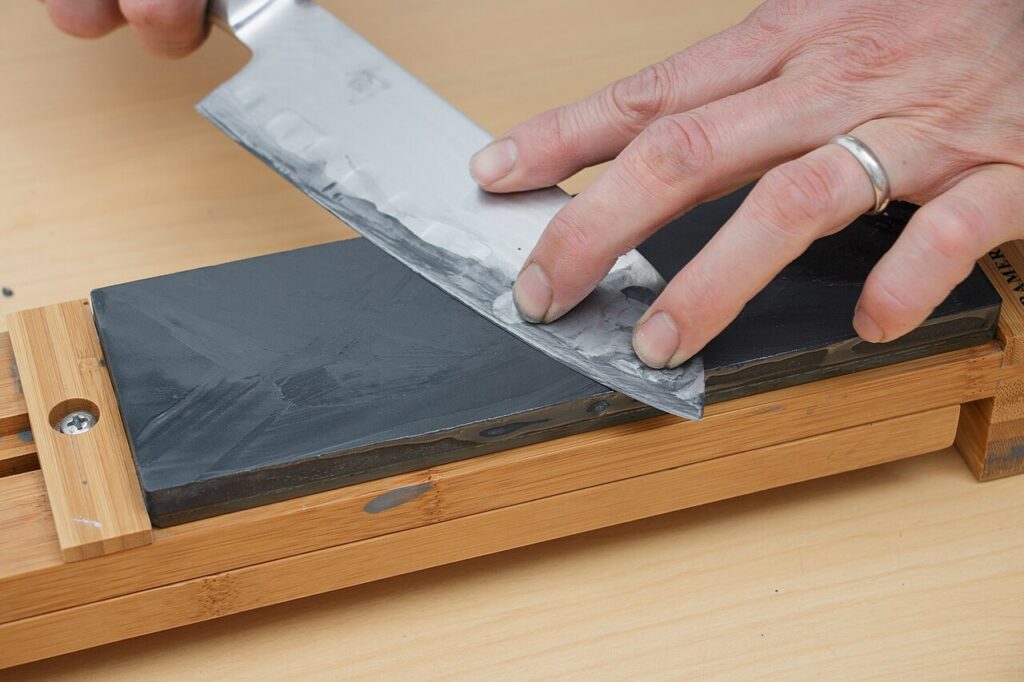
To flatten a whetstone, mark its face with a pencil grid and lap it on a flat, compatible flattening tool. Work across the face until the grid wears away evenly, then rinse. Match the water preparation and lapping method to your stone and tool.
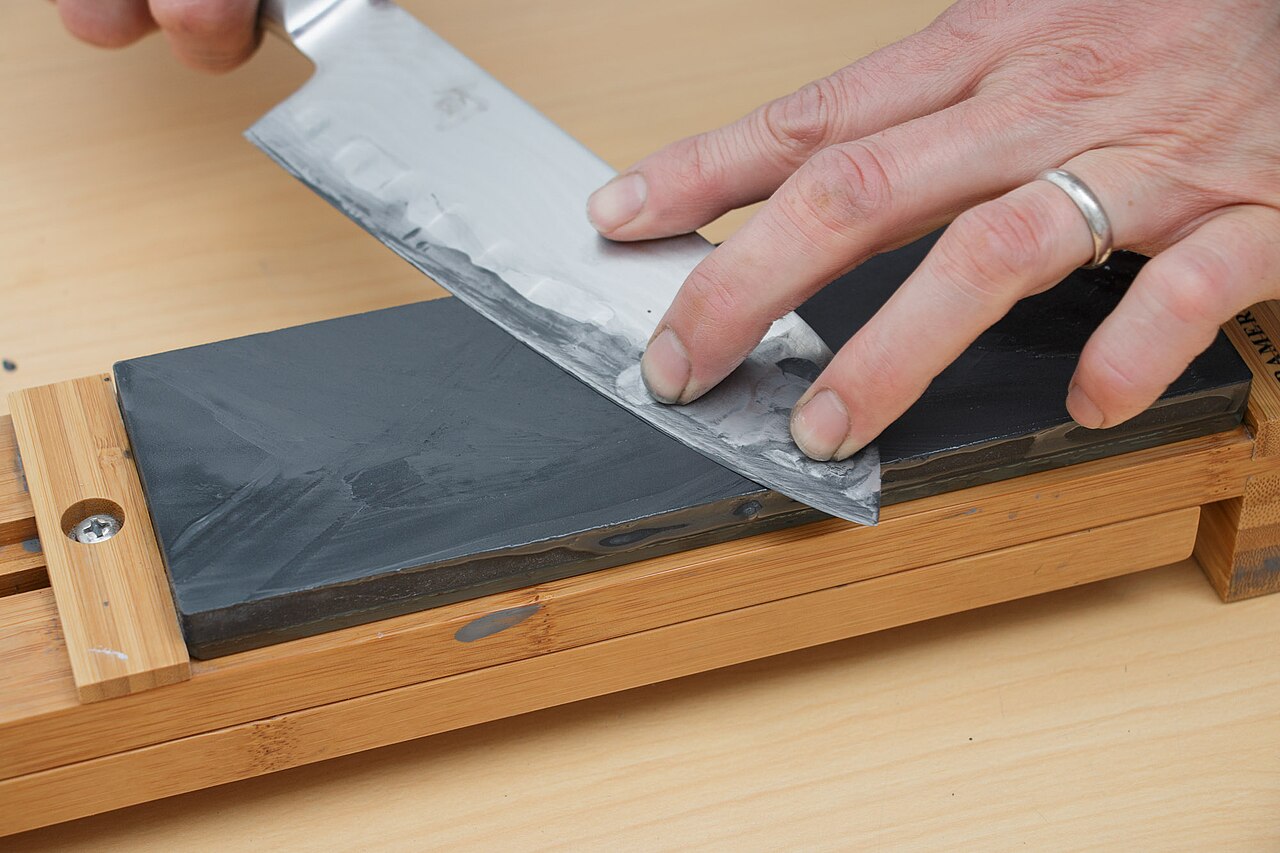
- Draw a loose pencil grid across the stone face.
- Lap it on a compatible, stable surface using the maker’s water and movement instructions.
- Refresh the grid to check contact across the face; rinse away slurry as directed.
We sell handles—not knives, stones, plates, grit or sharpening services—so we have nothing to sell you for this job; you may not need to buy anything.
Why a Whetstone Dishes in the Centre
Sharpening does not wear the whole stone equally. The knife crosses the middle during almost every pass, while the ends see the blade mainly as it enters or leaves the working area. Repeated abrasion removes more material from that busy central path, gradually leaving the face concave.
A second stone maker’s published how-to distinguishes soaking stones from splash-and-go stones in its handling guidance. Soft soaking stones release abrasive readily, making mud or slurry and losing shape quickly. Hard splash-and-go stones shed material more slowly and may pass repeated grid checks, but still dish. The relevant distinction is wear rate, not whether flattening will ever be necessary. Choosing which stones and grits belong in a sharpening setup is covered separately in the whetstone grit guide.
A slight hollow does not ruin a knife, but it makes repeatability harder. As the blade travels into and out of the hollow, its relationship to the abrasive surface changes, making a consistent angle impossible; angle control belongs in the sharpening angle guide.
Wide-bevel and single-bevel work exposes the problem most clearly. A broad, nominally flat face cannot register evenly against a concave stone, so some areas make contact while others bridge the hollow. This is a consequence of the stone’s shape, not a reason to change sharpening technique.
Check, lap, then verify
Check the instructions for the exact stone and lapping tool before starting; compatibility, water preparation and movement are product-specific. For example, SHAPTON directs DGLP users to place the plate on a stable surface, wet it, then move the stone forward and back and diagonally across the whole plate. Rinse slurry from the grooves as it builds up, and rinse the plate after lapping. Follow another tool’s prescribed method if its instructions differ.
Remaining pencil marks show areas the lapping surface has not yet contacted. Recheck with a fresh grid after another pass. When marks disappear across the face, the grid indicates contact across that surface; it does not certify a precise flatness tolerance.
Timing is maker-specific. SHAPTON recommends lapping its stones whenever a blade is to be sharpened; that is a recommendation for its own stones, not a universal schedule. Use your stone maker’s guidance.
Flattening Plates, Loose Grit and Sandpaper
These methods suit different circumstances rather than forming a ranking.
A flattening plate or dedicated flattening stone offers a straightforward working surface. Secure it so it cannot slide, add water as directed and move the whetstone over the whole abrasive face. Use even pressure and change direction or orientation periodically. A flattening stone performs the same job, but it is itself a wearing abrasive and must be checked for flatness.
Loose silicon-carbide grit and water on a genuinely flat slab is the traditional inexpensive route. Sprinkle grit onto the wetted slab, work the whetstone across the slurry and redistribute the mixture if it gathers in one area. Fresh loose particles cut the high spots while the slab supplies the flat reference. A Sakai cutlery association’s FAQ describes this method using carborundum and water on a concrete block, and likewise advises correcting the stone little and often. The essential feature is not concrete specifically, but a clean, stable surface that is actually flat.
Do not assume abrasive paper is safe for every stone. SHAPTON’s FAQ says abrasive paper can clog its stones and make a blade slip, so use paper only when the exact stone maker approves it. Compatibility applies to lapping tools too: SHAPTON’s Diamond Glass Lapping Plate guide scopes that plate to fine stones at 500 grit or finer and says its plates must not be used on electroplated diamond sharpening stones. Check the exact stone-and-tool instructions before lapping.
Whichever method is used, rinse the whetstone thoroughly afterward. Loose abrasive and coarse slurry left on the face can contaminate the next sharpening session.
The Flattening Tool Also Wears
A flattening stone can hollow for the same reason a sharpening stone does: repeated work concentrates wear in part of its surface. Give it its own pencil-grid check. A curved flattening stone cannot reliably produce a flat whetstone, no matter how carefully it is used.
A diamond flattening plate behaves differently. Its rigid backing does not hollow through ordinary abrasive wear, but its exposed diamonds dull with use. Slower cutting may mean the plate is losing effectiveness, not that it has become curved.
Loose grit on a sound slab avoids a second wearing stone. The grit is renewed, while the slab wears slowly enough to remain a useful reference surface. This is a simple flat-reference arrangement, provided the slab begins flat and grit is not allowed to collect beneath it.
Chamfer the Edges After Flattening
After flattening, lightly rub each crisp corner against the plate or slab to make a small chamfer. This reduces the chance of nicking the blade or crumbling into the working face. Do not round over a broad strip, and rinse away the particles.
Which Stones Never Need Flattening?
A sound diamond sharpening plate is the exception: its abrasive surface does not dish like a bonded whetstone, so it does not need flattening. It can clog, wear or lose cutting speed, but those are cleaning or replacement issues rather than a hollow that can be lapped away.
Every conventional abrasive stone should be checked on its own clock. A soft stone may fail the pencil-grid test after one session; a hard stone may pass repeatedly. Neither result creates a schedule for the next check. Mark it, take a few passes and let the grid answer.
Flattening is wet and gritty, and slurry gets on the handle—so we recommend wiping and drying it too; the wa handle care guide covers the rest.