For a vegetable-heavy kitchen, choose based on what the knife must do besides vegetables. Santoku and nakiri look like siblings and favor the same push-cutting stroke, so the choice is less about which blade cuts a carrot and more about whether it must also handle proteins and tip work. If you want one knife for most tasks, choose a santoku. If vegetables genuinely are the job and another knife covers the rest, choose a nakiri. It is the better vegetable knife: when the task is narrow enough, a specialist beats a generalist at its own work. For a practical sweet potato prep sequence, see our guide to wedges, sticks and cubes.
What are a santoku and a nakiri?
Set them side by side and the family resemblance is obvious. Both are compact Japanese kitchen knives, typically around 165–180 mm long. Both have relatively flat edge profiles that suit push-cutting, where the knife travels down and slightly forward rather than rocking continuously on its belly.
The santoku is the generalist. Its edge is fairly flat through much of the blade, but it usually rises in a gentle curve toward a defined tip. That tip matters. It can trim around an onion, remove a strawberry top, separate small pieces of meat, or make a controlled entry into fish or boneless protein. The curved front also gives a little more freedom when a cut is not perfectly vertical.
The nakiri is the vegetable specialist. Its blade is rectangular, with no pointed tip, and its long, flat edge is intended to meet the board along its whole length. That shape is built around repeated, complete cuts through vegetables. The squared-off outline may look substantial, but a nakiri is not a cleaver and is not intended for bones. For a comparison with a Chinese vegetable cleaver, see Chuka bocho vs Nakiri. For a practical task guide, see how to use a nakiri.
Both are normally double-bevel knives; the single-bevel Japanese vegetable knife is the usuba, which is a different commitment—see single vs double bevel. For a choice between nakiri and usuba, compare their cutting tasks, handedness and sharpening demands in our nakiri vs usuba guide.
The easiest distinction is therefore not “vegetable knife versus non-vegetable knife.” Both cut vegetables very well. It is “vegetable-capable generalist versus dedicated vegetable specialist.”
How do they feel at the board?
With ordinary vegetable prep, they can feel remarkably similar. Put either blade over a courgette, carrot, leek, or potato and a clean push cut feels natural. The relatively flat edge makes full contact with the board without demanding a pronounced rocking motion. For cooks who dislike the curved profile of many Western chef’s knives, both can feel direct and settled.
The difference becomes clearer at the ends of the blade.
On a santoku, the tip behaves like a small, precise tool within the larger knife. It can start an incision, reach into a tight spot, trim a blemish, or make short detail cuts without changing knives. When slicing boneless meat or fish, the tip and gentle curve also allow the blade to travel through the food more naturally. These are small advantages in any single cut, but they add up during mixed preparation.
A nakiri gives up that tip in exchange for certainty across the full edge. When cutting a pile of leafy greens, a row of spring onions, or tall produce such as an aubergine or cabbage section, the blade arrives at the board together. There is less chance of the rear of the cut finishing while a thin strip remains attached at the front—the familiar accordion effect.
Its tall, flat blade also changes how the knife is guided. The broad face can rest against the knuckles of the guiding hand, making repeated cuts feel stable and easy to judge. Afterward, that same broad face is convenient for lifting chopped vegetables into a bowl or pan. Use the face or spine for gathering food rather than dragging the sharpened edge sideways across the board.
Neither knife requires force when the edge is sharp and the food suits it. The nakiri’s advantage is rhythm: lift, move, cut, repeat, with the same complete board contact each time. The santoku’s advantage is adaptability when that rhythm is interrupted by trimming, portioning, or a task that wants a point.
What else is already in the knife roll?
This is the question that usually decides it.
For a one-knife cook, the santoku is the safer fit. It handles vegetables as its daily work while remaining useful for boneless meat, fish, herbs, fruit, and small detail jobs. A separate paring knife may still be useful, but the santoku can reasonably act as the main board knife.
A two-knife cook has more room to specialize. If another dependable knife already handles proteins and pointed work, the nakiri no longer needs to compromise. It can stay on vegetable duty, where its flat edge and tall blade offer the clearest benefit.
An existing gyuto or chef’s knife makes the case for a nakiri stronger. The larger general-purpose knife already provides a tip, a longer cutting edge, and flexibility across mixed ingredients. Adding a santoku may simply create a shorter version of work the existing knife already does. A nakiri adds a more distinct experience: compact, flat, tall, and focused on the board.
There is an exception. If the existing chef’s knife is technically capable but rarely used because it feels too long, too curved, or awkward in a small kitchen, a santoku may be the more useful addition. The best general knife is the one that actually comes out of the drawer.
A nakiri assumes that a partner knife will handle protein preparation and fine tip work. A santoku assumes that it may be asked to cover the whole meal. Anyone who is still choosing that main all-purpose knife, rather than adding a specialist, will find the closer comparison in gyuto vs santoku.
How much overlap is there, honestly?
A great deal. A santoku can absolutely be a vegetable knife. For many home cooks, it is all the vegetable knife they will ever need. Its edge is flat enough for clean push cuts, its blade is usually tall enough for comfortable knuckle clearance, and its tip does not prevent it from moving efficiently through produce.
The nakiri is a refinement, not a necessity. It rewards a cook who prepares vegetables often enough to notice complete edge contact, values a broad guiding face, and already has another answer for jobs that need a tip. It does not unlock a category of vegetables that a santoku cannot cut.
Cooking style matters too. Anyone who loves continuous rock-chopping should know that neither knife is designed around that motion. A santoku’s slight curve allows some gentle rocking, but it is still flatter than a typical rock-oriented chef’s knife. A nakiri is more emphatic: its strength is lifting and making clean push or straight downward cuts, not seesawing on a curved belly.
There is no universal winner. Choose the santoku if flexibility matters more than specialization. Choose the nakiri if vegetables truly dominate the board and the rest of the knife roll already covers everything else. If both descriptions sound acceptable, the santoku offers broader coverage while the nakiri offers a more particular pleasure.
Where does the handle fit?
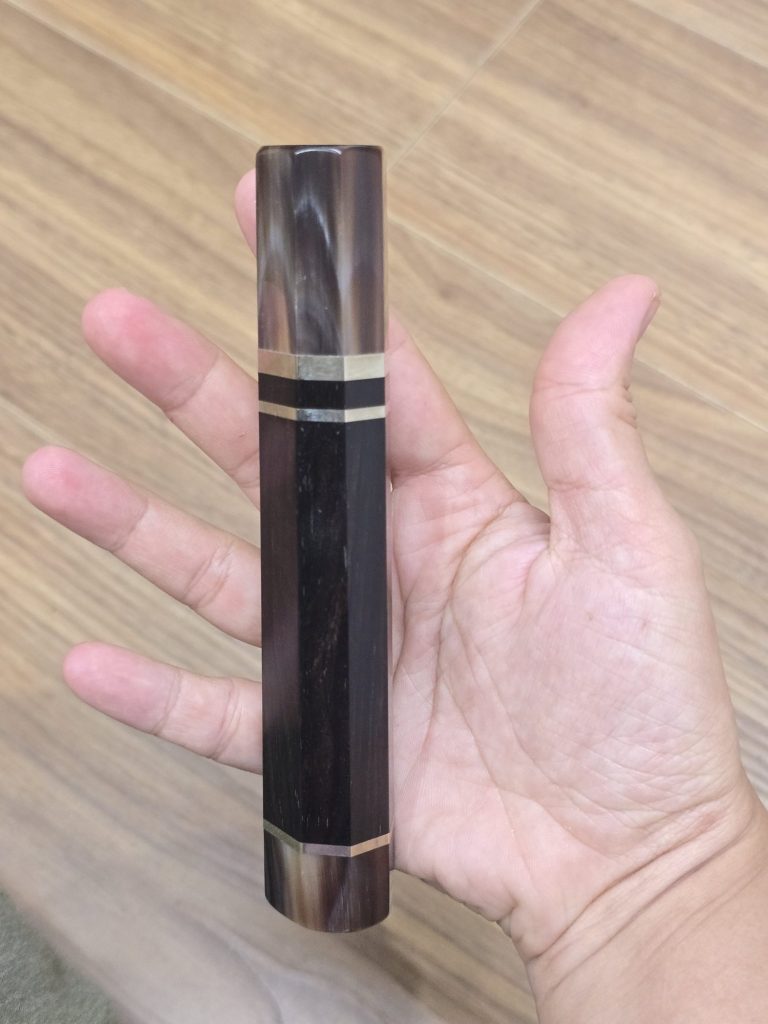
Both patterns are commonly fitted with wa handles. For context on the tang, machi, and how the handle meets the blade, see the anatomy of a Japanese knife. That made-to-order handle is where we come in at Horn & Grain; the choice between santoku and nakiri should remain about the cooking.