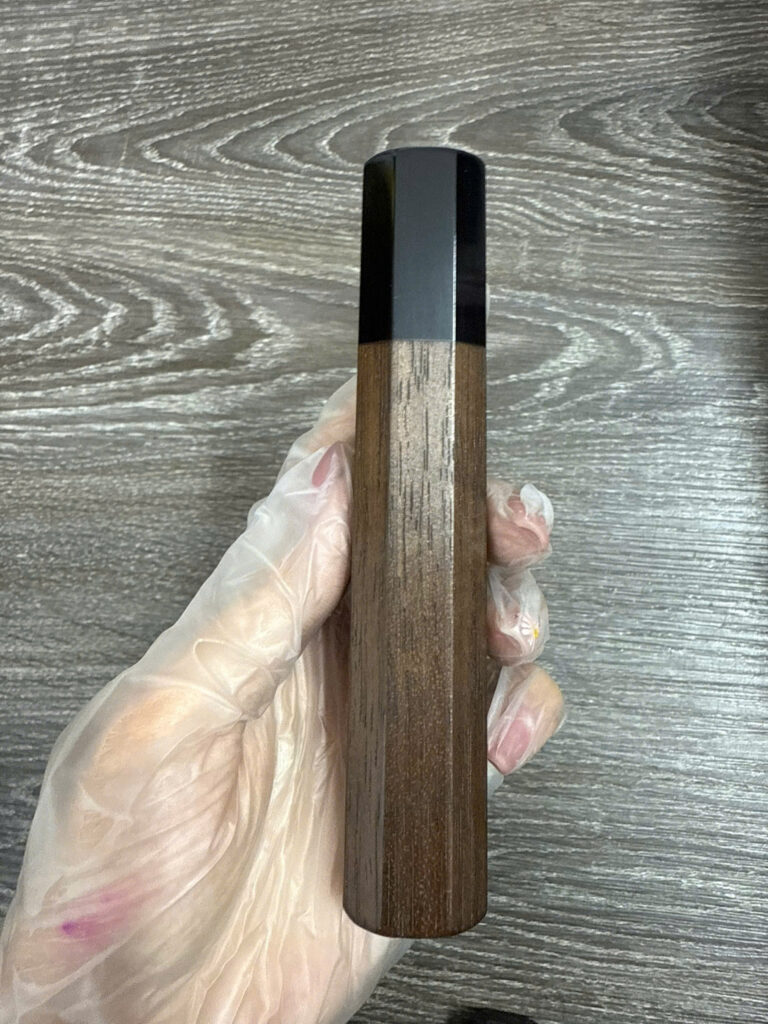
Yes—teak is a good wood for a Japanese knife handle for one particularly practical reason: the natural oil content that helps it endure ships, weather and outdoor use is also valuable in the wet, washed-often life of a kitchen. Teak suits cooks who want a warm-looking handle, a lighter feel and straightforward practicality. If you prefer substantial, planted weight behind the blade, one of our denser dark woods will probably suit you better.
Why does a wood famous for boats and benches belong in a kitchen?
Teak’s reputation is not an accident. It has been trusted for centuries in ships, outdoor furniture and cutting boards because its natural oils help it resist moisture. A knife handle faces a less dramatic version of the same problem: damp hands, splashes, washing and repeated changes between wet and dry.
That does not make teak waterproof. A teak handle should still be hand-washed, dried promptly and never left soaking. Its natural moisture resistance gives it a useful head start; it does not remove the need for ordinary care.
This is the honest case for teak. It is not an exotic material chosen only for appearance, nor are we suggesting that our blanks are somehow “marine grade.” It is simply a naturally oil-rich wood whose best-known strength happens to match the daily demands placed on a kitchen-knife handle.
For a home cook who uses a knife regularly and would rather not treat its handle like a museum object, that makes good sense.
What does a teak handle look like, and how does it age?
Teak sits in a warmer, lighter visual register than ebony and many other premium handle woods. Its colour is golden brown, with clean, generally straight grain that gives the finished handle a calm, architectural quality. Against a polished blade and black ferrule, it looks deliberate without becoming severe.
Every blank is different. Some pieces appear quieter and more even; others show stronger lines or shifts in tone. Because we build each handle to order and hold no finished teak stock, choosing teak means choosing that family of character—not reserving the exact grain pattern of a preview.
With handling, light and normal kitchen use, the surface can gradually mellow and develop a more lived-in appearance. The precise change depends on the individual piece and how the knife is used and cared for. We promise the natural variation of teak, not a particular board or an exact future colour.
How does teak compare with darker premium woods in the hand?
Teak is noticeably lighter than the ebony family, although the final feel also depends on the blank, handle size and profile. On many knives, that means a more blade-forward balance: you feel more of the blade and less planted weight at the rear.
That is a choice, not a ranking. A lighter handle can feel quick and unobtrusive, particularly for a cook who does not want the handle to dominate the knife. A denser dark-wood handle can feel steadier and more substantial in the palm. Neither balance is universally better.
If visual warmth, a lighter feel and moisture-conscious practicality matter most, teak is the clearer direction. If you want dark colour and deliberate rear weight, compare the denser alternatives in our wood guide.
Why pair teak with a black buffalo horn ferrule?
Black buffalo horn gives the golden-brown teak a clean visual stop. The contrast sharpens the handle without competing with the grain, while the ferrule reinforces the area where the handle meets the blade.
It is a restrained pairing: warm teak for the body, black horn at the front, and no extra materials added merely for decoration.
How is this handle built and bought?
This is one specific made-to-order handle: a teak body with a black, white, or marbled buffalo horn ferrule. It is our only teak product, and teak is not offered through our custom configurator.
You can choose an octagonal, oval, D-shape or round profile. If the first two are unfamiliar, our guide to octagonal vs oval explains how their edges and orientation feel in use.
On the product page, the size recommender uses your knife type and blade length to select the appropriate size tier. That is the starting point rather than a guess at the hidden fit. After checkout, we confirm fit from your knife’s measurements before building.
With a secure handle installed, leave it in place; height and thickness at the visible junction are useful partial fit evidence, not hidden tang dimensions. Clear photos can help when measuring is impractical. If the tang is already exposed, provide three measurements in millimetres: usable length from the shoulder/seating line to the tip, height near the shoulder, and face-to-face thickness at the same station. Our size guide explains the size tiers and typical dimensions in more depth.
The result is not a stock handle selected from a bin. It is a made-to-order teak handle in your chosen profile, sized through the recommender and then checked against the knife information you provide.
If that combination fits what you want—warm colour, lighter balance and a wood naturally suited to routine kitchen moisture—you can view the teak handle.