To open a coconut, drain it first: find the soft one of its three eyes, push a skewer through it and pour the water out. Then hold the coconut in a folded towel and tap firmly around its middle with a hammer or the spine of a heavy cleaver, turning it after each blow, until the shell cracks in two. Lift the white meat out with a butter knife or a sturdy spoon. Never strike the shell with the edge of a thin kitchen knife, and never pry with a blade.
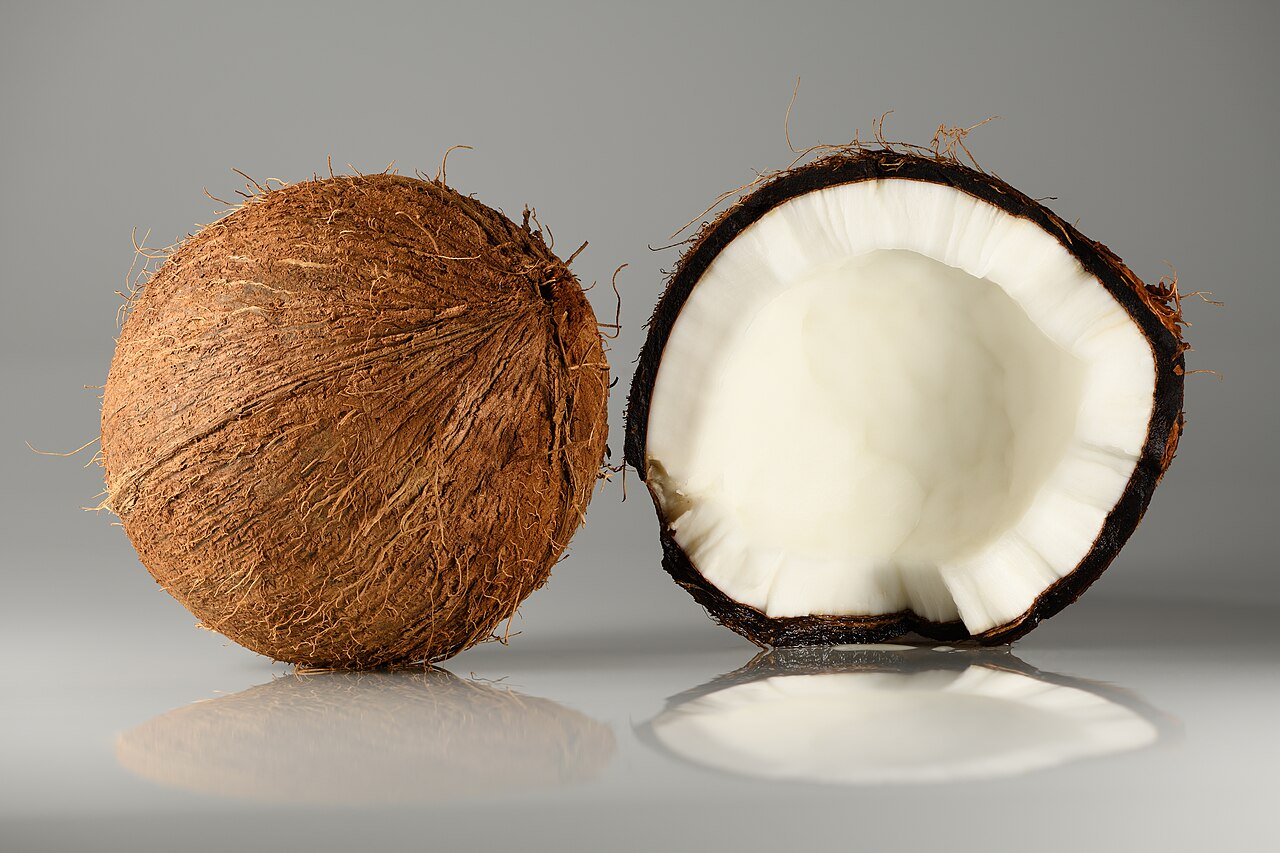
Brown mature coconut or young green one
This guide is for the brown, hairy coconut sold in most supermarkets. Food Network describes the mature coconut, the one to buy for its meat, as having a hard shell covered in brown hairy fibers. Wikipedia’s coconut article explains why it looks that way: mature coconuts sold for export usually have the husk removed, which leaves the familiar shell with three pores at one end. Young coconuts, sold for their water and softer, jelly-like meat, are known as green coconuts.
A young coconut opens differently: Wikipedia notes that street vendors who sell fresh coconuts for their water cut them open with machetes or similar implements. That is heavy-blade work; do not try it with a thin Japanese knife.
Choose a good one
Food Network says to avoid coconuts with cracks, mold or wet exteriors. Bon Appétit’s guide, by the chef Farokh Talati, adds two checks: the coconut should have a reassuring weight, since one that feels light for its size is probably old and dried out, and shaking it should give a generous amount of sloshing water inside. A crack in the shell, it warns, may have let air in and spoiled the flesh.
Drain the water through an eye
- Find the soft eye. One end of the shell has three dark spots. Wikipedia notes that two of the three pores are plugged and one is functional. Food Network’s method is to poke all three with a skewer to find the soft one.
- Open it. Push the skewer through the soft eye and work it around to make a hole about 1/2 inch wide, as Food Network describes. If the eye resists, it uses a screwdriver tapped through with a hammer. Do not use a knife tip: a point that slips on a round shell goes toward the hand holding it.
- Pour. Turn the coconut over a bowl or measuring cup and shake to release the liquid. Food Network says to drink it or refrigerate it in an airtight container for up to 4 days. Bon Appétit suggests tasting it before you use it, because the water can sometimes turn sour inside the shell, which is not always a reflection of how the flesh will taste.
Crack it along the equator
- Cradle it. Hold a folded kitchen towel in one hand and nestle the coconut in it, as Food Network does, and work over a sturdy counter or a bowl.
- Tap around the middle. Strike the equator, the widest line around the shell, firmly with a hammer or meat mallet (Food Network) or with the dull side of a cleaver (America’s Test Kitchen). Turn the coconut a little after each blow and strike the next spot. The aim is a crack that runs all the way around, not a smashed shell.
- Split it. When the crack has gone all the way around, pull the two halves apart.
On a cleaver, only the spine belongs on the shell. A thin, hard edge struck against something that hard chips; our guide to why Japanese knives chip explains what happens, and Chinese cleaver vs meat cleaver explains which cleavers are built for heavy blows and which are thin slicers.
Get the meat out
Food Network’s method is to carefully pry the flesh away from the shell with a butter knife; a long-handled spoon, such as an iced-tea spoon, is another option. Slide the blunt tool between the meat and the shell and lever gently, one piece at a time. Bon Appétit uses a butter knife for this step as well. Keep sharp knives out of it: levering puts exactly the sideways load on an edge that a thin blade cannot take.
America’s Test Kitchen suggests a way to make the meat come away more easily: freeze the whole coconut overnight, then crack it around its equator with the dull side of a cleaver and peel the shell off the meat. The water inside is frozen too, so it comes out without spilling.
Peel and cut the meat
The meat comes out with a thin brown skin on its back. Food Network removes it with a vegetable peeler or a paring knife, then rinses the pieces. Lay each piece on the board so it sits steady before slicing it into strips or chips, or grate it for cooking. Food Network says fresh coconut keeps in an airtight container in the refrigerator for up to 4 days.
What you need
A skewer, a screwdriver if the eye resists, a hammer or a heavy cleaver used only by its spine, a folded towel, a bowl, and a butter knife or a spoon. A peeler or a small paring knife handles the brown skin; our guide to vegetable peelers compares the shapes. For other fruit and vegetables, browse all our how-to-cut guides.
Sources: Food Network Kitchen, How to Open a Coconut (mature coconut, cracks or mold, soft eye and skewer, screwdriver, draining and storing the water, towel and hammer at the equator, butter knife or spoon, peeling the brown skin, storing the meat); America’s Test Kitchen, A Better Way to Extract Coconut Meat (freeze overnight, dull side of a cleaver around the equator); Bon Appétit, How to Crack Open a Coconut With Confidence (weight, sloshing water, cracks, tasting the water, butter knife); Wikipedia, Coconut (husk removed for export, three pores, two plugged, young green coconuts); Wikipedia, Coconut water (fresh coconuts cut open with machetes by street vendors).