A Damascus kitchen knife is one whose blade shows a wavy pattern from layers of different steels forged together and then etched. On most Japanese kitchen knives those layers are cladding wrapped around a single core steel, and the core is what forms the edge. So “Damascus” tells you how the outside of the blade was made and how it looks. It does not tell you how sharp the knife is, how long the edge lasts or how much care it needs. For those answers, look at the core steel the maker names.
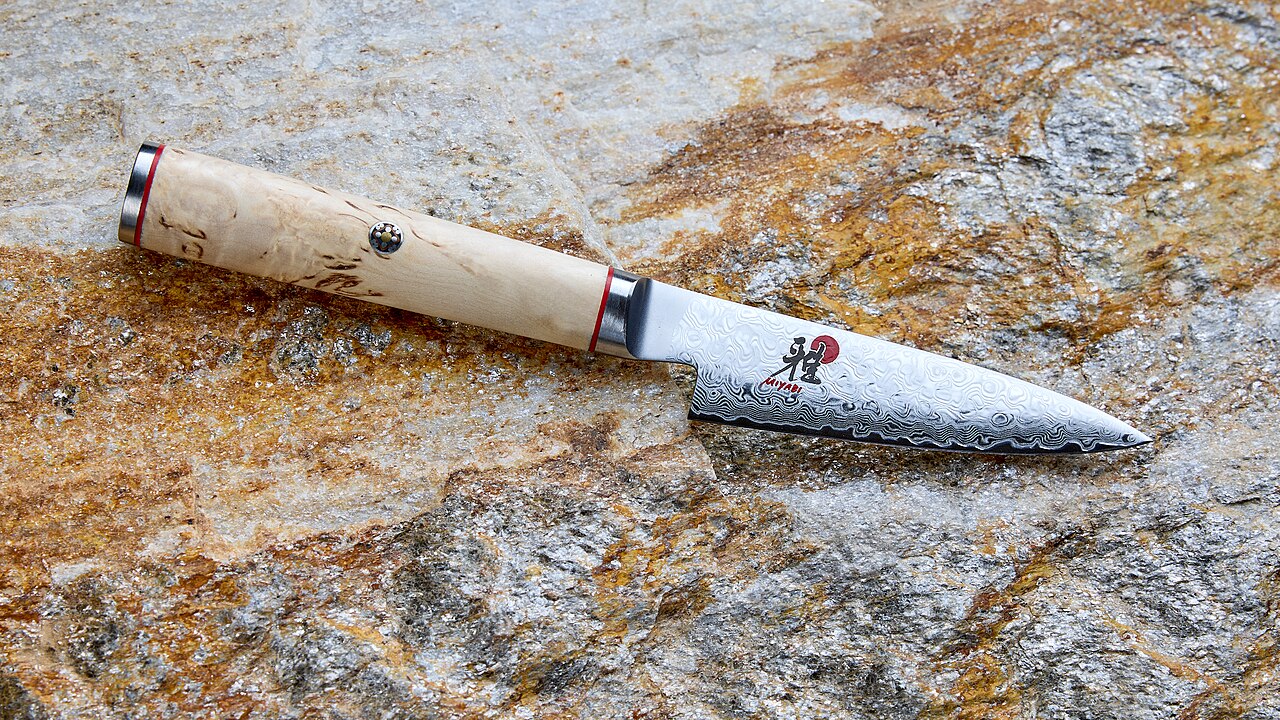
Damascus at a glance
Each row below is as the named source states it:
| Question | What the sources say |
|---|---|
| What “Damascus” means on a kitchen knife today | Pattern-welded steel: several steels welded into one billet, then drawn out and folded. The name is “technically incorrect” but widely accepted in the trade (Wikipedia, Damascus steel) |
| What it meant historically | The high-carbon crucible steel of historical swords forged by the wootz process, with banding and mottling “reminiscent of flowing water” (Wikipedia, Damascus steel) |
| How the pattern becomes visible | Polishing or acid etching highlights the bands, because acid darkens some steels more than others (Wikipedia, Pattern welding) |
| What does the cutting | The core: “the inner layer of steel that actually does the cutting” (Shun FAQ); “the core steel determines cutting performance” (Masahisa) |
| What the layers add | Durability and “visual distinction” (Masahisa) |
| Core steels you will see | Stainless VG10, VG-MAX or SG2 at Shun; Yasuki Blue-1 carbon steel in Sakai Kikumori’s Damascus Blue 1 line |
Sources: Wikipedia’s Damascus steel, Pattern welding and Wootz steel articles; Azuma Minamoto no Masahisa’s construction page; Shun’s FAQ; Sakai Kikumori’s Damascus Blue 1 page. These describe particular makers’ knives; others vary.
Two meanings of “Damascus”
The older meaning is a steel, not a pattern. Wikipedia describes historical Damascus steel as the high-carbon crucible steel of swords forged by the wootz process in the Near East, with a banded pattern. Its wootz steel article traces that crucible steel to southern India in the mid-1st millennium BC. Those patterns formed inside the steel itself.
The modern meaning is a method. Pattern welding forge-welds pieces of different steel into one bar, and Wikipedia notes that such blades are “often wrongly called Damascus steel”. The name stuck in 1973, when the bladesmith William F. Moran showed his “Damascus knives” at the Knifemakers’ Guild Show. Today a knife sold as Damascus almost always means this layered, pattern-welded construction. It is not a revival of the old crucible steel.
How the pattern is made visible
When the layered bar is ground smooth, the layers are there but hard to see. Wikipedia’s pattern-welding article explains that the bands are highlighted “by proper polishing or acid etching”. In its example, acid darkens 1080 plain carbon steel more than 15N20 nickel steel, so the two show as light and dark stripes. Couteaux Morta, a French knife maker, describes the same final step for its own Damascus: the blade is etched in acid to bring out the pattern.
The pattern sits at the surface. Our guide to Japanese knife blade finishes notes that etched Damascus can lose contrast under abrasives. That is why scouring pads and metal polish are a poor idea on the blade face.
What Damascus does and does not say about cutting
Makers are plain about this. Masahisa, a Tokyo knife maker, says of its layered suminagashi knives: “While the core steel determines cutting performance, the cladding contributes to durability and visual distinction.” Shun’s FAQ says the same in its own words. In a blade with Damascus cladding, the cutting core is “the inner layer of steel that actually does the cutting”, and at Shun that core may be VG10, VG-MAX or SG2.
So read a Damascus listing in two parts. The pattern tells you about the cladding. The core steel tells you how the edge will behave and how it will sharpen. Our Japanese knife steel basics explain how to read that core, and san-mai vs mono-steel covers the core-and-cladding build that most Damascus knives use. A pattern on its own does not make a knife better or worse.
Real layers or a printed pattern?
Some knives are sold as Damascus with a pattern printed or etched onto the surface of a single steel. The online knife retailer eKnives and Couteaux Morta give similar signs. On real pattern-welded steel, the pattern runs through the metal, so it can usually be traced across the spine and other edges. A surface imitation may stop at the faces or fail to line up at the spine. eKnives adds a caution: some genuine Damascus shows no pattern on the spine or edge because of how the folds fell. It also says price alone does not prove either way.
The test both describe is sanding a small area and etching it again with acid. Genuine layers come back; a printed pattern does not. That test marks the blade, so it is not something to try on a new knife. For a knife you are buying, it is more useful to ask the seller to name the core steel and say how the cladding is made. A listing that names neither gives you nothing to check.
Caring for a Damascus knife
Care follows the steels, not the pattern. If the core is carbon steel, as in Kikumori’s Damascus Blue 1 line, the exposed edge reacts like any carbon blade; see carbon steel kitchen knives for that routine. If the core and cladding are stainless, care is simpler but not optional. Shun’s FAQ says stainless knives “can still develop rust” when moisture is left on the blade.
For any Damascus knife, wash it by hand and dry it right away. Use a light coat of oil if it will sit unused; our comparison of camellia and mineral knife oil covers the choice. Treat early spots before they spread with our guide to removing surface rust. Keep abrasives off the etched faces unless you accept a duller pattern.
Handle note
A Damascus blade fits the same handles as any other blade of its shape and length. What decides the fit is the knife type, the blade length and the tang, not the pattern. If yours has a wa handle, our wa handle size guide covers sizing and our wa handle care guide covers the wood and horn.