To cut celeriac (celery root), scrub it, slice off the stem end so the root sits on a flat base, and halve it. Then cut the knobbly, root-covered skin away with a knife rather than trying to peel it all with a peeler, and cut the peeled halves into slabs, then sticks or cubes. The white flesh browns once it is cut, so drop the pieces into water with a little lemon juice or vinegar as you go.
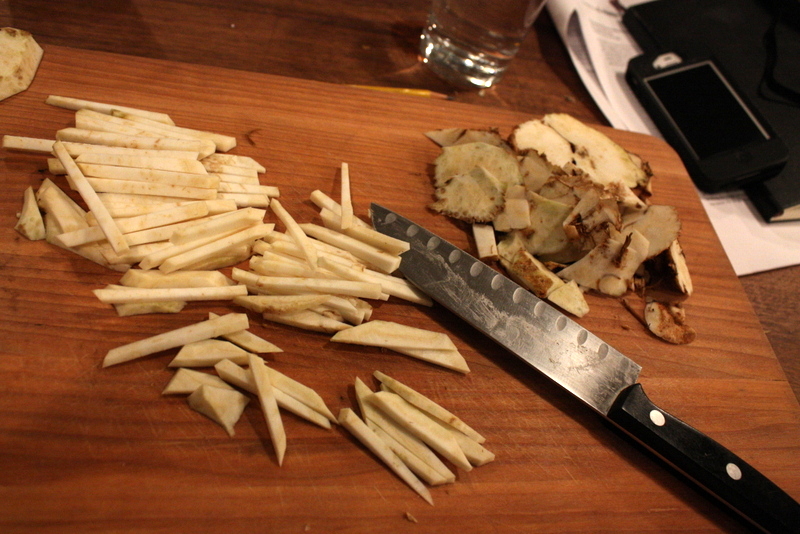
Celeriac is a type of celery grown for its root, not its stalks; for the stalks, see how to cut celery. The root is round, hard and covered in small rootlets that hold soil, which makes the peeling the hard part. Once it is peeled, it cuts like any other firm root.
Scrub it first
Soil sits in the crevices between the rootlets. UW Extension Polk County advises using a vegetable brush and washing vegetables under running water before cutting, cooking or eating, and the FDA says to rinse produce before you peel it, so dirt is not carried from the knife onto the flesh. Scrub the whole root, then dry it so it does not slide on the board.
Give it a flat base
A round, wet root that rocks under the knife is the main hazard here, so make the first cut the one that steadies it. America’s Test Kitchen’s method for large roots, over 1¼ pounds, is to trim the stem end to create a flat surface, then halve the root vertically and lay each half flat on its side. Mississippi State University Extension gives the same principle for any round food: cut it in half first and lay the flat side down. Keep the root on its flat side for every cut that follows.
Cut the skin away
- Trim the knotty end. With a half lying flat, cut away the tangle of rootlets at the base in a few slices.
- Follow the curve. Cut the skin off in strips, working from top to bottom around the root and keeping the knife’s path close to the surface. Take short, controlled strokes; there is no need to remove it all in one pass.
- Finish the hollows. America’s Test Kitchen uses a vegetable peeler for the skin that remains after the knotty roots are trimmed away. A small knife works too for the brown pockets left between the knobs. UW Extension Polk County notes that once the brown outer layer is removed, the flesh underneath should be bright white.
For smaller roots, America’s Test Kitchen says the tough exterior can simply be cut away with a chef’s knife. The knobs and crevices take some flesh with them, so do not chase every last speck of brown with a thick cut.
Keep the cut pieces pale
America’s Test Kitchen places prepared celeriac in acidulated water to keep it from discoloring: 1 teaspoon of lemon juice or vinegar per 1 cup of water. For a raw salad, UW Extension Polk County’s recipe tosses the fine julienne straight in lemon juice for the same reason. Set the bowl up before you start.
Cut for the dish
- Slabs. Lay each peeled half cut side down and slice it into even slabs. Every other shape starts here.
- Matchsticks. Stack two or three thin slabs and cut them into thin sticks for a raw salad. America’s Test Kitchen describes the classic remoulade: raw root grated or cut into matchsticks and dressed with a tangy mustard dressing. The plank-and-stack sequence is the one in our guide to julienning carrots.
- Cubes. Cut thicker slabs into sticks, then cut the sticks across into cubes for soups, stews, roasting or mash. America’s Test Kitchen lists braising, baking, roasting and mashing; UW Extension Polk County adds soups, stews and puree. Keep the cubes a similar size so they cook evenly, especially alongside other roots; our guide to cutting root vegetables covers a mixed tray.
- Grated. For a grated salad, grate a peeled wedge rather than cutting it by knife.
When the blade sticks
Celeriac is dense, and a thick slab can grip the blade partway through. Stop, draw the knife back out the way it went in, and make the piece smaller before cutting again. Do not twist the blade or lever the cut open. A thin Japanese edge is strong in a straight line, but a sideways load can chip it; see why Japanese knives chip.
Which knife
A gyuto or santoku with enough length to cross a halved root is the right size for the slabs and cubes, and a petty or paring knife is easier for the hollows between the knobs. For other vegetables, browse all our how-to-cut guides.
Sources: America’s Test Kitchen, All About Celery Root (flat stem end and halving for roots over 1¼ pounds, knotty roots trimmed, peeler for the rest, chef’s knife for small roots, 1 teaspoon acid per cup of water, remoulade matchsticks, braised, baked, roasted or mashed); UW Extension Polk County, Celeriac Veggie Bite (brush and wash before cutting, bright white flesh under the brown layer, fine julienne tossed in lemon juice to prevent discoloring, salads, soups, stews and puree); FDA, 7 Tips for Cleaning Fruits, Vegetables (rinse before peeling); Mississippi State University Extension, Kitchen Knife Basics (halve round foods and lay the flat side down).