To cut burdock root (gobo), scrub the skin clean rather than peeling it, then cut the root the way your recipe needs: thin sasagaki shavings for soups and rice dishes, or matchsticks for kinpira. Let the cut pieces fall straight into cold water, give them a short soak of about 5 to 10 minutes, then drain and cook.
Scrub, don’t peel
Kikkoman, the Japanese soy sauce maker whose cookbook covers basic prep, notes that the flavor of burdock lies between the skin and the root itself, so the skin should come off as thinly as possible. For fresh roots still in their soil, it says a quick scrub with a natural bristle scrubber or vegetable brush is enough. For older roots that have turned hard, it scrapes the skin off with the back of a kitchen knife: the spine, not the edge. Just One Cookbook also recommends a vegetable brush or tawashi over peeling. Our guide to choosing a tawashi brush covers which fiber suits sturdy, soil-covered roots.
Burdock is long and thin, so cut it into lengths that fit your board before you start. Keep a bowl of cold water beside the board from the first cut.
Sasagaki: thin shavings
Sasagaki means shaving the root as fine as bamboo leaves (sasa). Just Hungry describes it as sharpening a pencil:
- Score the end. Make several lengthwise cuts into the end of the scrubbed root, so the shavings come off narrow.
- Shave over water. Hold the uncut end and shave thin pieces off the scored end, rotating the root as you go. Kikkoman sets a bowl of cold water directly underneath to catch the shavings.
- Score again. When the scored part is used up, make new lengthwise cuts and keep shaving. Just Hungry slices the last stub as thinly as possible.
Keep each stroke a shallow slice that travels away from the hand holding the root. The job is thin shavings, not chunks: a thin Japanese edge that is levered or twisted against a dense root can chip, as our guide to why Japanese knives chip explains.
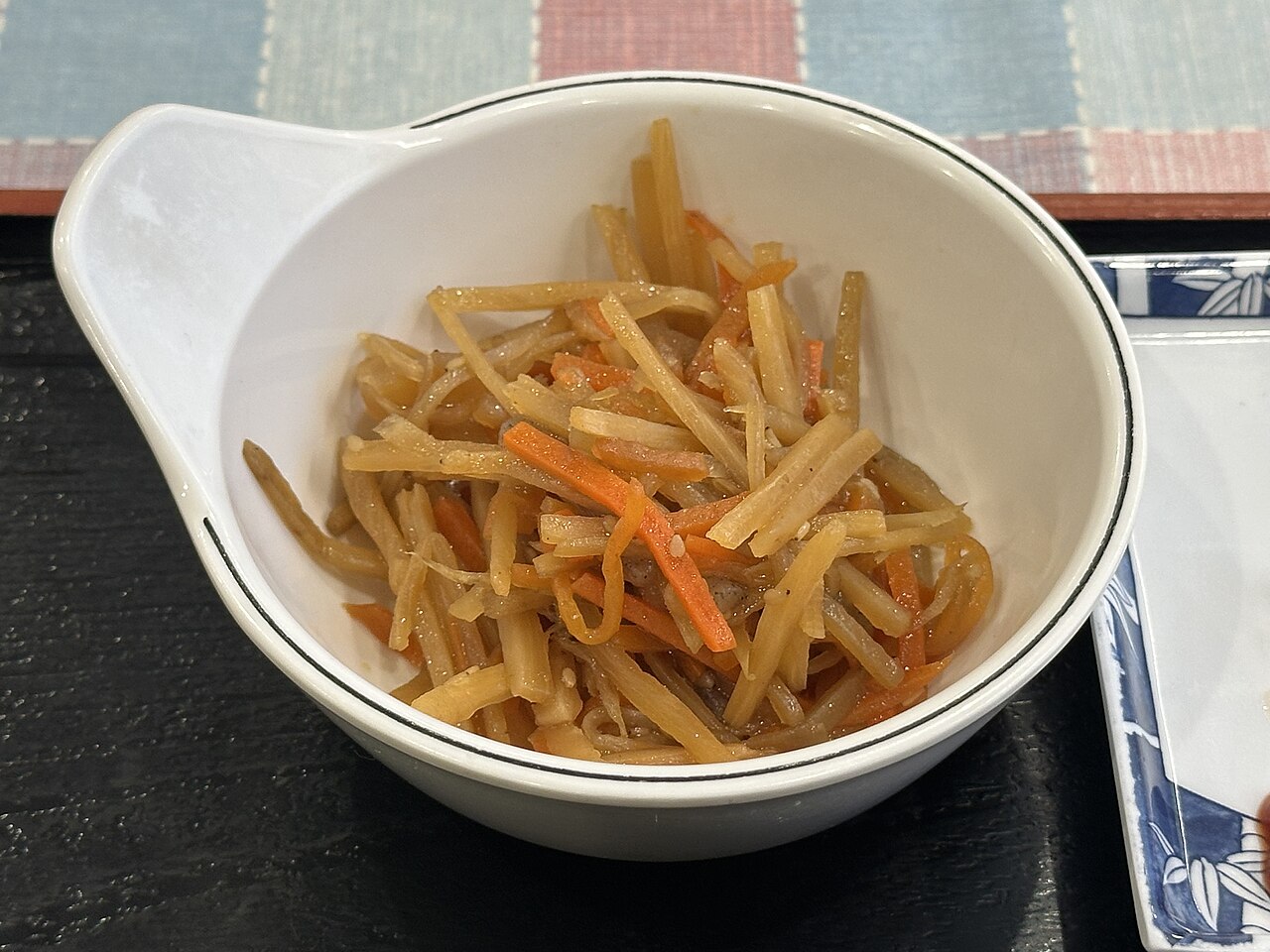
Matchsticks for kinpira
- Cut short lengths. Kikkoman scrapes the root, cuts it into 5 cm (2 in.) lengths and puts them in water.
- Cut planks. Slice each length into planks of around 3 mm (0.1 in.). If a length rolls, trim a thin strip off one side so it sits flat.
- Stack and cut. Slide a few planks into a low stack and cut them lengthwise into sticks about 3 mm wide.
It is the same plank-and-stack method as our guide to julienning carrots. Just Hungry notes that many people use sasagaki rather than matchsticks for kinpira gobo, so either cut works. Just One Cookbook lists slicing, roll cutting and chunks as other ways to cut gobo.
Soak, but briefly
Kikkoman says burdock has a high “lye” content (its term for bitter, astringent juices, not caustic lye) and soaks the cut pieces in water for about 5 to 10 minutes to remove the excess. It warns that if they soak too long, or the water is replaced, the flavor seeps out too. Just One Cookbook soaks gobo in vinegar water for a few minutes before cooking to keep the cut surfaces from oxidizing. Just Hungry notes that the soaking water turns yellow-brown and rinses the shavings lightly in a colander. Drain well, then cook.
Choosing and storing gobo
Just One Cookbook suggests picking firm, straight roots with smooth skin and a few fibrous roots attached. It stores gobo at room temperature in cooler seasons and in the fridge, wrapped in newspaper, in hot weather, and warns that a root left to dry out turns hard.
Which knife
For sasagaki the root is held in the air, so use a knife you can steer with small movements, such as a petty knife. Planks and matchsticks are board work, where a nakiri or santoku keeps the cuts straight. Scrape with the spine, and keep the edge for cutting. For other fruit and vegetables, browse all our how-to-cut guides.
Sources: Kikkoman, Burdock root (flavor under the skin, scrub fresh roots, scrape older roots with the back of the knife, lye, 5 to 10 minute soak, over-soaking, shavings over cold water, 5 cm lengths, 3 mm planks and matchsticks); Just Hungry, How to sasagaki cut burdock root (bamboo-leaf name, pencil method, scoring, re-scoring, yellow-brown water, light rinse, sasagaki for kinpira); Just One Cookbook, Gobo (Burdock Root) (brush or tawashi over peeling, other cuts, vinegar-water soak, choosing, storing).