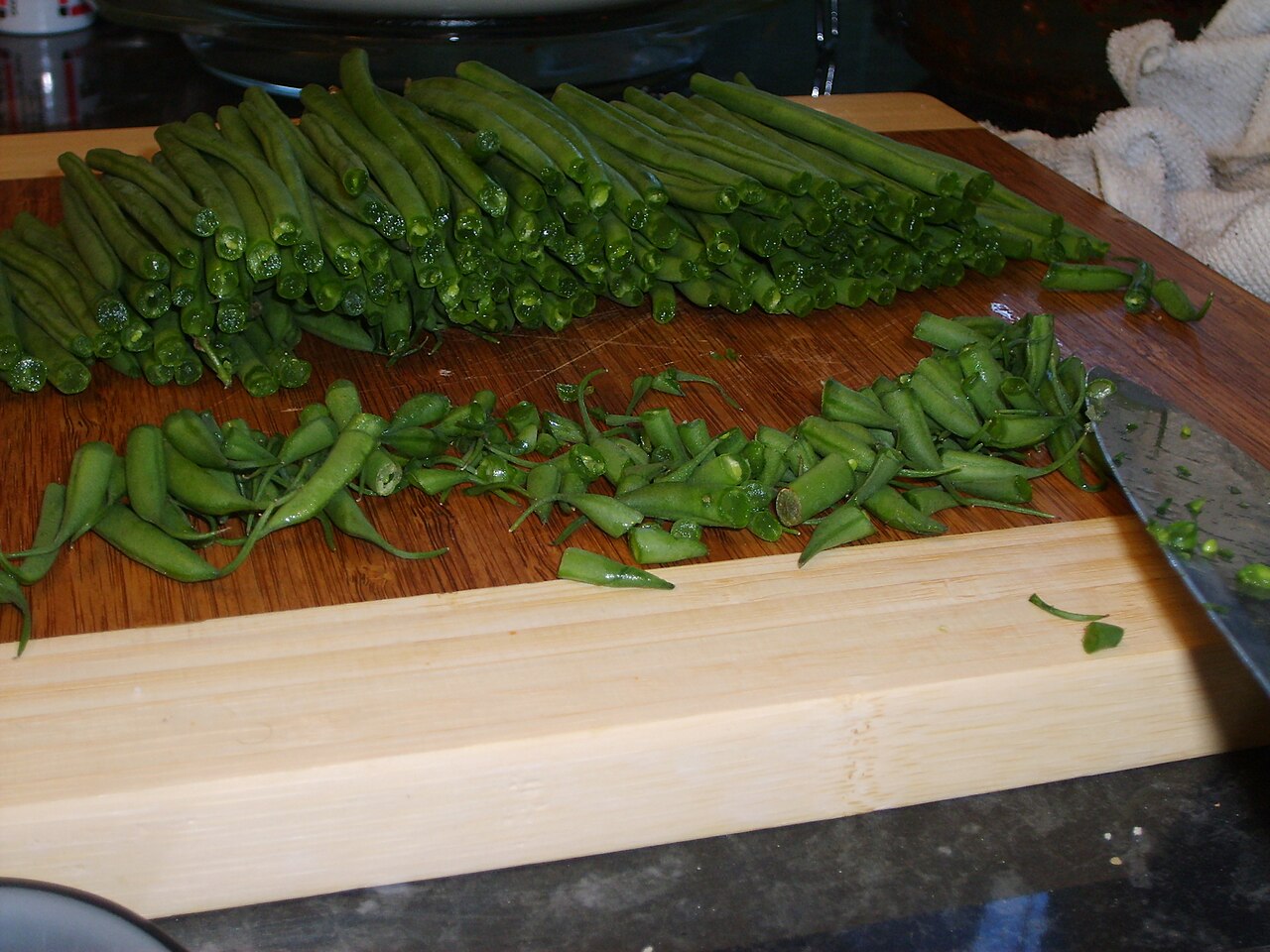
To cut green beans, rinse them, line up a handful with the stem ends level and slice the stems off in one cut. Then leave the beans whole, cut them into 1-inch pieces, slice them lengthwise for French-cut beans, or cut them on a diagonal. Only the stem end has to come off; trimming the thin tail is a matter of looks.
Rinse just before you cut
Illinois Extension’s advice is to wash beans under cold running water and drain them just before you prepare them, not before you store them, because wet beans develop black spots and decay quickly. Penn State Extension says to rub them gently under the water and not to soak them. Until then, Illinois suggests keeping fresh beans unwashed in plastic bags in the refrigerator crisper for up to 3 days.
Trim the stem ends in batches
Illinois Extension says only the stem end needs to be removed. Penn State’s preserving guide snips off both ends, so either is fine. Trimming bean by bean is slow; a handful at a time is quicker.
- Gather a handful. Pick up as many beans as you can hold in a loose bundle and tap them on the board so the stem ends line up on one side.
- Cut the stems off. Lay the bundle flat, hold it with your fingertips curled back from the edge, and cut straight down just behind the stems. Check for any bean that slid out of line and trim it on its own.
- Trim the tails if you like. Turn the bundle around, level the tails the same way and cut them off for a neater look.
- Remove any strings. Penn State says to remove strings if appropriate. Check one bean before you trim the batch: if it has a tough thread along its seam, snap the stem ends off by hand instead of cutting them, pulling each one down the length of the bean so the string comes away with it.
Whole beans and 1-inch pieces
Leave trimmed beans whole for steaming, roasting or blanching. For soups, casseroles and stir-fries, line up a handful again and cut across the row into 1-inch pieces, the size both Illinois Extension and Penn State use when preserving beans. Penn State notes you can also snap them into pieces by hand.
French cut (lengthwise)
French-cut beans are sliced lengthwise into thin strips. Oregon State University Extension slices beans lengthwise in its freezing and drying instructions, and notes for drying that it exposes more surface area.
- Lay a bean on its side. Set it on the board so it lies flat and does not roll.
- Split it down the middle. Starting at the trimmed end, draw the tip of a small knife along the bean’s length to cut it into two thin halves.
- Cut wide beans again. A broad, flat bean can be split into three or four strips.
This is slow by hand, so save it for a side dish where the shape matters, or for beans that are wide and flat.
Bias pieces
For long pieces with angled ends, line up a handful and angle the knife across the row instead of cutting straight across; Oregon State slices diagonally in its drying instructions. The same diagonal cut is described in our guide to cutting green onions, where a few stalks are also lined up and sliced together.
Cooking for a crowd
For a holiday side dish, the trimming is most of the work. Batch trimming is what makes a large pile manageable. Because Illinois Extension advises washing beans just before preparation rather than before storage, you can buy them a day or two ahead, keep them unwashed in the crisper, and rinse and trim them on the day.
Which knife
A nakiri or santoku suits batch work: their relatively flat edges meet the board along their length, so the cut goes through a whole row at once; see our guides to using a nakiri and santoku vs nakiri. For French cuts, a smaller blade is easier to control; paring vs utility knives explains the difference. For other vegetables, browse all our how-to-cut guides.
Sources: Illinois Extension, Preparing Beans (wash under cold running water just before preparation, not before storing, black spots and decay, only the stem end needs removing, 1-inch pieces or whole, store unwashed in the crisper up to 3 days); Penn State Extension, Let’s Preserve: Snap Beans (rub gently under cold running water, do not soak, snip off ends, remove strings if appropriate, cut or snap into 1-inch pieces); Oregon State University Extension, Preserving Foods: Green, Italian or Wax Beans (trim ends, slice lengthwise, slice diagonally or lengthwise to expose more surface area).