To slice a brisket, let it rest, then cut it in two where the thick, fatty point starts to rise off the thinner flat. Slice the flat across the grain into slices about 1/4 inch thick, then turn the point so you are cutting across its grain too, and slice it the same way. The point needs that turn because its grain runs in a different direction from the flat. Steven Raichlen’s Barbecue Bible describes this method; the Beef Checkoff’s barbecue cut guide puts the rule more simply: if brisket is sliced, cut it against the grain after cooking.
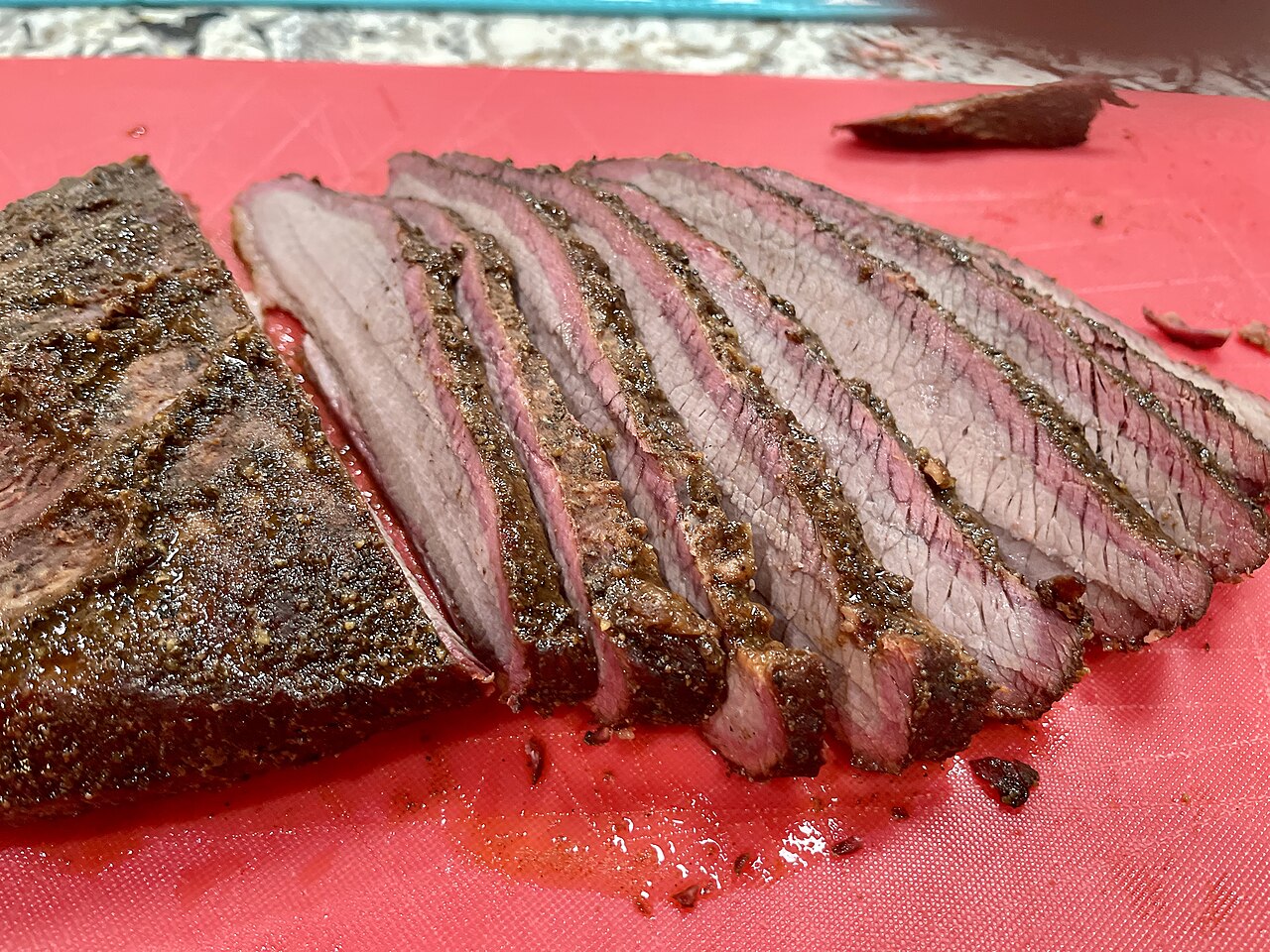
Flat, point and grain
A whole brisket is two parts. The Beef Checkoff’s Beef. It’s What’s For Dinner calls the flat the leaner half of the whole brisket, also sold as the “first cut,” and the point the less lean half, “juicy with full flavor.” The two are joined by a layer of fat, and their muscle fibers do not line up. Slicing across the grain matters because, as Purdue Extension beef specialist Ronald Lemenager puts it, “you’re essentially cutting the muscle fibers, so you have to cut across, not with the grain.” Virginia Cooperative Extension’s carving guide adds that the shorter fibers make the slices seem more tender.
The grain can be hard to see under a dark bark. Look at the side of the flat, or make one slice at the thin end and check the cut face: you want to see the ends of the fibers, not long strands running along the slice.
Before you slice
Raichlen rests a smoked brisket for 30 to 60 minutes before slicing so the juices can redistribute. If your recipe gives a different rest, follow it. Set up a board big enough for the whole brisket plus a row of slices, with a groove or a tray nearby for the juices; our carving board guide compares sizes and juice grooves.
For food safety, USDA’s safe minimum for whole cuts of beef is 145°F followed by a 3-minute rest, as South Dakota State University Extension lists it. Smoked brisket is normally cooked well past that for tenderness; check your recipe for the finished temperature.
Step by step
- Find the seam. Locate where the point bulges up from the flat. Raichlen cuts the brisket crosswise there, giving a flat section and a point section.
- Trim if needed. Raichlen trims excess fat from the top and may cut off a hard, dry tip to dice as burnt ends.
- Slice the flat. Begin with the flat and cut across the grain. Raichlen slices it on the diagonal across the grain, about the thickness of a No. 2 pencil, or about 1/4 inch.
- Turn the point. Raichlen says to rotate the meat about 90 degrees when you reach the point, because the grain runs differently in each section. He cuts the point in half widthwise and then slices those pieces against the grain.
- Keep the stroke long. Draw the knife through each slice with long, smooth strokes, as Certified Angus Beef advises for carving a roast, rather than pressing straight down. Virginia Cooperative Extension adds that the angle of the knife should not change once a slice has begun.
Raichlen also describes a second method from Ohio pitmaster Jim Budros: separate the point from the flat along the fat between them, then line the two up so their fibers run the same way and slice both together. Either way, the aim is the same: every slice cuts across the fibers.
If the slices fall apart or come out stringy
Stringy slices usually mean the knife ran along the grain; turn the piece and try again. Raichlen notes that thinner slices can fall apart, while thicker ones may lose tenderness, so adjust the thickness to how the meat holds together. If you only need part of the brisket, Virginia Cooperative Extension’s advice for any roast applies: leave some meat unsliced, because a solid piece dries out more slowly in the refrigerator than slices do.
The knife for this job
Raichlen recommends a long, sharp slicing knife, ideally 12 to 14 inches, with a Granton (scalloped) edge. A Japanese sujihiki is built for the same long drawing stroke: it is usually 240–270mm (about 9½ to 10½ inches), narrow and low, and our guide to what a sujihiki is lists brisket among the jobs it suits. A Western carving knife does the same job and is more tolerant near bone; sujihiki vs carving knife sets out the trade. A brisket has no bone, so either works, and a long gyuto you already own will do for an occasional cook; see gyuto vs sujihiki. Hold it in a relaxed pinch grip (see how to hold a Japanese knife) so the long stroke stays straight.
If you are fitting a wa handle to the slicer, our wa handle size guide puts a 196–255mm gyuto or a 210–255mm sujihiki in the Chef size and a 256–360mm sujihiki in Long.
Sources: Steven Raichlen, Barbecue Bible, How to Slice Brisket Like a Pitmaster (rest, cutting the flat and point, 90-degree turn, thickness, Budros method, knife); Beef. It’s What’s For Dinner, BBQ Beef Cut Guide (slice against the grain after cooking; burnt ends); Beef. It’s What’s For Dinner, Brisket Flat Half (flat and point); Purdue University College of Agriculture (cut across the muscle fibers); Virginia Cooperative Extension, Meat Carving (458-002) (shorter fibers, keep the knife angle, leave some unsliced); Certified Angus Beef, Roasting Guide (long, smooth strokes); SDSU Extension, Is It Done Yet? (145°F plus 3-minute rest, citing USDA FSIS).