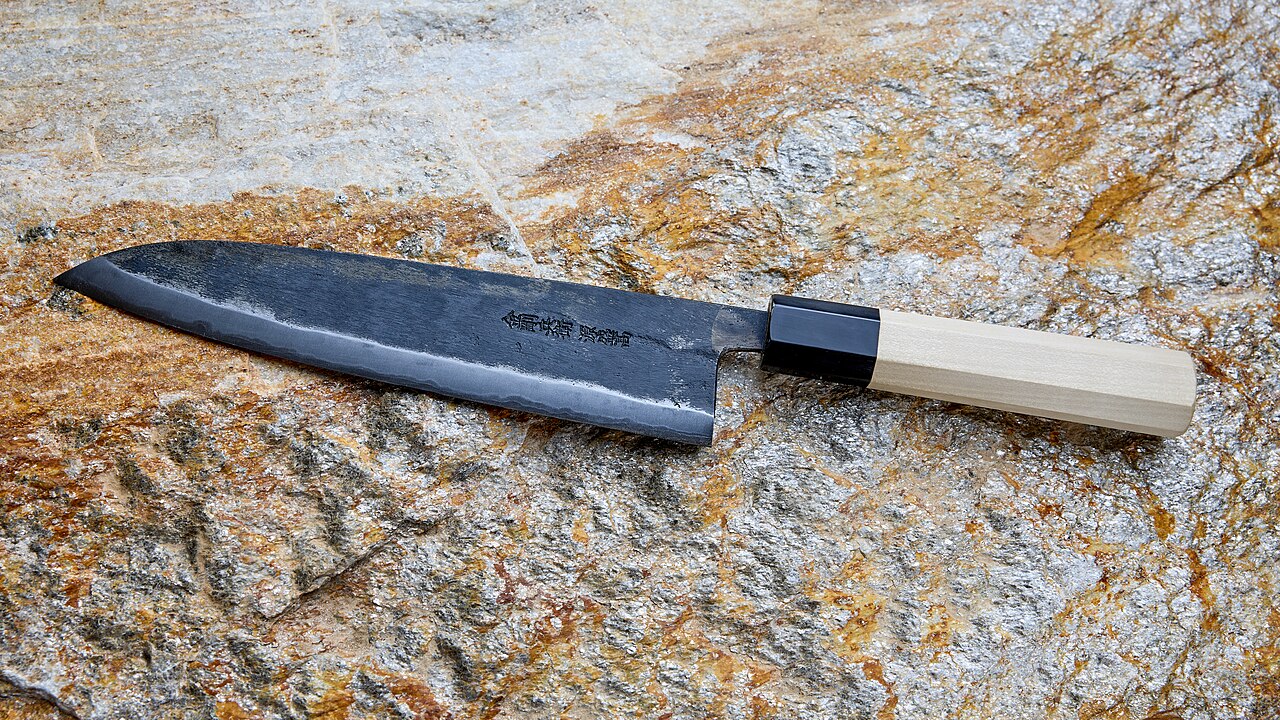
A carbon steel kitchen knife has an edge of high-carbon steel with little or no chromium, so it is not stainless. In Japanese knives that usually means White (Shirogami) or Blue (Aogami) steel from Yasugi. Makers and sellers praise these steels for sharpness and easy sharpening. The cost is care: carbon steel reacts with food, darkens to a patina and rusts if it is left wet. Choose one if you will wipe and dry the blade every time you use it.
Carbon vs stainless at a glance
Steel figures are Proterial’s typical compositions. GIN3 is a Yasugi stainless steel that Proterial lists for kitchen knives (Masamoto sells it as Silver #3), so it makes a fair comparison:
| Point | Carbon steel | Stainless steel |
|---|---|---|
| Example grades | Shirogami 2 (White #2), Aogami 2 (Blue #2) | GIN3 (Silver #3) |
| Carbon | 1.05–1.15% in both | 0.95–1.10% |
| Chromium | None listed for White #2; 0.20–0.50% for Blue #2 | 13.00–14.50% |
| Hardening hardness | HRC 60 or over | HRC 59 or over |
| How the maker describes it | “Carbon steel with minimum impurities” (White); alloy steel with tungsten and chromium for wear resistance (Blue) | “Stainless steel which has hardness and sharpness comparable to carbon steel” |
| Surface over time | Tarnishes and forms a patina, which helps protect against rust (Chefs Armoury) | Resists rust, but not completely: left wet or dirty it can rust and stain (Masamoto) |
| Daily care | Rinse after acidic food, dry fully before storing and oil the exposed edge (Chefs Armoury); clean and dry at once (Shun) | Wash by hand and dry at once (Shun, Masamoto) |
Sources: Proterial’s Yasugi Specialty Steel pages for Shirogami 2, Aogami 2 and GIN3; Chefs Armoury’s carbon steel knife care; the Masamoto Sohonten catalogue; Shun’s use and care page. Finished knives also depend on heat treatment and grind.
The table shows the real difference. White #2 and GIN3 carry similar carbon; GIN3 is stainless because of its chromium. That is why “high carbon” on a stainless label and “carbon steel” are not the same thing.
What “carbon steel” covers
Proterial, the maker of Yasugi steel, lists the White family as carbon steel with minimum impurities. It lists the Blue family as alloy steel with tungsten and chromium added “to improve heat-treatment properties and wear resistance”, and Aogami Super adds vanadium. Both families are carbon steels in the kitchen sense: neither has enough chromium to be stainless. Our White steel vs Blue steel guide compares the grades number by number.
Many carbon knives are clad. Knifewear, a Japanese knife retailer, explains that some knives put a carbon core inside stainless cladding, so only the very edge is exposed and less upkeep is needed. “Full-carbon” knives are clad in softer carbon steel, so the whole blade can rust. Read the listing for both the core and the cladding.
Edge and sharpening
Here the sources speak in tendencies, not guarantees. TOJIRO describes Shirogami as “friendly on sharpening” with a long-lasting edge. It describes Aogami as extra hard with long-lasting sharpness, though it “requires certain sharpening technique”. Knifewear says carbon knives “tend to keep an edge much longer” than standard stainless ones. Proterial’s GIN3 entry is a reminder that some stainless steels are made to compete on the same ground. As our Japanese knife steel basics put it, heat treatment and geometry still decide how a given knife behaves. If you plan to sharpen at home, our whetstone guide covers the basics.
Reactivity and patina
Carbon steel reacts with food. Chefs Armoury says onions, garlic, chives, artichokes and cabbage encourage a black patina, and that acidic foods promote rust. Shun says its Blue #2 Narukami edge “will darken, developing a patina which will help protect the edge”, and that orange or brown colors need attention at once. Knifewear’s rule of thumb: black or grey is good, red or orange is bad. Our carbon steel patina guide covers letting a patina form, forcing one and removing one.
Preventing rust
Chefs Armoury’s routine is short. Never use the dishwasher. Do not leave the knife wet on the bench, and dry it fully before you put it away. Rinse it straight after cutting acidic food, and wipe a little camellia oil on the exposed carbon steel. Shun adds that cleaning and drying straight away is key. Our camellia vs mineral oil comparison helps with the oil. If orange spots appear anyway, follow our guide to removing surface rust before they spread.
Who should choose carbon steel
A carbon knife suits you if you cook often, will wipe the blade as you work and dry it before setting it down, and like sharpening or plan to learn. It suits you less if knives are often left in the sink or on a wet board, or if they are shared with people who will not dry them. A stainless knife, or a carbon core in stainless cladding, is the easier middle ground. If this will be your first Japanese knife, how to choose your first Japanese knife covers the other decisions.
Handle note
Many carbon knives come on wa handles. Keep water and anything acidic off the wood and away from the ferrule, and dry the joint where blade meets handle. Our wa handle care guide covers the handle side, and the wa handle size guide covers fit if you rehandle one.