To carve a spatchcock turkey, let it rest, then work joint by joint on a large board: cut each leg off through the hip joint, separate thigh from drumstick at the knee, take off the wings at their joints, and lift each breast half off the breastbone before slicing it across. This is the joint-first order Illinois Extension teaches for any roast turkey. Only the starting shape is different: the backbone is already gone and the bird lies flat.
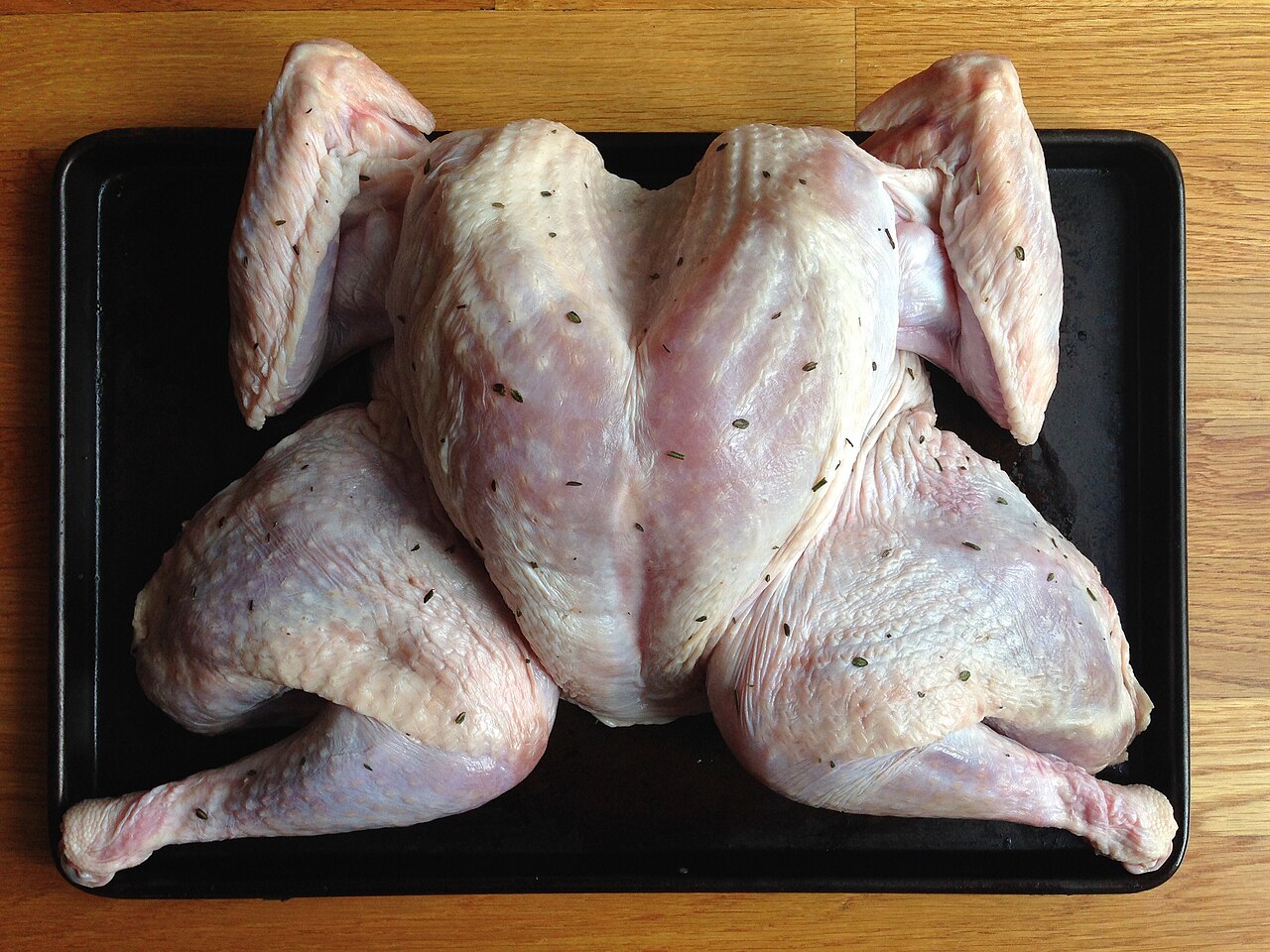
What spatchcocking changes
Spatchcocking is a way of butterflying poultry: the backbone is cut out and the bird is pressed flat. Some cooks also remove the breastbone so it lies flatter still. If yours still has its breastbone, the two breast halves are joined along it and you will cut either side of it in step 4. If the breastbone was removed before roasting, the halves are already separate, so skip that cut and go straight to slicing.
Before you carve
Check the temperature with a food thermometer. Illinois Extension gives 165°F as the safe minimum for whole turkeys and turkey parts, measured in the innermost part of the thigh and wing and the thickest part of the breast. It advises resting a roast turkey for 20 minutes after cooking so the juices spread evenly again for better slicing. A flattened bird is wide, so use the largest stable board you have, with a groove or rim for juices; our carving board guide compares sizes. Keep a carving fork or a folded napkin to steady the meat, as Illinois suggests, and a platter close by.
Step by step
- Remove the legs. Cut through the skin between the thigh and the breast. Press the leg outward and down until the hip joint shows, then cut through the joint to free the leg and thigh together. Repeat on the other side.
- Split thigh and drumstick. Cut them apart at the knee joint. Illinois Extension takes the thigh meat off by slicing around both sides of the thighbone, leaves the drumstick whole, and slices drumstick meat parallel to the bone.
- Remove the wings. Cut into the joint just above each wing and lift it away. Illinois cuts the wing in two at its middle joint; you can serve it whole.
- Lift off the breast. Find the breastbone running down the centre. Cut along one side of it, keeping the blade against the bone, and ease the meat away from the ribs with short strokes until the half comes free. Repeat on the other side.
- Slice the breast. Lay each half skin-side up on the board and slice it across the grain with long, smooth strokes.
Illinois Extension is plain about one rule: cut the bird apart at the joints, because hacking through bone is not an option. If the knife stops, move the leg or wing to find the gap again rather than pushing harder. Kitchen shears can take a stubborn joint or a small bone; our guide to kitchen shears in a Japanese kitchen explains why they suit that contact better than a fine edge.
Keep leftovers safe
Illinois Extension says to refrigerate leftovers within 2 hours of cooking, divide large amounts into smaller portions in shallow containers so they chill faster, and use cooked turkey from the fridge within 3 to 4 days.
The knife for this job
The joint work wants a manageable blade with a usable tip; a chef’s knife or gyuto you know well is enough. If whole birds are a regular job, a honesuki is the Japanese poultry knife, with a stiff, pointed tip for working around joints; see what a honesuki is. Breast slices are cleaner with a longer, thinner slicer; sujihiki vs carving knife compares the two choices. Thin, hard Japanese edges can chip if they hit bone or twist in a cut, which is why why Japanese knives chip is worth reading before carving day. A relaxed pinch grip, covered in how to hold a Japanese knife, keeps the tip under control.
For a wa handle, our size guide puts a 196–255mm gyuto in the Chef size; a honesuki is fitted individually rather than auto-sized. For carving the whole round bird instead, see our turkey carving guide.
Sources: Illinois Extension, Carving (rest, leg, thigh, wing and breast steps; joints, not bone); Illinois Extension, Using a Meat Thermometer (165°F and where to measure); Illinois Extension, Storing Leftovers (2 hours, shallow containers, 3 to 4 days); Wikipedia, Butterflying (definition of spatchcocking).