A sujihiki is a long, narrow Japanese slicing knife for boneless meat and fish. It is double bevel, usually 240–270mm long, with a low blade that draws through a roast or a fish loin in long strokes. Korin calls it the Western-style equivalent of the yanagiba, the traditional single-bevel sashimi knife.
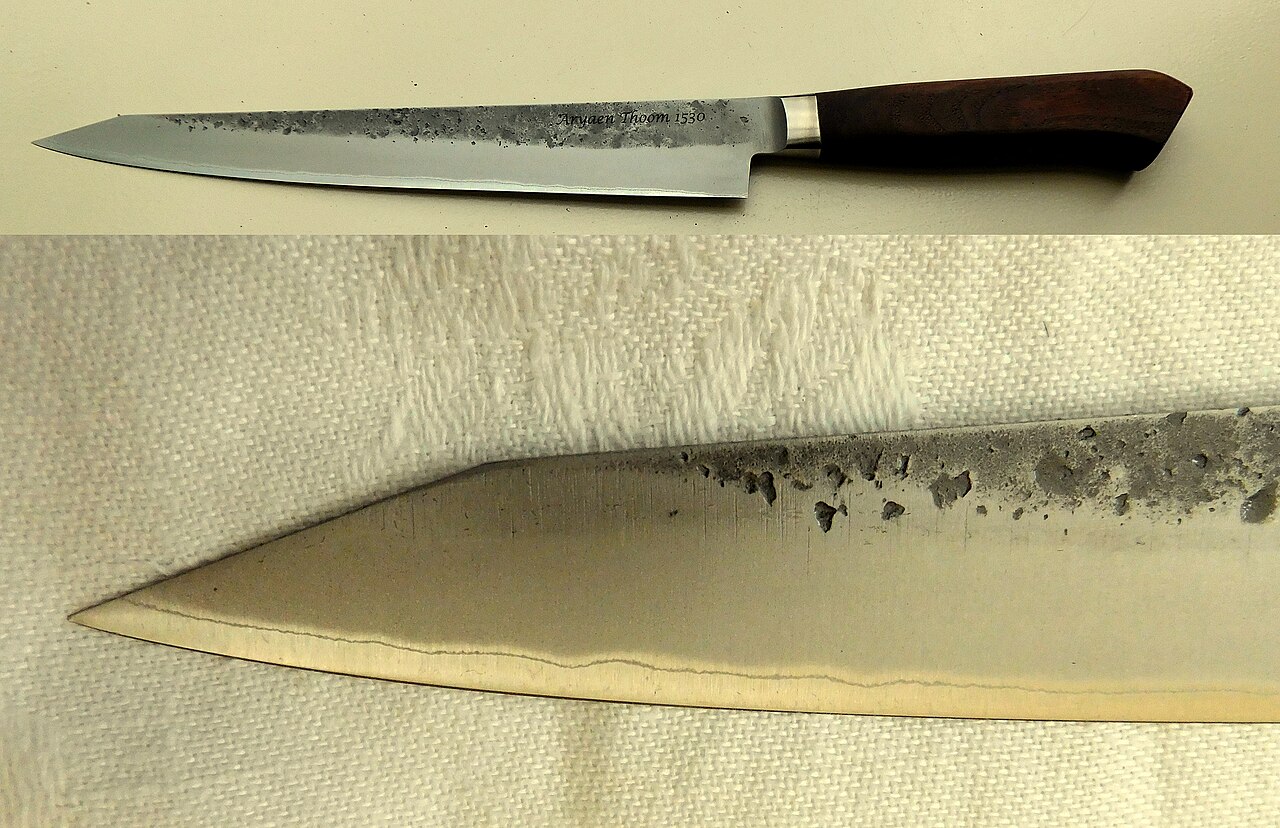
Sujihiki at a glance
Every figure below is as the maker or seller lists it:
| Spec | What the sources list |
|---|---|
| Blade length | 210–240mm for home use and 210–270mm for professionals (TOJIRO); 240 and 270mm in Masamoto’s catalogue; mostly 240 and 270mm at Korin |
| Bevel | Double bevel: Korin lists its Togiharu Molybdenum Sujihiki at 70/30 |
| Profile | Long, with “a much narrower blade” (Masamoto); the short height “creates less friction when slicing” (Korin) |
| One example | Togiharu Molybdenum Sujihiki: 270mm, 202g, 1.58in at the widest part of the blade (Korin) |
| Typical use | Slicing boneless protein (Korin); cutting large slabs of meat into parts, and as a slicer or sashimi knife (TOJIRO); trimming tendons, slicing cooked meats, ham and sashimi (Masamoto) |
Sources: Korin’s sujihiki style page and Togiharu Molybdenum Sujihiki; TOJIRO’s knife guide (archived copy); the Masamoto Sohonten catalogue. These describe particular knives; other makers vary.
What the long, narrow blade does
Length lets one stroke do the work. A slicer is meant to draw its whole edge through the food, rather than saw back and forth in short strokes. The low blade adds less surface to drag through the meat; Korin says the sujihiki’s short height creates less friction, so the blade draws through fish and meat with little effort.
Masamoto lists a further traditional job: its sujihiki is mainly used for removing tendons from meat, as well as slicing cooked meats, ham and sashimi. The same narrow blade gives little knuckle clearance on the board, so a gyuto or santoku remains the better tool for chopping vegetables.
Sujihiki vs its nearest neighbours
Yanagiba. A yanagiba is single bevel and made for one hand, mainly for raw fish. A sujihiki’s double bevel makes it easier to share and to sharpen; see what is a yanagiba.
Gyuto. A gyuto already slices acceptably. Whether a dedicated slicer earns its place is the question in gyuto vs sujihiki.
Carving knife. A Western carving knife does the same job of slicing cooked roasts; sujihiki vs carving knife compares how they are built.
Who it suits
A sujihiki suits a cook who regularly slices roasts, brisket, ham or fish loins and wants thin, even slices in one stroke. Because it is double bevel, it can be shared between right- and left-handed cooks. If you rarely slice large pieces, the gyuto you already own may be enough.
Handle size for this knife
On our wa handle size guide, a sujihiki of 210–255mm takes the Chef · gyuto, kiritsuke size, with a starting handle length of about 125–135mm. One of 256–360mm takes Long · sujihiki, yanagiba, at about 140–150mm or more. From about 270mm, both yanagiba and sujihiki take Long. These are starting ranges, confirmed against your own knife before the build begins. On our product pages you enter the knife type and blade length and the size recommender picks the tier; then build the handle in the handle configurator.