To julienne carrots, peel and cut them into short lengths, slice a thin piece off one side so each length sits flat, cut it into thin planks, then stack a few planks and slice them lengthwise into matchsticks. Utah State University Extension gives the classic julienne as strips 1/8 inch by 1/8 inch by 2½ inches. Kikkoman’s Japanese version, sengiri, uses 4-5 cm lengths and 1-2 mm planks for a finer strip. Use the size your recipe asks for; evenness matters more than the exact number.
For a broader beginner path through the basic cuts and their sizes, see our knife skills for beginners guide.
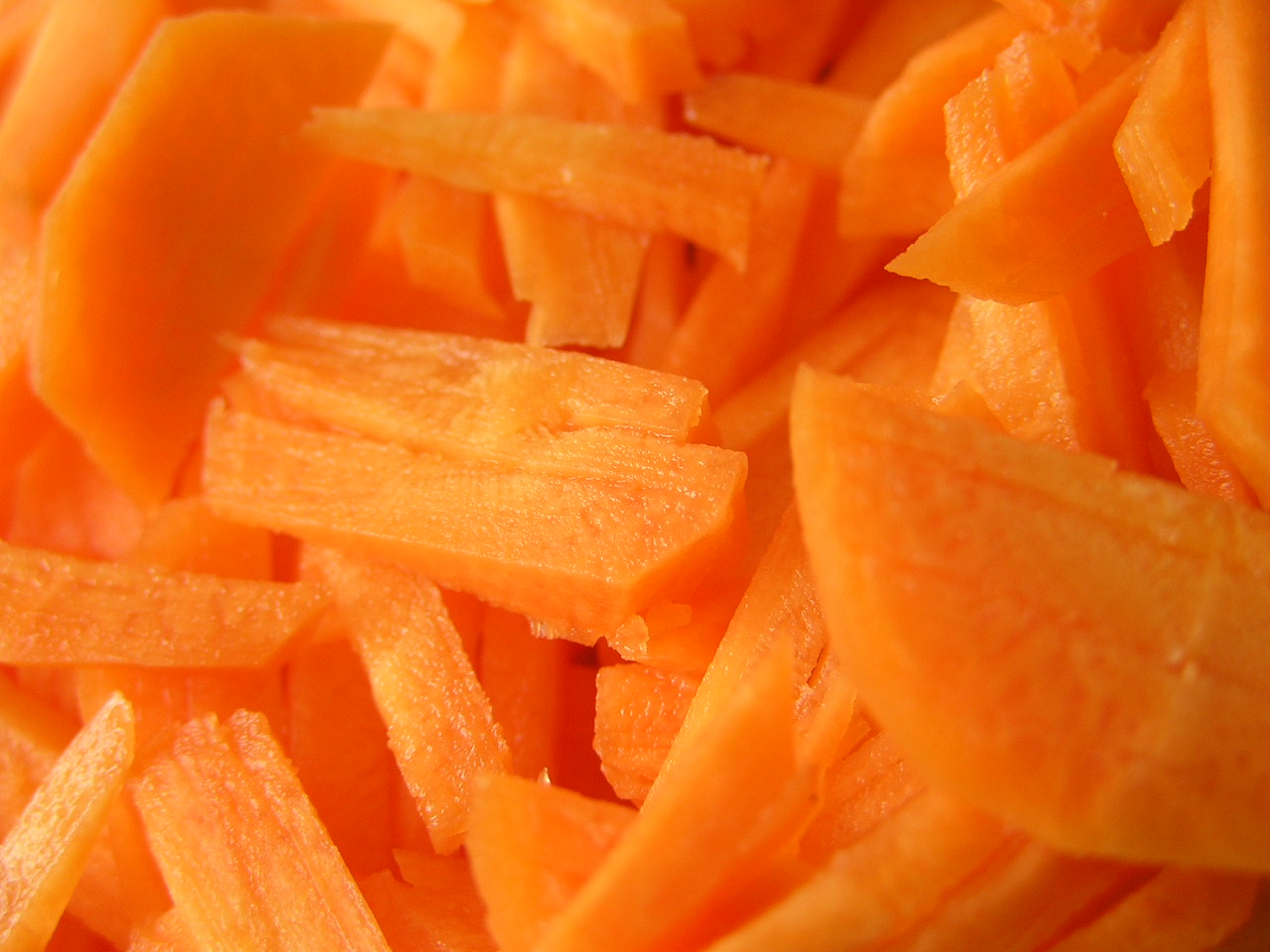
Julienne and the neighboring cuts
| Cut | Size | Typical use |
|---|---|---|
| Julienne | 1/8 × 1/8 × 2½ in strips (USU Extension) | Salads, slaws, stir-fries, garnishes |
| Batonnet | 1/4 × 1/4 × 2½-3 in strips (USU Extension) | Thicker sticks; crosscut into ¼-inch small dice |
| Brunoise | 1/8-inch cubes (USU Extension) | A fine dice, made by cutting julienne across |
| Sengiri | 4-5 cm lengths from 1-2 mm planks (Kikkoman) | Japanese salads and garnishes |
America’s Test Kitchen describes the same classic sequence, starting from a squared 2-inch length and ending with 2 × 1/8 × 1/8-inch sticks.
Step by step
- Cut short lengths. Peel the carrot and cut it into pieces about the length of the strip you want; Kikkoman uses 4-5 cm, about 2 inches. Short pieces are easier to hold steady than a whole carrot.
- Make a flat face. Kikkoman says it is safer and easier to cut if you slice a thin piece off one side and set that cut face down. Mississippi State University Extension gives the same rule for round foods.
- Cut planks. Slice the length into even planks, as thick as the strip will be wide: 1/8 inch for a classic julienne, 1-2 mm for sengiri.
- Stack and slice. Stack two or three planks, sliding them so they lie flat, and slice lengthwise at the same spacing to make matchsticks. Keep the guiding hand curled, fingertips tucked behind the knuckles.
Squaring off all four sides makes neat, identical sticks but wastes carrot, and America’s Test Kitchen notes the rectangles tend to slip under the knife. Its simpler method is to slice the carrot on the bias into slices about 2 inches long, shingle them in a line and cut them into thin sticks, guiding the knife with the knuckles of the non-knife hand. The sticks vary a little in length, which ATK says is fine for most dishes.
Why strips taper or break
Uneven planks make uneven sticks: if the first slices vary, careful final cuts cannot fix it. A stack that is too tall will slide, so keep it low. If the knife wedges in a dense carrot, the cause may be motion or blade geometry rather than a dull edge; our guide to why a sharp knife wedges in vegetables helps you tell which. If you would rather use a mandoline with a julienne blade, read how to use a mandoline slicer first and use the guard.
What this means for your knife and handle
Julienne is a slicing job, so a thin, sharp blade with a flat stretch of edge suits it: a gyuto, santoku or nakiri all work, as our Japanese vegetable cutting guide explains. Long runs of fine cuts are where a comfortable handle and a relaxed grip pay off; see how to hold a Japanese knife. If the edge skates on the carrot skin, check it with our guide on how to tell whether a knife is sharp.
Sources: Utah State University Extension, Knife Skills handout (julienne, batonnet and brunoise sizes); Kikkoman, Julienned (carrot lengths, flat face, 1-2 mm planks); America’s Test Kitchen, A Simpler Julienne; Mississippi State University Extension, kitchen knife basics.