For a first general kitchen knife, choose steel. It offers more choice in blade shapes, working geometry and sharpening methods. A ceramic knife can be a useful additional slicer for suitable fruit, vegetables and boneless food, especially if you enjoy a light blade. Buy it with a clear storage plan and a sharpening method specifically approved for ceramic.
The decision is less about which material is “sharper” than which jobs you expect one knife to do. A knife that suits breakfast fruit preparation may be a poor choice for the mixed, occasionally awkward work of preparing an entire dinner.
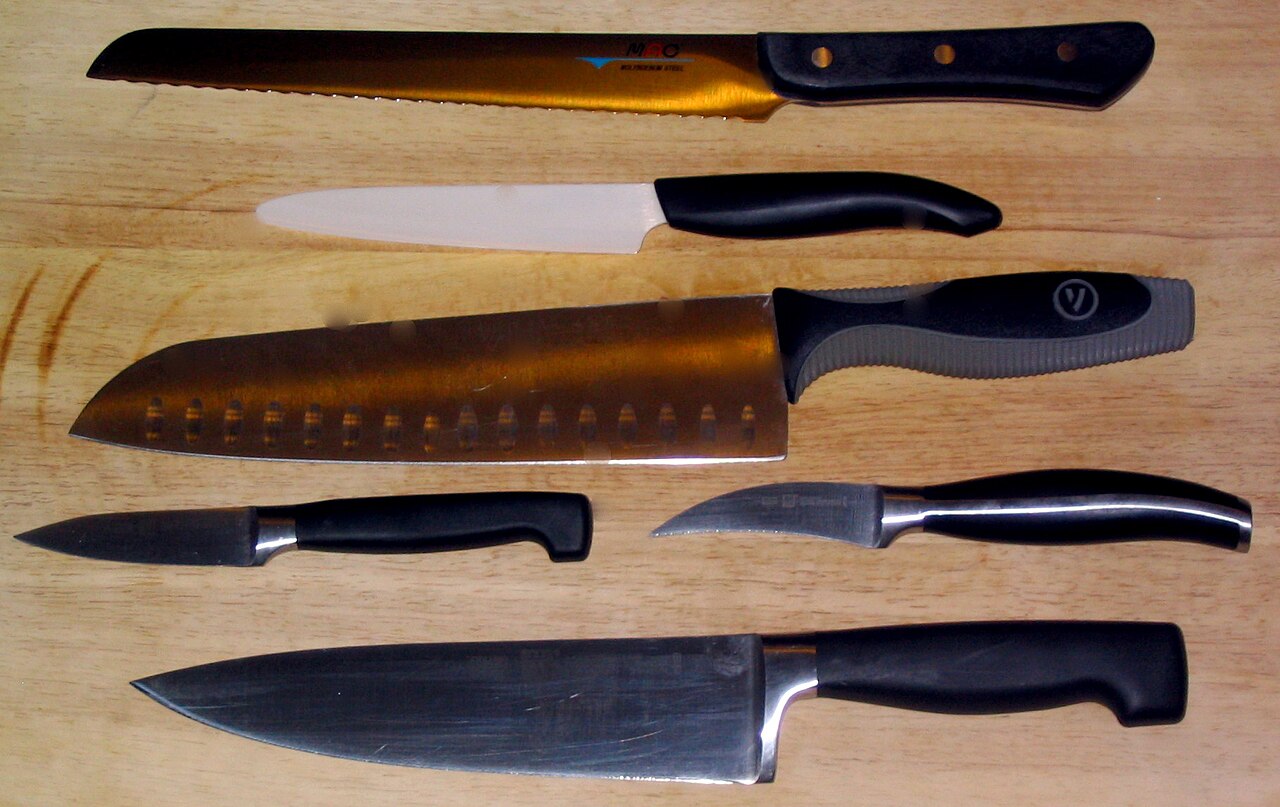
Identify what the word ceramic describes
A ceramic blade is different from a steel blade with a ceramic coating. It is also unrelated to the ceramic abrasive in some sharpeners. Check the blade material in the specifications rather than identifying it by colour: neither a black blade nor a white one establishes what is underneath.
That distinction becomes important when the edge needs attention. A sharpening tool sold as “ceramic” may be designed to sharpen steel knives. Its name can describe the abrasive wheel or rod, not the material it accepts.
Steel is a broad category too. A thin, hard Japanese gyuto and a sturdy knife intended for heavier work do not behave alike simply because both are metal. The steel basics guide explains why material, hardness and geometry need to be considered together.
Smooth slicing is ceramic’s natural role
Kyocera describes its ceramic knives as tools for smooth slicing and suitable preparation of produce and boneless proteins. It explicitly excludes bones, frozen food, heavy-rind squash and coconuts, as well as prying and smashing garlic with the blade’s side. Those are product-use limits, not an invitation to test the material’s toughness. Kyocera’s use guidance.
Imagine a small station used for cucumber, tomatoes and peeled fruit. A ceramic slicer can have a well-defined job there. Now consider a crowded station where the same knife is picked up to force through dense food, lever a pit or scrape the board. The opportunity for inappropriate loading is much greater.
Steel gives you a broader range of purpose-built tools, but it does not make every steel knife suitable for those jobs. Japanese Knife Imports warns against hard inclusions and sideways force with thin, hard blades. A delicate steel knife still needs appropriate technique and food. JKI’s knife-care guidance.
Edge wear and breakage are different problems
An edge that resists ordinary wear can still be vulnerable to a knock or sideways load. Ceramic’s hardness therefore should not be read as a promise that the knife will tolerate being dropped into a sink, twisted in food or stored against other utensils.
For a buyer, “holds an edge” needs two follow-up questions: under what use, and what happens when it no longer cuts well? A long interval between sharpening is useful only if the blade remains intact and you can restore it when needed.
Avoid treating a manufacturer’s edge-life claim as a fixed number of meals. Food, board contact, technique and blade design all change the comparison. We have not tested these materials against one another, so there is no honest basis here for a universal multiplier or a winner on sharpness alone.
The everyday observation that matters is whether the knife cuts its intended foods cleanly without extra force. That applies to steel and ceramic alike.
Sharpening may decide the purchase
Steel kitchen knives can be maintained with an appropriate stone, compatible guided system or professional service. The right method still depends on the blade’s geometry; the sharpener guide explains those choices.
For ceramic, choose an explicitly compatible route. Kyocera provides both professional and home-maintenance options for its knives. Do not assume your existing steel-knife sharpener is suitable, or that any tool containing diamond automatically has the right guides and instructions for your ceramic blade. Kyocera’s sharpening support. If the edge is already dull or chipped, see our maker-specific ceramic-knife recovery guide for compatible home and professional routes.
A useful naming example appears in Kyocera’s own range: RSN-20BK has a ceramic wheel and is described for steel knives. RSD-01-BK has a diamond wheel and is described for Kyocera ceramic and steel knives. The first product’s “ceramic” label refers to its abrasive; the second explicitly accepts the ceramic blade. Kyocera’s sharpener specifications.
Before buying, establish whether the service or compatible device is available where you live. Include its cost and practical inconvenience in the decision. Do not buy a chipped second-hand ceramic knife on the assumption that routine sharpening can repair every defect.
Care moves from corrosion to contact
Ceramic avoids the rust concern associated with a steel blade, but washing and storage still matter. Food residue still needs to be removed, the handle still needs appropriate care, and the edge needs protection from hard contact.
Kyocera’s current US guidance calls for hand washing with mild detergent and protected storage in a block, tray or sheath. Avoid a loose drawer where the edge meets other tools. These are small routines, but they are central to ceramic ownership rather than optional precautions for special occasions. Kyocera care and storage.
Use a suitable cutting board for either material. Do not move from the board to a ceramic plate for the last few slices and assume that a hard blade makes the surface harmless. Kyocera also advises against twisting or levering its blades and provides separate instructions for damage and sharpening. Kyocera handling manual.
Choose for the person sharing the kitchen
If several people reach for one general knife, a steel model suited to their normal tasks is the more practical first choice. Its profile, grip and maintenance should fit the household. The first Japanese knife guide is a useful starting point if you want a Japanese steel knife specifically.
Ceramic makes more sense as an additional tool with a clear role: a light slicer that returns to protected storage and is kept away from jobs requiring impact, twisting or force. Someone who already uses that routine may find its limits easy to accommodate.
Choose the blade whose upkeep and working limits you will actually respect. A modest steel knife maintained regularly can be an excellent daily tool; a ceramic knife can be an enjoyable companion when its narrower role suits your cooking.