A used Japanese knife is worth buying when its remaining shape suits your cooking and its condition can be understood before you pay. A famous maker’s stamp, attractive patina or fresh polish does not answer either question. Start with the complete blade, then examine the edge, tip, straightness and handle. Add essential repairs to the delivered price before comparing it with a sound alternative.
The most useful first distinction is between a knife you want to cook with and a restoration project you want to work on. Either can be satisfying. Trouble begins when the price assumes the second and your expectations assume the first.
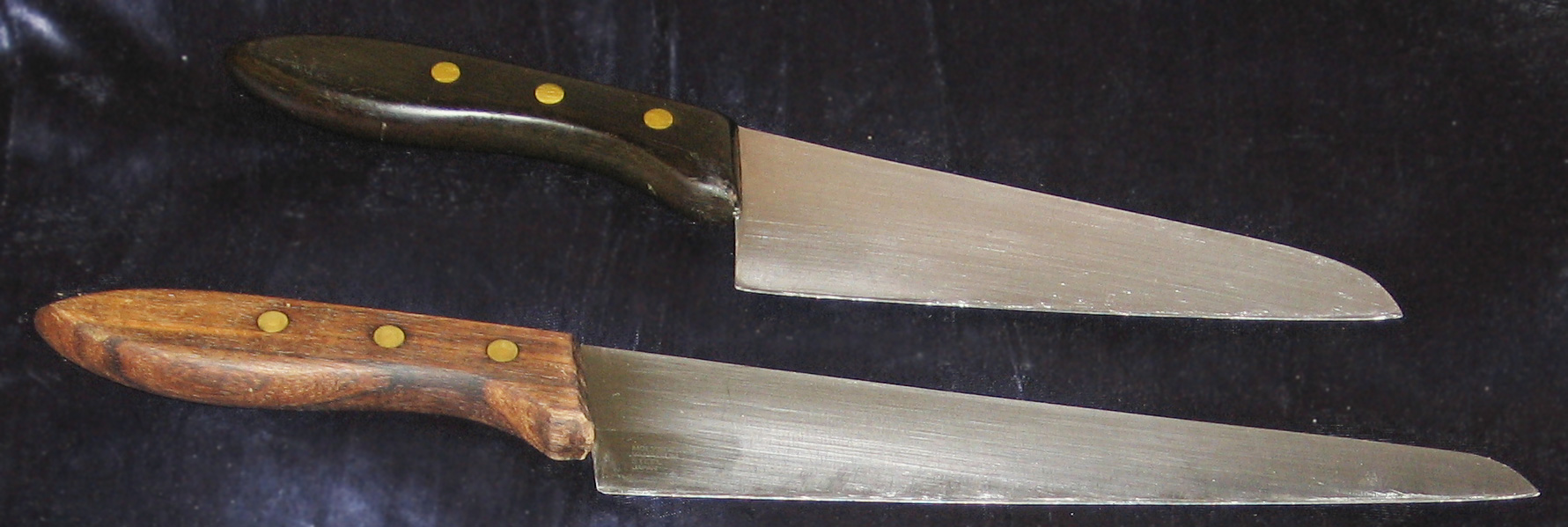
Ask for the knife’s present dimensions and history
An old catalogue description may say 210 mm, but previous sharpening or a repaired tip can change the knife you receive. Ask for its current blade length and height at the heel, plus clear photographs of both complete sides. A ruler in the same plane helps make the scale intelligible. Handle length and overall weight are useful context when balance matters to you.
Ask whether the knife has been thinned, had chips removed, been straightened or received a replacement handle. “Recently sharpened” describes an operation, not the quality of the result. A seller who can explain what was done gives you more to evaluate than one who only says it is sharp.
Also establish the intended handedness and bevel type. A single-bevel yanagiba bought cheaply is still the wrong tool for ordinary vegetable preparation if what you need is a general kitchen knife. Use the first Japanese knife guide to settle the task before chasing a bargain.
Request views that show more than the finish
A useful photo set includes both blade faces, the whole edge profile, close views of the tip and heel, a view along the spine, the handle junction and any disclosed damage. A clear view from the heel toward the tip can help show the blade’s thickness and asymmetry, although perspective limits what you can judge from a photograph.
For a single-bevel knife, ask to see the back as well as the broad front bevel. Its condition needs assessment by someone familiar with that geometry. A shiny back is not proof that it was maintained correctly, and an apparently uneven front bevel is not enough to diagnose a defect.
Avoid asking the seller to demonstrate straightness by laying a blade face on a table. Japanese Knife Imports explains that asymmetric grinds can make a straight blade appear bent in that test; trained visual inspection from several directions is more useful. Its repair notes also distinguish twisting from sideways bending. Neither is something to price as “just a quick sharpening.” JKI’s straightness and geometry notes.
Read the edge as a continuous shape
Look from heel to tip rather than zooming only into the worst chip. Does the outline still resemble the profile you want? A long rising belly, a flatter chopping section and a fine tip serve different movements. A previous repair may leave a functional knife with a shape you would not have chosen new.
A local hollow in the edge deserves attention because it may leave part of a cut connected on the board. A shortened blade may still be useful, but its original model length no longer describes its reach. A tall knife that has lost substantial height may have less knuckle clearance than the same model in a shop photograph.
Repair consumes more than the missing piece. Removing a deep chip requires bringing surrounding steel into a coherent edge, and the thicker material above that new edge may need thinning. A specialist’s service description separates sharpening, chip repair, thinning and refinishing for good reason. These are different jobs, with different effects on the knife. JKI’s service explanation.
The broken-tip and deep-chip guide explains the shape tradeoffs. For buying purposes, the question is whether the likely result is worth owning, not whether all visible damage can theoretically disappear.
Separate old colour from unresolved corrosion
Dark staining can be part of a used carbon-steel knife’s appearance. Orange corrosion, cavities near the edge or recurring rust at the handle junction raise different questions. Cleaning a face does not reveal the depth of every pit, and a photograph cannot certify the hidden tang.
Ask for close photographs of suspect areas after ordinary cleaning and drying, without requesting aggressive polishing. Fresh abrasive work can remove evidence and change the finish you were hoping to preserve. The rust-removal guide separates surface cleaning from situations that need closer assessment.
If the listing shows a crack, serious pitting at the cutting edge or a doubtful blade-to-handle junction, obtain a professional assessment before treating it as a usable kitchen knife. There is no photograph-based depth threshold that makes every such purchase acceptable. A low price does not resolve an unknown repair.
Inspect the handle without removing a secure one
A worn handle can be replaceable; a sound tang is the prerequisite. Ask whether the handle moves, whether the wood or ferrule is cracked, and whether corrosion is emerging at its mouth. An intentional gap near the blade’s shoulders is not, by itself, evidence that the handle is loose.
When the handle is secure, leave it installed. Clear junction photographs and visible junction height and thickness are useful partial evidence. They do not reveal the dimensions or condition of the steel inside, and the seller should not remove a good handle merely to produce measurements.
If the tang is already exposed, request exactly three primary dimensions in millimetres: usable length from the shoulder or seating line to the tip, height near that shoulder, and face-to-face thickness at the same station. The tang measurement guide shows how to record them. An attractive replacement handle cannot compensate for an unsuitable or damaged tang.
Price the knife you will actually receive
Compare the purchase price plus delivery, applicable import costs and necessary work with a sound knife that meets the same need. Keep cosmetic refinishing separate from work required for reliable use. You may happily accept scratches while still needing a proper edge repair.
Before paying, make sure the return terms cover the uncertainty you are taking on, and keep the seller’s photographs and condition description. A stamp or claimed workshop connection alone is not authentication. If maker identity is what creates the price premium, the evidence for that identity matters independently of whether the knife cuts well.
A straightforward purchase has a suitable present shape, clear condition and manageable upkeep. A restoration purchase has a defined problem, an assessed repair and an acceptable total. When photographs or answers cannot distinguish those two, passing on the knife is a complete buying decision.