Choose SG2 when greater resistance to abrasive edge wear is a worthwhile part of a knife you already like. Choose VG-10 when that particular knife gives you the shape, fit and value you need. Both are stainless knife steels, and either can make a useful everyday kitchen knife. SG2 is not a reason to accept the wrong size or grind; VG-10 is not a reason to dismiss a well-made knife.
The difference becomes clearer when you separate three questions: how the steel is made, how the edge wears, and what the completed knife asks of its owner.
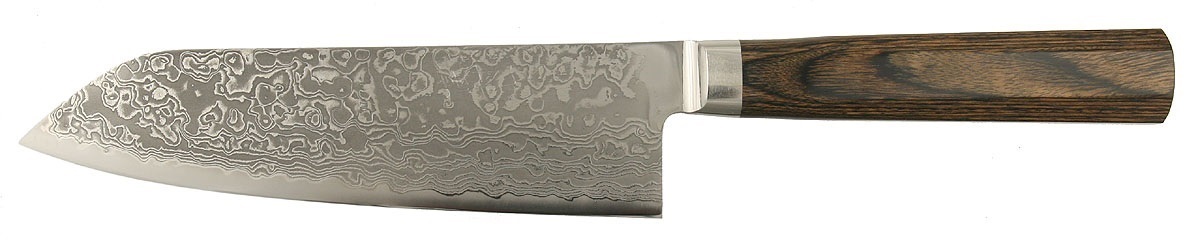
What changes inside the steel?
Takefu Special Steel describes SG2, or Super Gold 2, as a powder-metallurgy steel. This production route begins with steel powder and produces a fine, uniform structure. Takefu presents hardness, toughness, abrasion resistance and corrosion resistance as aims of the grade.
VG-10 is a different stainless blade-steel design, with chromium, molybdenum, vanadium and cobalt among its alloying elements. Takefu emphasizes wear resistance, corrosion resistance and sharpening in its description.
“Powder steel” therefore tells you something meaningful about SG2’s manufacture. It does not tell you that its factory edge is sharper, that a particular knife has a thinner grind, or that you cannot sharpen it at home. Those questions concern the finished tool and its maintenance.
Edge retention means more than one thing
An edge can lose useful sharpness through gradual wear. It can also be damaged by rolling or chipping, or cut poorly because its geometry does not suit the food. A claim about wear resistance addresses one part of that picture.
Metallurgist Larrin Thomas’s VG-10 and SG2 investigation placed SG2 ahead in wear resistance. The SG2 edge-retention value in that article was estimated, rather than measured in a pair of matched kitchen knives. His specimens also showed similar corrosion behaviour and fairly close toughness at comparable hardness.
This supports considering SG2 for resistance to abrasive wear. It does not support an “SG2 lasts twice as long” promise in your kitchen. Nor does it establish that all VG-10 knives resist chips better. Different heat treatments, edges, ingredients and cutting habits would all enter such a comparison.
If your current knife dulls gradually during ordinary preparation, wear resistance may matter. If the edge repeatedly chips, first investigate the edge and the way it meets the food and board. Buying a more wear-resistant steel does not directly solve that second problem. Our guide to chipped Japanese knives explains how to separate those causes.
What this means at the sharpening stone
Sharpening deliberately removes steel to rebuild an edge. A material that resists wear can also ask more of that abrasive work. That is a useful expectation, not a stopwatch prediction: the stone, edge thickness, damage and sharpening technique all influence the session.
Do not assume that SG2 requires an entirely new sharpening kit. Begin with your knife and stone makers’ compatibility guidance. A suitable medium stone can form part of routine maintenance; repair work and a very worn or thickened edge are different jobs. The whetstone grit guide separates ordinary dullness from repair and optional polishing.
The practical question is whether you prefer to refresh an edge more readily or value a possible longer interval between wear-related sharpenings. A cook who already enjoys maintaining VG-10 may gain little from changing steels. Someone making many repeated cuts may give wear resistance more weight, provided the rest of the knife fits.
Neither preference makes the technique optional. Work along the whole edge, complete the deburring step and assess the cut before progressing to a finer finish. Repeatedly polishing an unfinished edge will not reveal the steel’s potential.
Compare similar knives before comparing prices
A thin 240 mm SG2 gyuto and a short, heavier VG-10 santoku differ in more than their steel. The longer blade may suit large ingredients; the shorter knife may fit your counter better. One may separate dense food more readily because of its grind, regardless of which steel costs more.
Bring the comparison closer to like for like. Start with the same general blade type and a similar length. Then look at blade height, thickness and grind, handle fit, bevel, construction and the maker’s finished specifications. If those are substantially different, treat your choice as a whole-knife decision.
This is also why cladding belongs in the description. A steel name may identify the cutting core, while another material forms the outer faces. The anatomy guide explains how those parts fit together. Decorative layers, a polished finish and a more elaborate handle can affect price without changing the core steel comparison.
Which would we put on the shortlist?
| Your priority | A useful starting point |
|---|---|
| A dependable knife within a firm budget | Keep a suitable VG-10 model on the shortlist; reserve money for a board and maintenance |
| Wear resistance in a similar knife you already want | Consider SG2, with a realistic sharpening plan |
| Fixing recurring chips or uncomfortable handling | Diagnose those problems first; the steel name alone does not resolve them |
These are buying priorities rather than a ranking of every knife. If the SG2 version costs more, identify what you gain in the complete product. If you cannot explain that gain in terms of your cooking, keeping the better-value VG-10 option is a reasonable decision.
The care routine is still ordinary
Both steels belong in a stainless-care routine: clean after use, dry thoroughly and protect the edge in storage. TOJIRO’s maintenance guidance is a useful example of why stainless is not permission to leave a knife wet or dirty.
The final choice should leave you with a knife you can use confidently and maintain. Use the steel comparison to refine that choice after the broader steel basics are clear—not to overrule the blade, handle and working space you actually need.