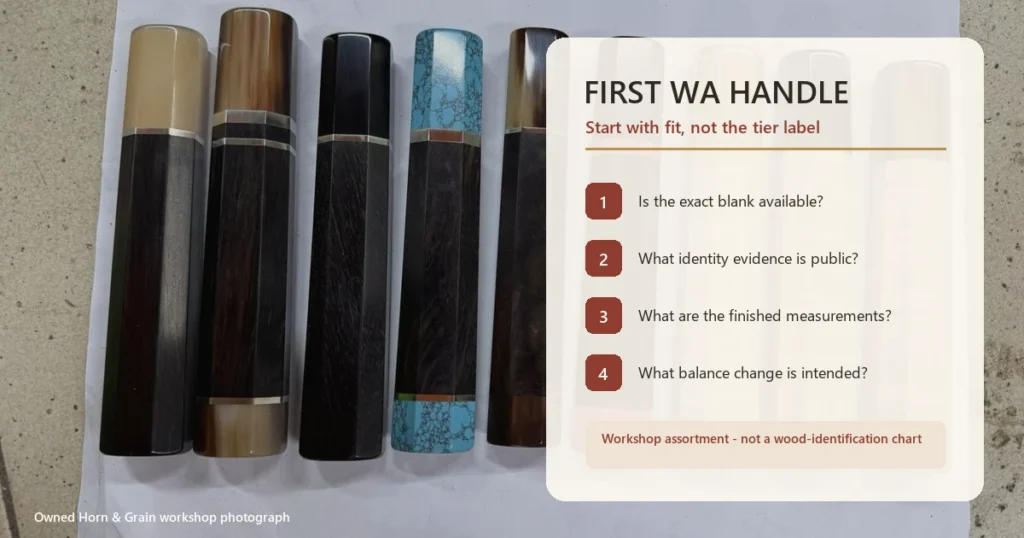
Quick answer: for a first Horn & Grain wa handle, Walnut is the clearest evidence-backed starting point in the current Entry tier. It is marked available, has a current black-horn product example, and the public catalog declares Juglans nigra. Mã Wood is also marked available, but its botanical identity is not publicly verified; choose it only after the actual blank, identity, finish, measurements and finished weight are confirmed. Cherry, Maple and Oak appear in the current Entry tab as “Check stock” request materials, so they are possibilities to ask about, not immediate stock promises.
“Entry” is a catalog tier, not a grade of performance and not a guarantee that one wood is cheapest, lightest or easiest to maintain. The best first handle is the one that fits the tang, creates the balance you want, suits your grip and comes with evidence you can evaluate. Do not save on the wood name and then guess at the fit.
The current entry-level shortlist
Walnut: available, evidence-rich
- Public identity: catalog-declared Juglans nigra; supplier or batch proof still needs confirmation for the piece.
- Visible direction: warm brown grain with a current black buffalo horn product example.
- Best first question: does this measured candidate preserve or change my knife’s balance as intended?
Mã Wood: available, identity unresolved
- Public identity: the configurator supplies the name Mã Wood, not a verified botanical species.
- Evidence limit: the label cannot support claims about density, durability, origin or care.
- Best first question: what species, supplier, batch, finish and actual-piece measurements support this option?
Cherry, Maple and Oak: check stock
- All three appear in the current Entry tab but are marked available by request.
- Supplier confirmation and an approved individual blank are required before treating one as an orderable choice.
- Compare real candidates only; do not rank a preview swatch against available stock.
Why Walnut is the safer first comparison
Walnut does not win because it is universally lightest. It wins this starting recommendation because the current offer is easier to verify. Horn & Grain shows Walnut as available in the configurator, publishes a Walnut & Black Buffalo Horn product example, and declares the material as black walnut, Juglans nigra. Kew accepts that species, while the USDA Forest Products Laboratory documents the species’ characteristic brown heartwood, grain and wood properties.
That still does not prove an individual blank. Ask whether the supplier or batch record supports the declaration and whether the photographed piece is the one you will receive. The product page does not publish finished weight or complete dimensions, so your decision should be conditional on the actual candidate. The dedicated walnut wa-handle guide covers that piece-level review in depth.
How to evaluate Mã Wood without guessing
Mã Wood is a current available label, but the public catalog does not give it a verified botanical identity. A common or supplier name can map to different materials, and visual similarity cannot resolve species. Without identity and batch information, claims such as “harder than walnut,” “more water resistant,” “locally sourced” or “low maintenance” would be unsupported.
This does not automatically make a Mã handle unsuitable. It changes the buying process. Request the botanical name if known, supplier and origin record, clear photographs of the exact blank, finished weight and dimensions, moisture or seasoning confirmation appropriate to the maker’s process, and the intended finish. If those answers are unavailable, choose by verified fit and appearance only—and accept that species-level performance claims remain unknown.
What “Check stock” means for Cherry, Maple and Oak
The current configurator keeps Cherry, Maple and Oak visible in the Entry tier but marks them as request materials. Horn & Grain explains that check-stock woods need supplier confirmation. A preview is therefore an invitation to ask, not evidence that a suitable blank is on the bench today.
If one of these is your preference, contact the maker before building the rest of the design around it. Ask which exact species is being quoted, whether the blank is available now, and whether photographs, dimensions, finish and finished-weight targets can be supplied. Do not carry botanical names or care claims from an old article into a new order unless they match the current supplier record.
Fit outranks the tier label
A modest material with a correct tang fit is a better first handle than a premium blank shaped from guesses. Record the blade type and length, tang height and width near the shoulder, current handle length, and any known insertion depth. Include photographs from the side, spine, choil and tang opening with a ruler visible. If the old handle is loose or already removed, say how it was installed and describe any gaps or damage.
Horn & Grain’s current S, M, L and XL choices are blade-length pricing bands, not universal finished dimensions. The company says it confirms final length, cross-section and tang fit from the knife measurements. Use the size and fit guide for a starting framework, not as permission to skip measuring your knife.
Balance: ask for a result, not a “light wood”
Wood species can influence mass, but handle geometry and added materials can overwhelm a simple species ranking. A larger walnut handle may weigh more than a smaller handle in another wood. Ferrule material, metal rings, end caps, bore depth, final moisture content and finish all contribute. There are no verified matched finished weights on the current Entry choices, so this guide does not invent a lightest-to-heaviest table.
State the result you want: keep the knife blade-forward, move the balance slightly toward the hand, or preserve the present balance while changing shape. Then request the candidate handle’s finished weight and dimensions. If the maker cannot supply a final figure before shaping, ask for a target range and an approval step before installation. Tier price is not a balance measurement.
Choose shape for the user
The current configurator offers octagonal, oval, D-shape and round profiles. An octagonal handle is a sensible first choice when clear blade orientation matters. Oval and round profiles allow easier rotation. A D-shape is handed; Horn & Grain’s current order flow asks for left- or right-handed orientation and says the finished profile will be confirmed. None of these shapes is universally most comfortable.
Tell the maker which hand will use the knife, whether the user pinch-grips or holds farther back, and where the present handle causes pressure. Corner easing, taper and cross-section affect comfort more than the label alone. A first buyer should prioritize repeatable orientation and a pressure-free grip over extra decoration.
Keep the first design easy to verify
Start with one available wood, one ferrule direction and no optional end cap or rings unless they solve a clear visual or balance goal. Every added material changes appearance and may change weight. Natural horn also varies, so ask whether the photo shows the exact ferrule. A simpler specification makes it easier to see whether wood, shape or dimensions caused the result.
For care, ask which finish is applied and which product is compatible with it. USDA Forest Products Laboratory guidance explains that wood exchanges moisture with its environment and that finishes support appearance, protection and cleanability rather than making wood waterproof. Keep any natural-wood handle out of the dishwasher and standing water, and dry the ferrule and blade junction promptly.
A five-question first-order checklist
- Availability: is this exact wood and blank available now, or only shown by request?
- Identity: what catalog declaration, supplier or batch record supports the material name?
- Fit: which knife and tang measurements will determine final dimensions and insertion depth?
- Balance: what are the candidate’s finished weight and dimensions, and what change should they create?
- Approval: will you review actual-piece photographs, finish, shape and measurements before installation?
If a seller answers only with a tier name or generic species description, the decision is not ready. A useful first-handle quote connects a real piece to a real knife and states which facts remain to be confirmed.
Reviewed 8 August 2026. Method: the current Horn & Grain configurator and Walnut product page were checked for material names, availability states and order fields. Walnut’s catalog declaration was checked against Kew and USDA references. No price, stock duration, unverified Mã identity, request-only availability, finished weight, dimensions or universal performance ranking was inferred.
Sources and next reading
- Horn & Grain wa handle wood guide for the broader material landscape
- Horn & Grain wa handle care guide for routine inspection and finish-aware care
- Horn & Grain contact page for check-stock and identity questions
- Royal Botanic Gardens, Kew: Juglans nigra
- USDA Forest Products Laboratory: Black walnut (Juglans nigra)
- USDA Forest Products Laboratory: Moisture relations and physical properties of wood
- USDA Forest Products Laboratory: Finishing wood
Start a first-handle configuration and send the measurements needed for fit review