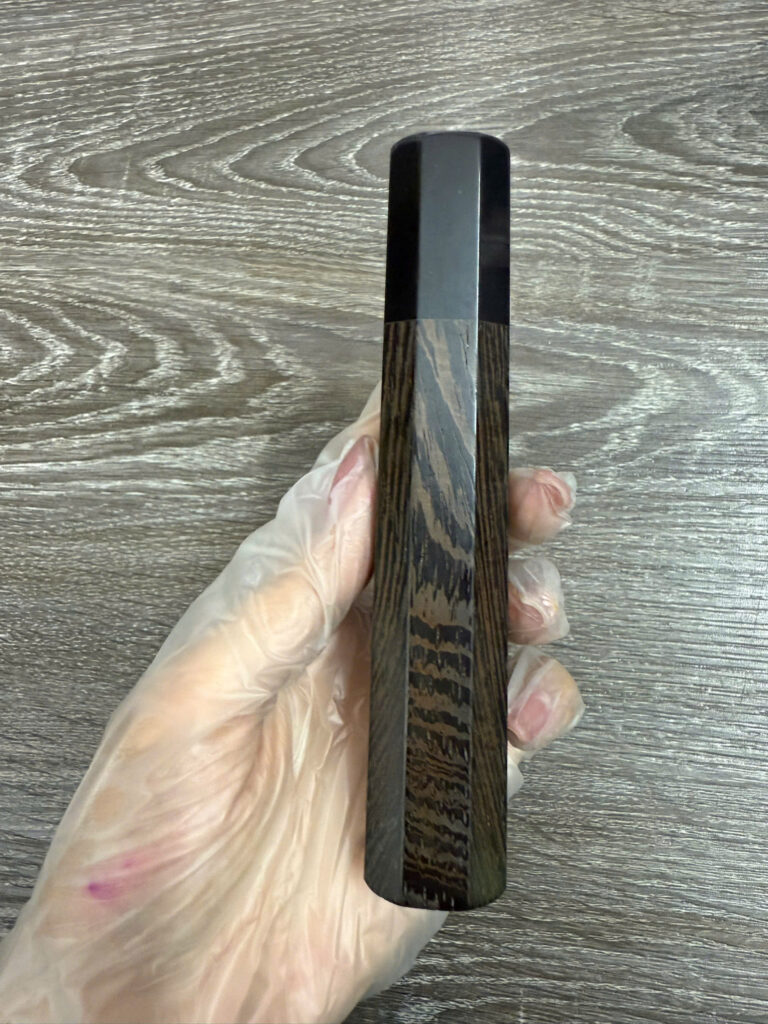
Choose Wenge for a dark wa handle with visible brown-and-black grain. It suits a simple black-horn ferrule when you want the wood’s lines to stand out. The product photo below shows one finished example; check the actual piece and its finish when choosing your handle.
Is wenge the right handle for your knife?
Choose Wenge when you want dark, linear, openly grained wood and the proposed handle suits the actual knife. Do not treat it as automatically cheaper than Ebony: the current catalogue gives Wenge and Ebony the same advertised product price, while the configurator places them in different base tiers. Those are separate pricing contexts, not a guarantee of every custom total or continuing stock.
Fit depends on the actual blade, tang evidence, handle dimensions, construction, ferrule, bore, and intended use. Keep a secure installed handle fitted; junction photographs provide only partial evidence. If the tang is already exposed, use its three primary measurements rather than estimating fit from overall knife dimensions.
Where wenge fits the build
| Decision point | What to check for wenge | Buyer note |
|---|---|---|
| Fit | Actual construction, blade geometry, and available fit evidence | Do not infer finished weight or balance from the wood name alone. |
| Feel | Open pores, facet edges, and palm contact when wet | Comfort depends on the actual surface and finish; identify that finish before maintenance. |
| Care | Finish identity, water exposure, drying, and maker guidance | Keep it clean and dry; use only maintenance compatible with the supplied finish. |
| Visual match | Stripe direction, ferrule color, and blade finish | Let the banding lead; keep the ferrule quiet. |
Match wenge to your knife’s measurements
Use the configurator to choose the wood, ferrule, shape, and size. Measurements and photographs are optional before purchase and can be added or corrected on the order page after payment until bench work starts.
Wenge works well when
- You want a dark handle that still shows clear grain movement.
- The proposed dimensions and construction have been considered with the blade, tang, ferrule, and bore.
- You are willing to identify the supplied finish and follow the care guidance for that finish.
Look elsewhere when
- You require a uniformly black appearance that the actual offered Wenge blank does not show.
- You want the wood name alone to guarantee a particular finished weight or balance.
- The handle will sit wet often with no chance to dry between uses.
What to check before ordering
- If the tang is already exposed: usable length from the shoulder or seating line to the tip, height near the shoulder, and face-to-face thickness at that same station, all in millimetres.
- Optional context: preferred shape, grip style, blade type and length, and the balance feel you prefer.
- If the handle is secure, leave it installed; side and spine photographs of the junction are optional partial evidence, not hidden tang dimensions.
- Maker, model, wider knife photographs, and current balance are optional context.
Density, construction, and finished balance
Wenge is a dense handle choice, but that description does not determine the mass or balance of a finished handle. Handle length and cross-section, the actual blank, ferrule and end cap, bore and tang depth, and the blade’s geometry all contribute to the installed result.
Knife-length rules are not reliable here: a gyuto, santoku, nakiri, petty, or slicer can use either of several woods when the build is matched to the blade. Evaluate the proposed dimensions and construction instead of assigning Wenge to a particular size range.
Living with open grain
Wenge’s coarse, open-pored surface makes the supplied finish relevant to feel and care. Ask which finish is on the actual piece before applying a maintenance product: an unfinished or oil-finished surface and a cured film finish do not accept the same treatment.
Keep the handle clean and dry, then follow the maker’s guidance for its identified finish. There is no universal oiling calendar, and oil should be used only on a stable surface with a finish meant to receive it; it is not a remedy for movement, cracking, or moisture at the joint.
Pairing a ferrule with the stripe
Because wenge already carries strong horizontal banding, the ferrule should support the grain rather than add a second loud element. A dark buffalo horn ferrule reads as a quiet continuation of the wood and keeps the whole front of the handle calm and formal. A pale amber or mottled brown ferrule introduces sharp contrast that competes with the stripe and can make the transition feel busy.
The test is whether the front of the handle reads as one build. With a wood this graphic, restraint at the ferrule and a clean, simple shape usually look more deliberate than stacking another bold detail on top of the figure.
Which knives and cooks suit wenge
Wenge suits a buyer who values dark, visible grain and understated contrast. Whether it suits a gyuto, santoku, nakiri, petty, or slicer depends on the actual handle dimensions and construction, blade and tang geometry, and other components rather than the knife category alone.
Wenge should not be treated as an automatic budget substitute for Ebony, and neither wood name guarantees a uniformly black blank or a particular finished weight. The current catalogue and configurator use different pricing contexts. The wenge vs ebony comparison discusses the two dark options, the broader wa handle wood guide covers grain and density across woods, and the best wa handle woods guide places Wenge alongside the wider range.
Fit and measurement notes
Keep a secure installed handle installed. Close side and spine photographs of its junction can show accessible height, thickness, alignment, and condition, but they are partial observations rather than hidden tang dimensions. If the tang is already exposed, record exactly three primary dimensions in millimetres: usable shoulder- or seating-line-to-tip length, near-shoulder height, and face-to-face thickness at that same station.
Do not calculate a finished balance outcome from the Wenge name or blade length. The actual blank, handle dimensions and cross-section, ferrule and end cap, bore and tang depth, and blade geometry all matter. No matched finished-weight and dimension evidence supports a universal size rule for this wood.
Care for a wenge handle
Keep the handle clean and dry, and do not apply oil until the supplied finish has been identified. An unfinished or oil-finished surface may accept a compatible product, while a cured film finish may not. Follow the maker’s guidance for that finish instead of using a weekly or monthly schedule.
Movement, an opening gap, cracking, or moisture at the blade-to-handle joint should not be treated with extra oil as though it were a repair. Ask Horn & Grain to identify the supplied finish and assess the actual piece before adding a maintenance product. For another botanically distinct dark option, the ebony handle guide explains Ebony without treating its name as a guarantee of appearance or finished weight.
Best fit for wenge
A wenge wa handle for Japanese knife suits buyers who want a dark, linear grain without going fully black. It can look formal while still showing enough texture to feel handmade.
Because wenge has strong grain lines, pair it with a simple ferrule and a clean shape. Too many contrast elements can make the handle feel visually crowded.
The short recommendation
Choose Wenge for its dark linear grain, not for a guaranteed price, mass, or balance outcome. Base the build on the available fit evidence, actual dimensions and components, then identify the supplied finish before choosing any maintenance product. The configurator lets you choose the wood, ferrule, shape, and size, while the made-to-order handles show current catalogue designs.