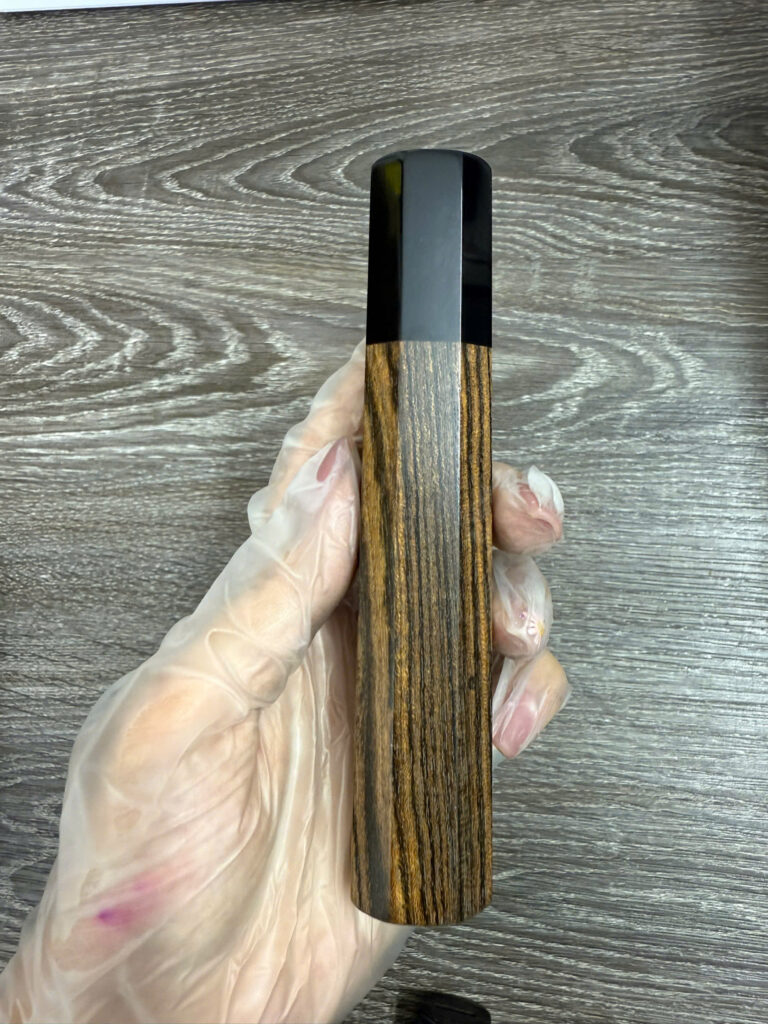
Living with zebrawood means living with contrast: a pale straw-yellow ground crossed by dark brown to near-black stripes. It is the loudest wood in our range, worn casually where Macassar ebony reads formally. Interlocked grain adds a subtle three-dimensional shimmer as the handle moves under light. The overall character is consistent, but the striping varies from piece to piece—your handle will belong to the same family as the photographed one, not reproduce its exact pattern.
This is a handle for someone who wants the knife to catch the eye before it reaches the board. The useful question is not simply whether zebrawood looks bold today. It is whether that boldness feels like your taste rather than a passing attraction.
What are zebrawood’s stripes actually like?
Zebrawood’s pattern begins with its pale straw-yellow ground. Dark brown and sometimes near-black streaks run through it, creating the high contrast that gives the wood its name. Paired with a black buffalo horn ferrule, those streaks become even more prominent.
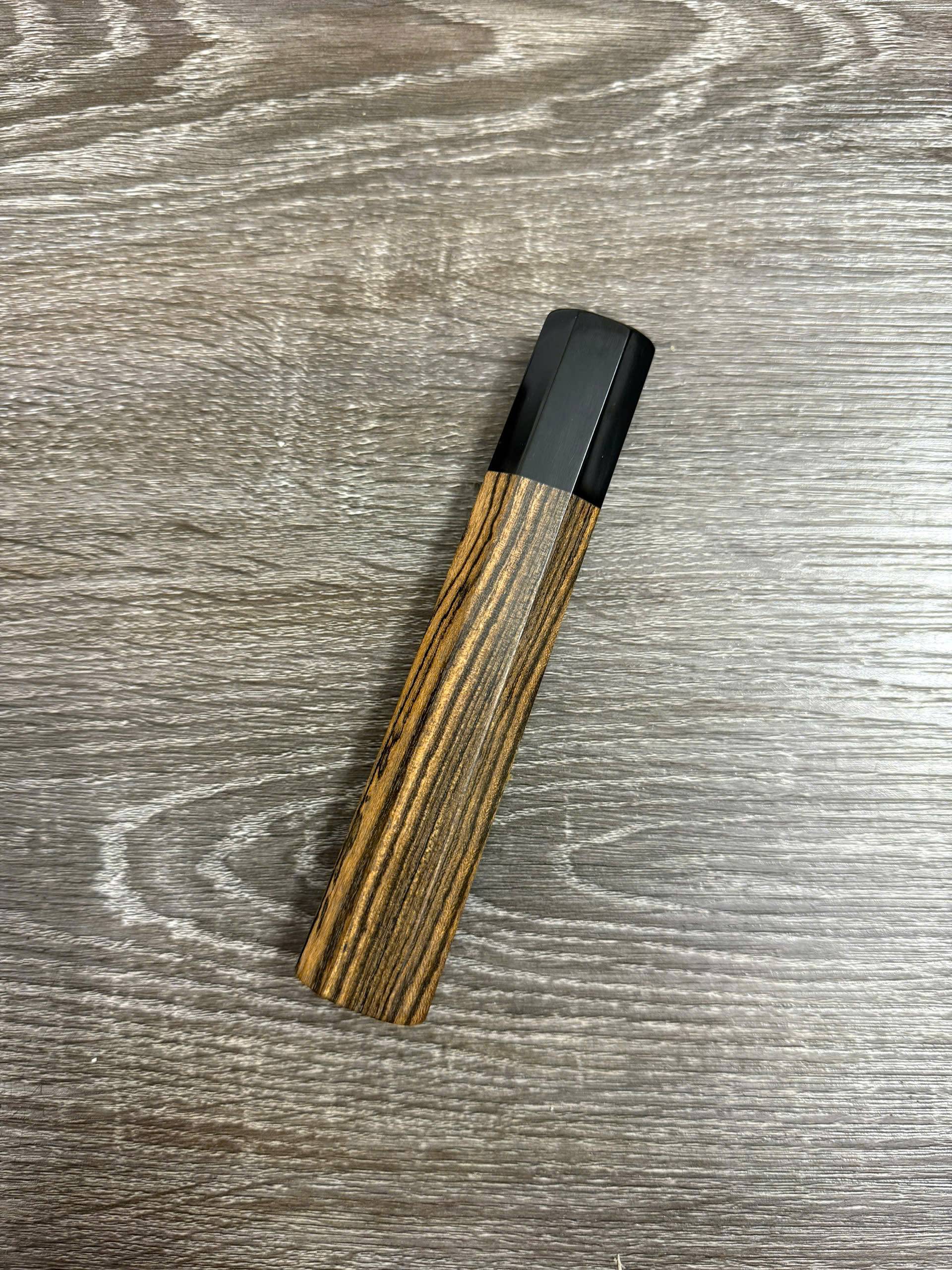
Stripe count is not the most important part. Distribution matters more. Several closely packed streaks can make one area feel busy while leaving another visually empty; fewer, better-spread stripes can give the whole handle a stronger presence. What matters is whether the pattern carries convincingly across the handle body rather than how many individual lines can be counted.
That distinction also explains why two zebrawood handles can both be unmistakably zebrawood without looking identical. Natural patterning does not repeat like printed fabric. Some pieces will feel more linear, some more irregular, and some will have stronger pockets of contrast.
What does interlocked grain mean in your hand?
For the owner, interlocked grain is primarily a visual experience. Under changing light, parts of the grain can appear to brighten or recede, giving the surface a subtle sense of depth. Turn the handle slightly and the pattern may shift in emphasis.
It is not a flashing or glittery effect, and it does not compete with the stripes. Think of it as a quiet second layer beneath the high-contrast pattern: the stripes make the first impression, while the shimmer rewards a closer look. It helps zebrawood feel dimensional rather than simply pale wood marked with dark lines.
Zebrawood or Macassar ebony—which stripe is yours?
Choose zebrawood if you want a casual, high-contrast statement: pale ground, dark marks and an energetic pattern. Choose Macassar if your idea of stripes is more formal and black-and-gold. You can compare that direction on the Macassar ebony page.
We sell both, and neither is an upgrade from the other. They express different tastes. If your attention is moving away from sharp contrast and toward dark grain itself, wenge is also worth considering.
Will you still want bold in three years?
We cannot answer that for you, and we would be wary of anyone who claimed they could. Zebrawood is a conversation piece in hand and on the counter. That quality does not disappear once the initial novelty has passed.
The better test is to look beyond the surprise of the stripes. Do you regularly choose strong pattern, visible contrast or objects with an informal sense of character? If so, zebrawood may continue to feel natural long after it stops feeling new. Its boldness can become part of how you recognise the knife.
If you usually choose restrained colours and are drawn to zebrawood mainly because it interrupted your scrolling, pause before ordering. A statement handle that feels slightly too loud now is unlikely to become quieter through familiarity. Our wood guide is the better place to compare quieter woods. Steering away from zebrawood is the right result if what you really want is something calmer.
What does “hand-selected” promise?
We hand-select each piece so that its striping is vivid and well-distributed across the handle body. That selection is real: we are looking for material that delivers the recognisable contrast zebrawood is chosen for, not merely wood carrying the species name.
It does not promise a particular stripe count, width, spacing, direction or symmetry. A specific layout cannot be ordered, and we cannot provide a preview of the individual handle before it is made. We build to order rather than offering a row of finished zebrawood handles from which to choose.
Treat the product photographs as a guide to the wood’s character, contrast and overall presence—not as a map of where every dark line will appear. Natural variation is part of choosing zebrawood, but hand-selection keeps that variation within the vivid, well-distributed character we intend.
How buying works
Our zebrawood handle is made to order with a zebrawood body and black buffalo horn ferrule. You choose an octagonal, oval, D-shape or round profile. This is the only zebrawood combination we offer; zebrawood is not available through our custom configurator.
On the product page, the size recommender uses your knife type and blade length to select the appropriate size tier. After checkout, we confirm fit from your knife’s measurements before making the handle. The sizing step narrows the format; the fit confirmation is what connects the made-to-order handle to your particular knife.
If the contrast feels like something you will enjoy living with—not merely something that looks striking for a moment—you can order the zebrawood handle.