A new bulge or apparent swelling does not identify its own cause. First locate the change: is it across the wooden body, confined to the horn ferrule, or concentrated at the front junction around the tang? Environmental moisture and a hidden tang problem are both possibilities, but they lead to different decisions.
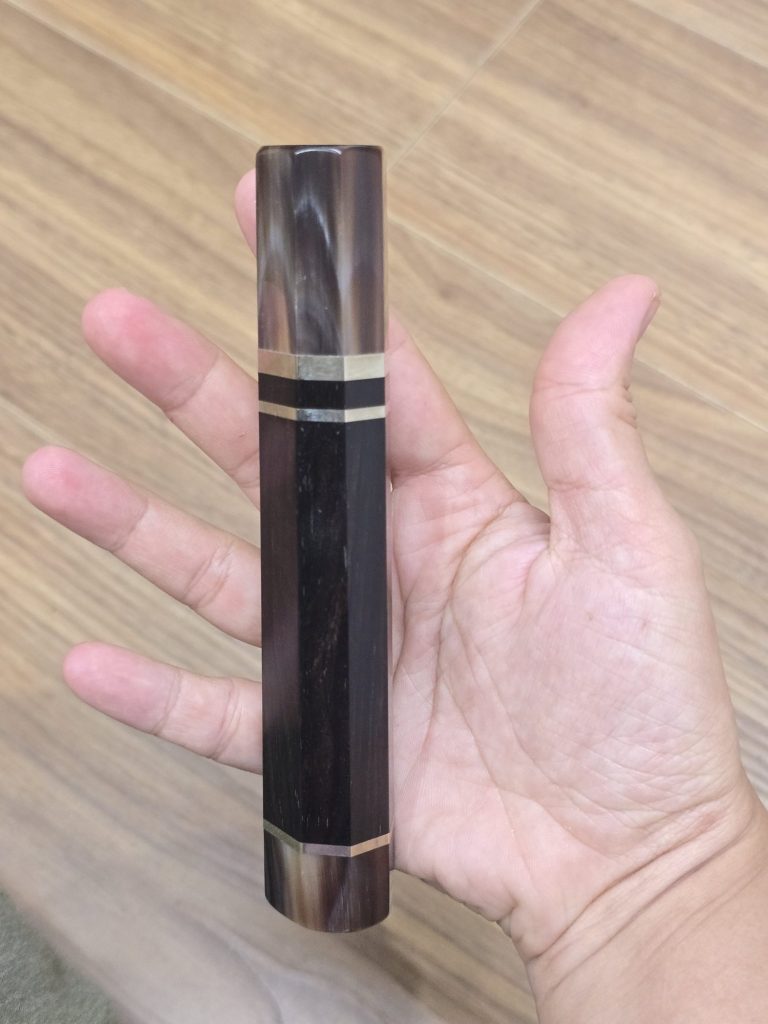
What the location can tell you
A broad change in the wooden body following wet or humid conditions is consistent with moisture movement, although it does not prove that moisture is the only cause. The USDA Forest Products Laboratory’s Wood Handbook chapter states that wood exchanges moisture with its environment, influenced by humidity, temperature and the wood’s existing moisture condition. It does not provide a universal drying time or a visual test for internal soundness.
If the change is in the horn ferrule, exposure history matters. Abbeyhorn’s Product Care guidance says horn can swell with too much moisture and advises avoiding soaking, hot or boiling water, dishwashers, heat and rapid temperature or humidity changes.
A localized bulge at the ferrule or handle entrance deserves separate attention. Sakai Ichimonji’s single-edge knife anatomy guidance notes that bulging in this area can accompany tang corrosion and merits inspection. That is a possibility, not proof that every bulge is rust.
Preserve the evidence before changing it
Record when the change first appeared and whether it followed immersion, hot-water cleaning, humid storage or a rapid environmental change. Photograph the wood, ferrule and front junction, including any crack, opened seam, lifted part or movement that was already noticed. Do not remove a secure handle solely to inspect the hidden tang.
Towel away surface water and keep the knife in a stable, dry setting. Do not use heat, sanding, clamps or forced removal to restore its outline. Even if the visible shape later changes, ambient drying alone does not establish that the assembly is sound.
A broad, non-progressing appearance change without a crack, seam opening or movement can be documented while material-specific advice is sought. A localized or growing bulge, front-junction change, crack, lifted ferrule or noticed movement is reason to pause use and obtain an assessment. If movement is part of the problem, follow the separate loose-tang assessment.
Use the wa-handle care guide for ordinary cleaning and drying. In persistently damp conditions, the humid-weather storage guide explains why a still-damp knife should not be enclosed.