A heat-exposed wa handle cannot be assigned to refitting or repair from discoloration alone. Remove it from the heat source, leave it in a stable ambient setting and document what changed. Do not quench it, reheat it, clamp it or accelerate cooling; reaching room temperature does not prove that the assembly is undamaged.
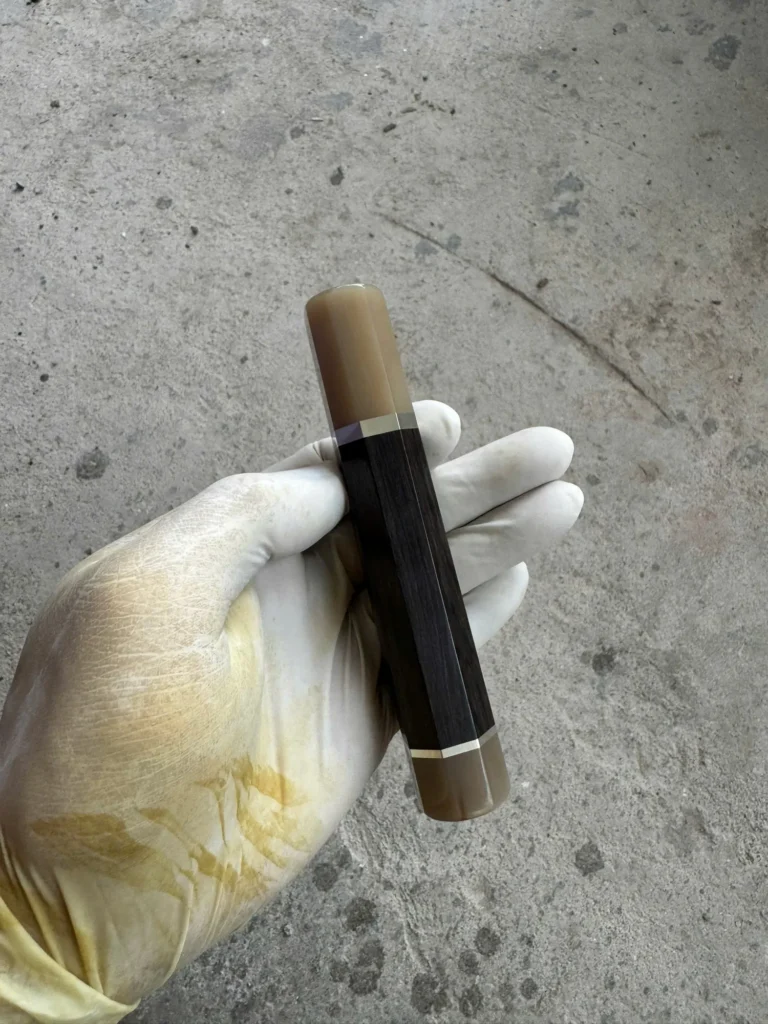
Build a post-exposure record
Write down the heat source and the duration if known. Note whether the exposure involved dry heat, steam, hot water or a dishwasher, and which part of the handle was affected. Photographs taken from consistent angles are more useful than treating the surface before its condition has been assessed.
Record observations separately:
- Appearance: new color, loss of sheen, surface texture or staining.
- Shape: a bulge, warp or changed outline in the wood or ferrule.
- Joints: a new opening at the horn-to-wood seam or around the tang.
- Structure: a crack, detached part, shifted handle or movement already noticed during normal handling.
Do not pry, flex or stress-test the handle to add evidence.
The USDA Forest Products Laboratory’s Wood Handbook chapter on moisture relations explains that wood exchanges moisture with its environment and that the response is affected by humidity, temperature and its existing moisture condition. This is one reason a rapid forced correction is not a reliable diagnostic. For horn, Abbeyhorn’s Product Care guidance advises avoiding heat and rapid temperature or humidity changes.
Decide by condition, not by the event label
A stable appearance change without a crack, separation or altered fit does not by itself identify the finish or justify sanding, oiling or refitting. Preserve the record and seek finish-specific advice before cosmetic treatment. Routine handling and cleaning limits are covered in the wa-handle care guide.
Refitting concerns the seating of components that are still sound and compatible. Repair addresses damaged material, while a cracked or detached component may require replacement assessment instead. Sakai Ichimonji’s handle-replacement guidance notes that cracks or ferrule damage can admit moisture to the tang area and that corrosion can compromise repairability.
Pause use and obtain an assessment when heat is followed by a crack, lifted or detached ferrule, changed junction, bulging or movement. The exposure record helps distinguish a possible seating problem from damage that refitting cannot solve. For future prevention, see how to protect a horn ferrule from heat.