Use a spider strainer when you need to lift a batch of food out of hot oil or boiling water and let it drain on the way out: its wide, shallow wire basket holds more pieces than a spoon and lets liquid run straight through. Use a slotted spoon when you want a few pieces from a pot, or to serve food out of its juices while the liquid stays behind. Neither one drains a whole pot; that is a colander’s job.
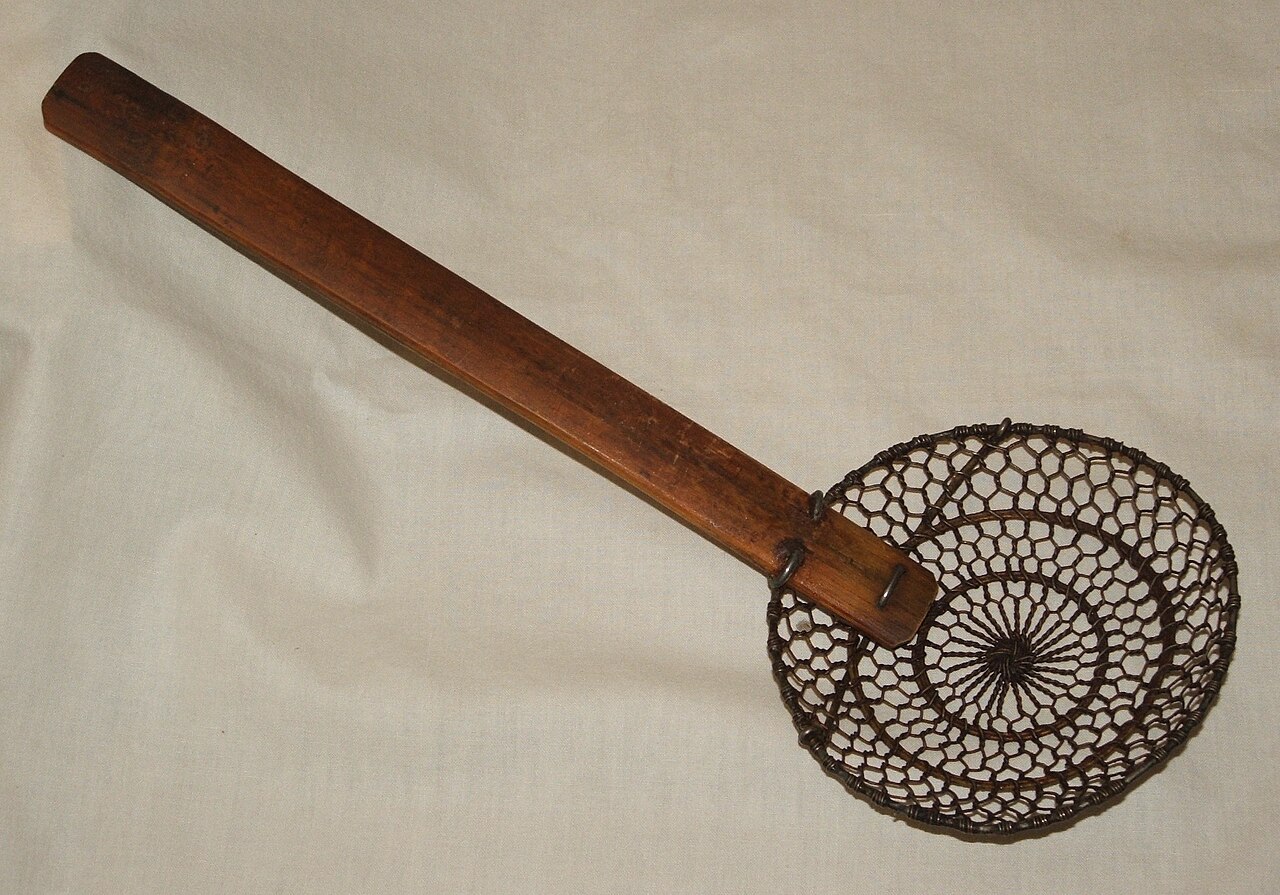
What each tool is
Wikipedia describes the spider as a type of skimmer common in East Asian cooking: a wide, shallow wire-mesh basket on a long handle, named for the wire pattern that looks like a spider’s web. It is also called a spoon sieve, spoon skimmer or basket skimmer, and it has been widely adopted in Western kitchens.
A slotted spoon, by the same source, is any spoon with slots, holes or other openings in the bowl that let liquid pass through. The cooking-size version retrieves items from a cooking liquid while preserving the liquid in the pot; smaller ones serve foods packed in their juices.
Spider strainer vs slotted spoon at a glance
| Task | Easier tool | Why |
|---|---|---|
| Lift fried food out of oil | Spider | A wide open basket lifts several pieces and drains fast |
| Lift blanched vegetables out of boiling water | Spider | Moves a batch to an ice bath or tray in one pass |
| Scoop dumplings, gnocchi or ravioli from a pot | Spider | Supports soft pieces across a broad surface |
| Take a few beans or a poached egg from liquid | Slotted spoon | A smaller bowl gives more control over single items |
| Serve vegetables or fruit out of their juices | Slotted spoon | The juice stays in the dish |
| Drain a whole pot of pasta | Colander | Both lifting tools take a portion at a time |
When a spider is the better fit
Wikipedia calls the spider a handy tool for skimming stocks, blanching vegetables and deep frying, and good for lifting and draining foods from hot oil, soups, stocks and boiling water. Cookbook author Katie Chin recommends a traditional Chinese-style strainer with a long bamboo handle, often called a spider, for lifting deep-fried foods out of oil and taking blanched foods out of boiling water.
The open weave is the point. Oil and water fall through the gaps instead of pooling in a bowl, so food drains as you lift it and the liquid stays in the pot. The broad basket also means fewer trips: you can scoop a whole batch of fries, tempura or blanched greens at once rather than chasing pieces one spoonful at a time. The long handle keeps your hand farther from the hot surface.
To use one, slide the basket under the food from the side, lift it level, and hold it over the pot for a moment so the liquid drips back before you move it to a tray or bowl. If you fry at home, a deep, stable pot matters as much as the tool; our guide to choosing a tempura pot covers shape and oil marks.
When a slotted spoon is enough
A slotted spoon has a smaller, deeper bowl than a spider, so it gives you more control when you want one or two pieces and less of the rest. It is handy for lifting a poached egg, a few chickpeas or a ladle-sized portion of vegetables from a braise, and for serving food from its juices at the table.
It is slower for a batch, and liquid can sit in the bowl of the spoon if the slots are small. Katie Chin notes that a wide Western slotted spoon can stand in for a spider, but advises against a plastic one for deep-frying. Check what your spoon is made of before you put it in hot oil.
Spider vs skimmer vs strainer
The names overlap in shops. A fine-mesh skimmer is made for clearing foam from the surface of a broth rather than lifting food; our guide to the mesh skimmer vs ladle covers that job. A spider’s wider wire gaps suit solid pieces. To drain a whole pot at once, pour it through a colander or fine-mesh strainer instead; see colander vs strainer for choosing between them.
Which one to keep
If you fry, blanch vegetables or cook dumplings and pasta shapes often, a spider earns its drawer space. If you mostly braise, poach and serve, a slotted spoon covers it. Many cooks keep both, along with a pair of kitchen tongs for larger pieces. For tools worth owning for years, see the kitchen tools guide.
Sources: Wikipedia, Spider (utensil) (skimmer from East Asian cooking; wide, shallow wire-mesh basket with a long handle; other names; lifting and draining from hot oil, soups, stocks and boiling water; skimming stocks, blanching vegetables, deep frying); Wikipedia, Slotted spoon (openings let liquid pass through; retrieves items while preserving the liquid; serving foods packed in juices); Katie Chin, Everyday Chinese Cookbook (2016), via ckbk (Chinese-style strainer with a long bamboo handle; lifting fried and blanched foods; wide slotted spoon as a substitute, not plastic for deep-frying).