Olivewood can be a practical wa-handle material when the actual piece is suitably conditioned, finished and proportioned. Its warm colour and lively grain do not by themselves show that a handle will be light, dimensionally inert or smooth in the hand.
A substantial wood that still moves
An original study of Olea europaea from Turkey measured density, shrinkage and swelling. Its tested timber was relatively dense and showed moisture-related dimensional movement. That sample is not a specification for a finished handle, but it is enough to reject two casual assumptions: olivewood is not automatically lightweight, and attractive grain does not make it inherently stable.
Weight and balance must be considered at the scale of the proposed handle. Its volume, tang cavity, ferrule or end cap and the knife’s present balance all matter. An actual dry blank or completed handle tells more than a species-level label.
Finish governs the tactile result
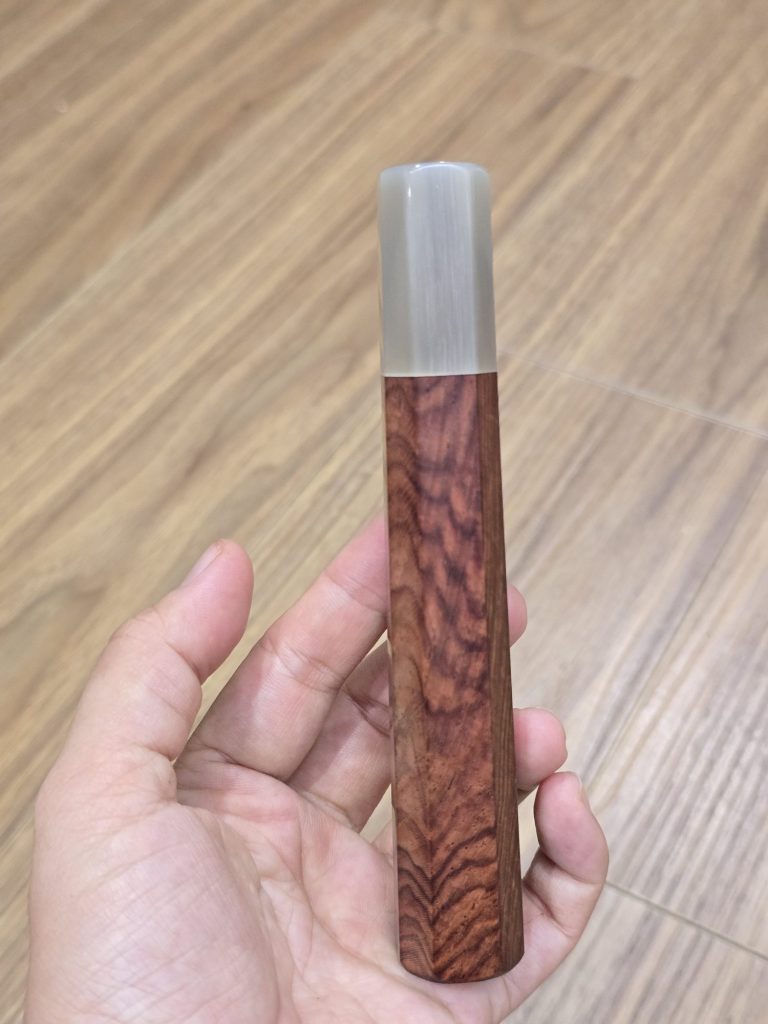
Grain is primarily visual; sanding and finish determine much of what the hand encounters. Ask for images of the actual blank and proposed finished faces, together with a clear account of its preparation and finish. No single photograph can promise that the same pattern will wrap around every face of an octagonal handle.
A 2026 experiment on steamed olive boards found that treatment changed colour and that other responses varied by property and treatment. This demonstrates that processing can matter; it does not establish that any listed handle was steamed, stabilized or made waterproof. A glossy-looking blank is likewise not evidence of a particular process.
Fit before decorative grain
The tang cavity and finished proportions must suit the knife. Never remove a secure installed handle just for assessment; visible readings at the junction are useful partial evidence, not measurements of the hidden tang. Photographs and the intended proportions can help frame the choice, but they cannot replace fit evidence.
Olivewood is not currently shown in Horn & Grain’s published catalogue or configurator. Treat this page as material-choice guidance, and use the published wood guide to see currently offered alternatives.
Care should follow the known finish. Hand-wash or wipe the handle, dry it promptly, and do not soak it or place it in a dishwasher. Olive wood is not olive oil: kitchen olive oil is not a default treatment, and the species name establishes neither antibacterial performance nor food-safety certification. The wa-handle care guide covers the practical routine without inventing a mandatory oiling schedule.