The best wa handle for a deba is one fitted to that individual knife’s tang while preserving comfortable grip clearance, an appropriate relationship to the substantial blade and the user’s preferred balance. Blade length or a generic size label alone cannot settle those questions.
Fit the individual tang first
A securely installed handle should stay on. Overall and junction photographs can document proportion, alignment and the visible condition where the knife enters the ferrule. Accessible junction height and thickness are partial evidence only; they do not reveal the dimensions of the tang concealed inside the handle.
If the tang is already exposed, record exactly three primary dimensions in millimetres:
- Usable length from the shoulder or seating line to the tip.
- Height near the shoulder.
- Face-to-face thickness at that same station near the shoulder.
These readings should inform the opening and its placement. Do not remove a secure handle to obtain them, and do not force a mismatched tang into an opening.
Judge proportion in relation to the blade
A deba can have a thick, substantial blade, so its starting handle proportion may differ from an all-purpose gyuto of similar length. H&G’s wa-handle size guide therefore treats deba individually rather than assigning a tier from blade length alone.
Look for enough clearance for the intended grip and an external size that feels coherent with the existing knife. There is no single fixed set of handle dimensions that suits every deba. The largest option is not inherently the best one.
Consider rear mass without assuming heavier is better
Additional handle material or a denser material can increase mass behind the blade. Some users may welcome that change; others may prefer to retain more of the knife’s existing forward presence. The decision should come from the particular blade and grip preference, not from a rule that every deba requires heavy wood.
Choose profile and handedness deliberately
A D-shaped handle must be oriented for the user’s handedness. Symmetric oval and octagonal profiles avoid that handle-orientation issue, but they do not alter the handedness of the blade itself. Profile choice should also account for width, height and corner easing rather than relying on the profile name alone.
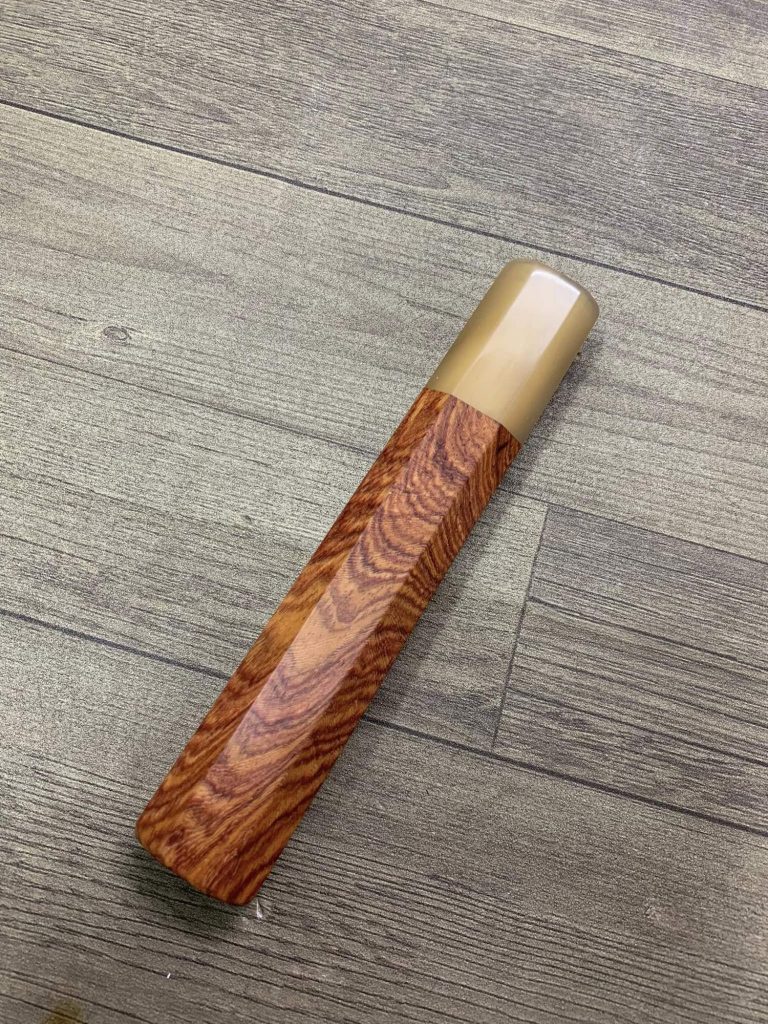
The available Siamese rosewood deba handle with buffalo-horn ferrule offers a wider octagonal starting design. Its listing identifies the materials and profile; it does not prove compatibility with every deba. Final suitability still depends on the individual tang, desired proportion and user.