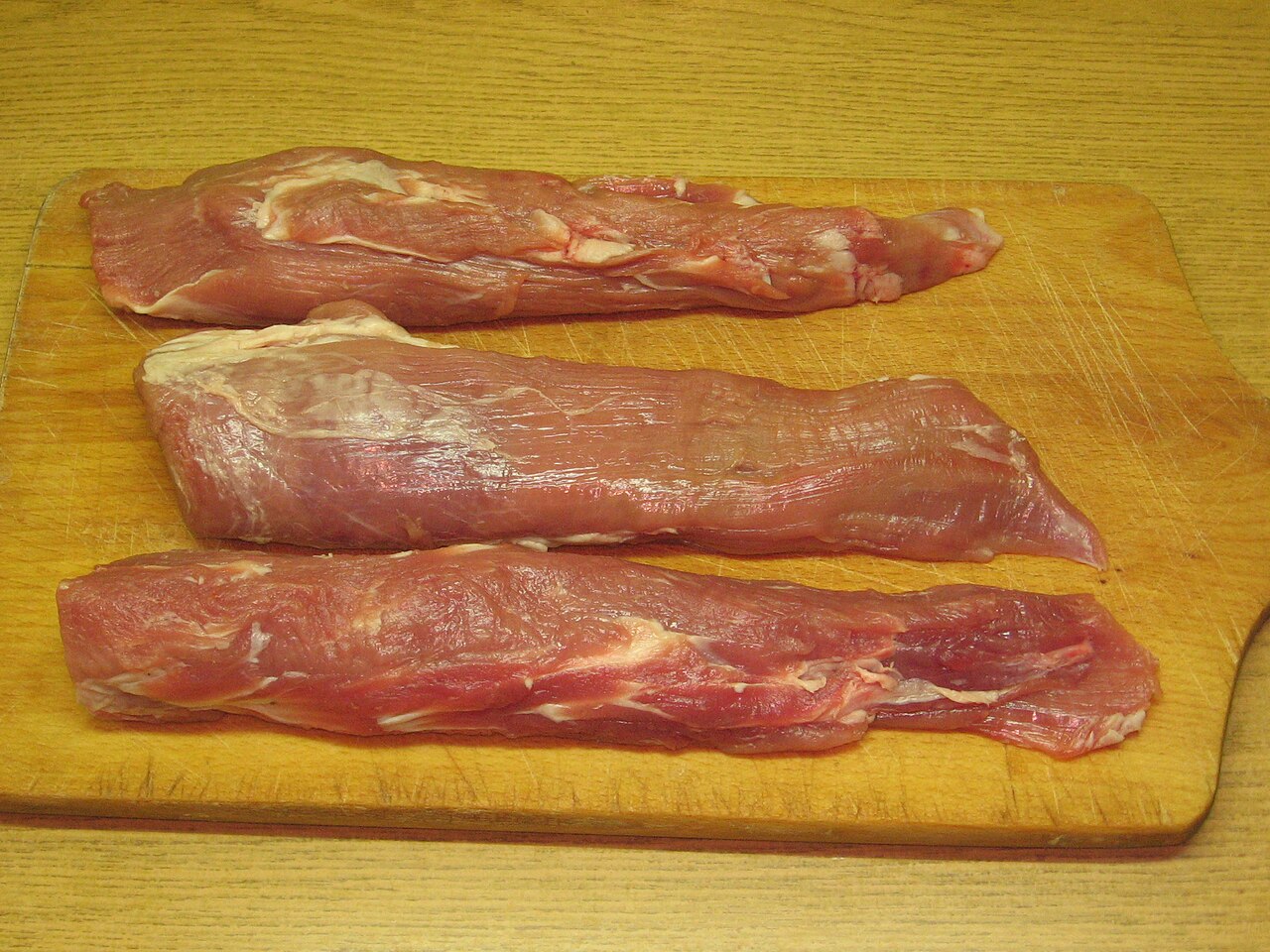
To cut a pork tenderloin, pat it dry, trim the loose fat, then take off the silverskin: slip the tip of a thin knife under the membrane, tilt the blade slightly up toward it, and cut along while you hold the freed end taut. Then slice the tenderloin across into even medallions, or cut it open lengthwise and butterfly it for stuffing. Cook it to 145°F and let it rest for 3 minutes.
Set up the board
Use a board you keep for raw meat, poultry and seafood, not the one for bread and produce; that split is what USDA’s Food Safety and Inspection Service suggests, and our guide to the cutting board for raw meat sets it out. In Cook’s Country, Matthew Fairman pats the tenderloin thoroughly dry with paper towels before he trims it.
A tenderloin usually comes with some exterior fat and a shiny membrane known as the silverskin. Fairman is happy to leave some of the fat on for flavor, but says the silverskin is unpleasantly chewy and can cause the tenderloin to buckle when cooked, so it has to go entirely.
Take off the silverskin
- Find the edge. The silverskin is the thin, white, slightly shiny layer on the surface. Turn the tenderloin so it faces up.
- Get the tip under it. The RecipeTips glossary puts the knife tip under the silverskin about half an inch from the end where it starts or stops.
- Angle the blade up. Tilt the edge slightly upward, toward the membrane rather than the meat, and cut along the length of the tenderloin.
- Keep it taut. Hold the freed end of the strip with your other hand. RecipeTips says the tension lets the cut between the meat and the silverskin be made as cleanly as possible.
- Turn around and finish. When the strip comes off at the far end, reverse direction and take off the piece still attached at the start.
- Repeat in strips. Fairman removes the silverskin in strips, as many times as needed. If a strip tears, The Takeout’s Dennis Lee says to cut beneath it again with the knife to get going.
A short, narrow blade such as a petty knife is enough; our petty knife guide lists trimming fat, sinew and silverskin from a modest cut among its jobs.
Medallions
- Slice across. Cut straight down across the length. America’s Test Kitchen cuts uniform slices to promote even cooking, and lays a ruler in front of the loin to slice at the one-inch marks.
- Flatten if the recipe asks. The same ATK recipe pounds each 1-inch slice to ¾ inch with the flat side of a chef’s knife blade.
Butterflying for a stuffed tenderloin
The Chopping Block, a Chicago cooking school, makes one cut along the entire length of the tenderloin horizontally, without cutting all the way through, then opens it like a book. It suggests a sharp knife, ideally a slicing knife.
- Lay it flat. Put the trimmed tenderloin on the board with a long side facing your knife hand.
- Keep your hand flat on top. Press lightly with your palm, fingers flat and above the line of the blade.
- Cut along the middle. Draw the knife through in long strokes, keeping the blade level, and stop short of the far side.
- Open and flatten. Open it like a book. The Chopping Block covers it with parchment and pounds it lightly with the flat side of a meat mallet to about ¼ inch.
- Fill and tie. Roll it snugly around the filling and tie it with 4 to 5 pieces of kitchen twine, as that recipe does.
Cook and clean up
The USDA safe minimum for pork chops and roasts is 145°F with a 3-minute rest, as listed by South Dakota State University Extension. Put the thermometer in the thickest part, away from fat; with medallions, push it horizontally into the side of one.
FDA advice is to wash your hands for at least 20 seconds with soap and warm water after handling any raw food. For the board, FSIS recommends hot, soapy water after each use, a rinse with clear water, then air drying or patting dry with clean paper towels. To sanitize wood or plastic, flood the surface with 1 tablespoon of unscented liquid chlorine bleach per gallon of water, leave it for several minutes, then rinse with clear water.
Which knife
A tenderloin has no bone, so any sharp, narrow blade works. A boning knife is made for close control around fat and sinew, and a petty knife does the same job. For the long butterfly cut, a slicing knife such as the sujihiki gives you length to draw through in one stroke. For vegetables and other cuts, browse all our how-to-cut guides.
Sources: USDA FSIS, Cutting Boards and Food Safety (separate boards, washing, bleach solution); Matthew Fairman, Cook’s Country (trimming, silverskin); RecipeTips, Silverskin (removal method); Dennis Lee, The Takeout (restarting a torn strip); America’s Test Kitchen, Sauteed Pork Tenderloin Medallions (uniform 1-inch slices, pounding to ¾ inch); The Chopping Block, Stuffed Pork Tenderloin 101 (butterflying); SDSU Extension, Is It Done Yet? (145°F plus a 3-minute rest, per USDA FSIS; thermometer placement); FDA, Selecting and Serving Fresh and Frozen Seafood Safely (20-second handwash after any raw food).