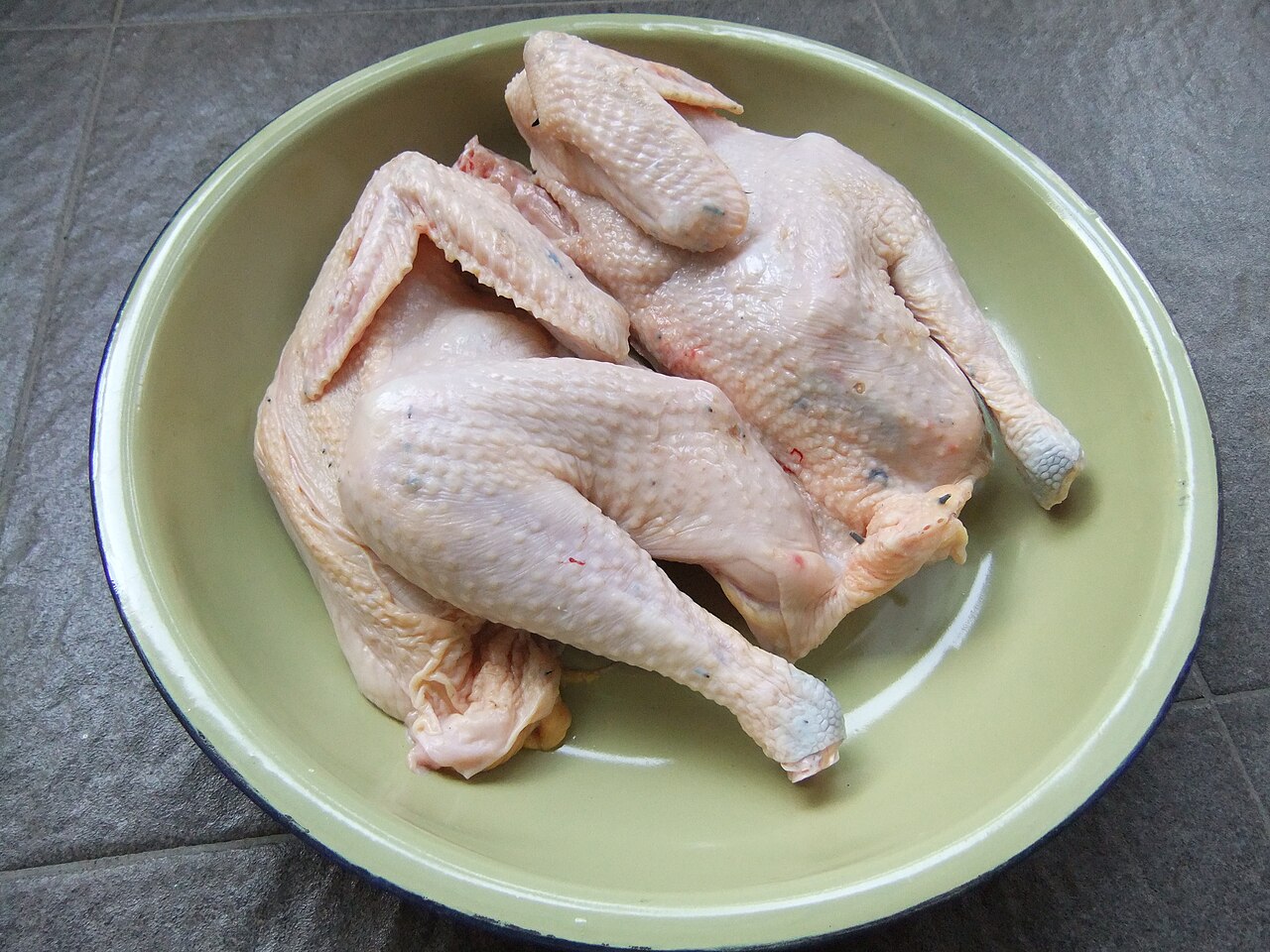
To cut up a whole raw chicken into 8 pieces, take off the two wings and the two legs at their joints, split each leg into a thigh and a drumstick at the knee, cut the breast away from the backbone, then cut the breast in half. That gives 2 wings, 2 thighs, 2 drumsticks and 2 breast halves, with the back left over for stock. The skill is finding joints, not cutting bone: Texas A&M AgriLife Extension’s guide says that when it is done properly, “the bones are disjointed – not cut.”
Before you start
- Do not rinse the chicken. University of Maine Extension says not to wash raw chicken, because doing so can spread bacteria in your kitchen. Open the package, discard the liquid, and take out the bag of giblets (usually the neck, liver and gizzard) if there is one.
- Use a board kept for raw meat. Put a clean, damp towel or paper towel under it so it cannot slide, as UMaine does. Our guide to the cutting board for raw meat sets out the two-board routine.
- Wash your hands with hot, soapy water for 20 seconds before you start.
- Use a sharp, firm knife. UMaine uses a 6-inch boning knife and suggests a sharp paring or fillet knife if you do not have one; Texas A&M calls for a sharp, rigid knife of 5 or 6 inches.
Step by step: 8 pieces
- Wings. With the chicken breast side up, pull one wing away from the body and cut down through the joint where it meets the body. Repeat on the other side. (Mississippi State Extension starts with the wings; UMaine takes them off last, with the breast. Either order works.)
- Legs. Cut through the skin between the thigh and the body. Bend the thigh back until the hip joint pops out of place, then cut through the joint and close along the back to free the whole leg. Repeat on the other side.
- Thighs and drumsticks. Lay each leg skin side down and look for the line of fat that runs across the joint between thigh and drumstick. Cut along that line and through the joint. If the blade meets bone, Texas A&M says to move it slightly to one side and try again.
- Breast from back. Stand the chicken on its neck end and cut down through the small rib joints along each side of the rib cage to separate the breast from the back, as the National Chicken Council’s method (published by Mississippi State University) does. Kitchen shears can make this cut instead of the knife.
- Breast halves. Lay the breast skin side down and cut it in half through the breastbone, as Illinois Extension does; the Mississippi State method cuts the wishbone in two at its V. You now have 8 pieces.
Mississippi State’s count is 9 parts, because it keeps the back as a piece: two legs, two thighs, two wings, two breast halves and the back. Texas A&M’s “commercial style” gives 8 pieces, and its “family style” gives 13 smaller pieces, which it considers ideal for frying because they are all about the same size.
Boneless breasts instead
To take the breasts off the bone, leave the bird whole after removing the legs. UMaine cuts down the middle of the breast to expose the keel bone, then works from one side of it and follows the curve of the ribs to lift the meat away, passing through the wing joint. Repeat on the other side; the carcass goes to stock.
Clean up and store
When you finish, wash the knife and board with warm, soapy water, rinse, and then sanitize. UMaine’s method for plastic or glass boards is a scant teaspoon of liquid chlorine bleach in a quart of water, left wet on the board for 2 minutes, then rinsed and air-dried; for a wooden board, follow its maker’s care instructions and our guide to cleaning a wooden cutting board. Wash your hands again.
UMaine, citing the FoodKeeper app, keeps fresh chicken pieces 1 to 2 days in the refrigerator or 9 months in the freezer, packed in portion sizes in the coldest, lowest part of the refrigerator so raw juices cannot drip onto other food. Cook chicken to at least 165°F, checked with a food thermometer in the thickest part.
The knife for this job
A boning knife or a Japanese honesuki is made for this work: both separate meat from bone, and neither is meant to cut through it. Our guides to what a honesuki is and honesuki vs boning knife follow that shape through a whole bird joint by joint. For an occasional chicken, the chef’s knife you already own will manage with patience. Shears take the backbone and the small rib bones, the cuts most likely to chip a thin, hard edge; see kitchen shears in the Japanese kitchen and why Japanese knives chip.
On our wa handle size guide, a honesuki is fitted individually after checkout rather than sized automatically.
Sources: University of Maine Cooperative Extension, Bulletin #4068, How to Cut Up a Whole Chicken (do not wash raw chicken, damp towel under the board, 6-inch boning knife, joint and fat-line cuts, boneless breasts, bleach sanitizing, storage times, 165°F); Texas A&M AgriLife Extension, Chicken Cut-up: Family Style (bones disjointed not cut; 5- or 6-inch rigid knife; 8 vs 13 pieces); Mississippi State University / National Chicken Council, Cutting Up Whole Chickens (9 parts; breast from back along the rib cage; wishbone at the V); Mississippi State University Extension, How to Cut Up a Whole Chicken (wings first; bend the leg until the joint pops; sanitize knife and board); Illinois Extension, You Can Cook! Whole Chicken (cut the breast in half through the breastbone; back for stock).